






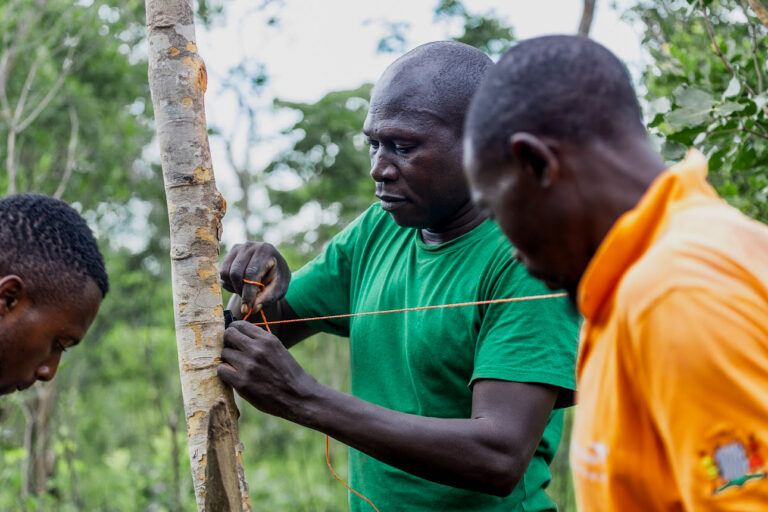
- In Zambia’s Eastern Province, a community radio station beams out programs and messages on coping with human-wildlife conflict.
- Tuning in are villagers living in a transfrontier conservation area straddling this part of Zambia, and neighboring Malawi.
- When Mongabay visited, residents were mostly worried about attacks by hyenas, which officials say have recently claimed the lives of four children.
- But cutting-edge satellite technology also provides farmers with an early warning on the approach of potentially destructive elephant herds.
LUNDAZI, Zambia – In a yellow, single-story building in the eastern Zambian town of Lundazi, a radio presenter fields numerous calls from anxious villagers on nearby farms. Sitting across from presenter Joseph Mwale in the air-conditioned studio are two officials from Zambia’s Department of National Parks and Wildlife (DNPW). One of them, Senior Ranger Mathews Mumbi, tells listeners: “Avoid going out at night to avoid the ngozi (accidental harm).”
Many of the villagers tuning in to the Thursday evening program live in a transfrontier conservation area (TFCA) straddling eastern Zambia and neighboring Malawi: dangerous encounters with wild animals is a way of life here.
The twice-weekly radio show on Chikaya FM, a community radio station, is sponsored by the International Fund for Animal Welfare (IFAW), which works with the DNPW to promote human-wildlife coexistence across three Zambian farming districts – Lundazi, Lumezi and Chipangali — home to around half a million people. In theory, the TFCA links Kasungu with Zambia’s Lukusuzi and Luambe National Parks, but to reach the Zambian parks, elephants and other wild animals must cross farmland and roads and navigate past schools and homesteads.


During a break in the radio show, the station runs an advert with the sound of an elephant trumpeting in the background and a message in the local language, Tumbuka: animals are important, the pride of the country, and belong to everyone. The advert also offers guidance on what people should do if they encounter elephants: don’t throw stones, don’t harass them, don’t get too close.
Normally, elephants dominate the radio conversations, but tonight the animal on most callers’ minds is the spotted hyena (Crocuta crocuta), or fisi as it’s known in Tumbuka.
Local wildlife officials say the carnivores have attacked people and livestock recently. Four children have been killed since October in Lundazi and Lumezi districts, which jointly cover more than 11,000 square kilometers.
Beyond these tragic human losses, one caller tells Mumbi that hyenas are killing goats and chickens in his village. “Is it an offence for our dogs to chase and kill the hyena?” he asks.
“I’m not saying you should be hunting hyenas,” Mumbi replies, “but if it happens [and] the hyena is killed by the dogs, you have 24 hours in which to report [the hyena death] to the Department of National Parks.”
Mumbi and his colleague Mwizaso Chipeta tell listeners that animals feel threatened when confronted. People should take steps to reduce encounters: strengthen livestock enclosures, they suggest, or add solar lighting to deter nocturnal predators.
For many listeners advice on living proactively with wildlife – including elephants — is essential.


Four years ago, 263 elephants were introduced to Kasungu National Park just across the border in Malawi; in that same year, elephants started to appear in farmers’ fields in this part of eastern Zambia, having been absent from this region since the 1970s.
Though important in promoting human-wildlife coexistence, Chikaya FM’s broadcasts don’t reach far beyond the borders of Lundazi district. Complementing this approach, and reaching thousands of farmers living in conflict-prone areas along the border with Kasungu National Park, is a 21st-century system.
This comes through early-warning messages generated via satellite collars fitted to 31 of the 300 to 400 elephants now living in Kasungu.
Because the collared animals are dominant females, each leading around seven to 10 others, IFAW officials can track most of the population through EarthRanger, a real-time wildlife monitoring software platform.
In a room in Lundazi, not far from Chikaya FM, IFAW’s landscape conservation program manager, Henry Ndaimani, displays a map of the surrounding landscape on his laptop screen. It shows Lukusuzi and Kasungu National Parks and the farming districts in between. He points to two lines bordering the western edge of Kasungu – one red, one yellow. On the map they appear close together. In reality the yellow line sits one kilometer inside the boundary of Kasungu.


When either of these lines is breached by a collared elephant, park officials on both sides of the border are alerted via email, WhatsApp and SMS. Mobile teams are quickly deployed to the areas in the actual landscape where the elephants are likely to emerge and threaten crops.
With maize ripening in mid-March when Mongabay visited, that risk was real. Yet most elephants were congregated on the eastern side of Kasungu, possibly kept there by recent heavy rains, and reports of incursions into Zambia were few. Instead, community volunteers from Primary Response Teams (PRTs), wearing distinctive green uniforms and carrying smartphones, were uploading data about other conflicts. Two of their recent reports included hyena attacks.
Two red icons on Ndaimani’s dashboard mark a non-fatal hyena attack on a person on February 19. Another report, uploaded on March 4, shows a photo of a hyena victim: a domestic pig with a deep bite wound on its snout.
“This system is trying to make sure that most of the [human-wildlife conflict] cases in the corridor area are reported,” says Ndaimani. Once logged, state wildlife officials can then decide how to respond. This will discourage people from taking matters into their own hands, and putting themselves at risk, like one of the callers to Chikaya FM who asked if residents could attack a hyena den if they found one. The answer was: no, you could be injured if you try, rather inform the national parks department.
Mumbi, the national parks official, told Mongabay that while the Zambia Wildlife Act does not require DNPW to compensate victims of human-wildlife conflict, the department works with community resource boards to manage the aftermath of injuries or deaths, investigates incidents, and may recommend culling the offending animal. Where such boards are absent, IFAW helps grieving families cover funeral costs.
“In circumstances involving injuries, the DNPW ensures that victims receive prompt medical attention by quickly transporting them to hospitals,” he added.
While little can be done to protect farmers from hyena attacks, which Mumbi says could be partly driven by prey shortages in Kasungu, IFAW is leading efforts to install solar-powered electric fencing around vulnerable fields, creating “elephant-proof” farming clusters. These clusters enclose adjoining plots within strands of charged wire that deliver non-lethal electric shocks strong enough to deter elephants. By mid-March, 29 clusters – covering a total of 80 kilometers — had been completed, with a further 60 kilometers planned this year.
The system is not without its hitches. Seven of the 41 satellite collars fitted to elephant matriarchs have failed and need to be removed, repaired and redeployed. But with around 80% of the animals still visible on the EarthRanger dashboard, mobile teams can carry valuable early warnings to farmers, rather like weather forecasts, but for elephants.
In mid-March, with most elephants still gathered deep inside Kasungu, the situation remained relatively calm. “The response teams,” Ndaimani said, “can sit back and relax.”
Banner image: Installing an IFAW-supported temporary solar fence in Chikomeni chiefdom, within the Malawi-Zambia Transfrontier Conservation Area, to deter human-elephant conflict. Image courtesy of IFAW.
In plan for African wildlife corridors, there’s more than one elephant in the room
Feedback: Use this form to send a message to the author of this post. If you want to post a public comment, you can do that at the bottom of the page.


