



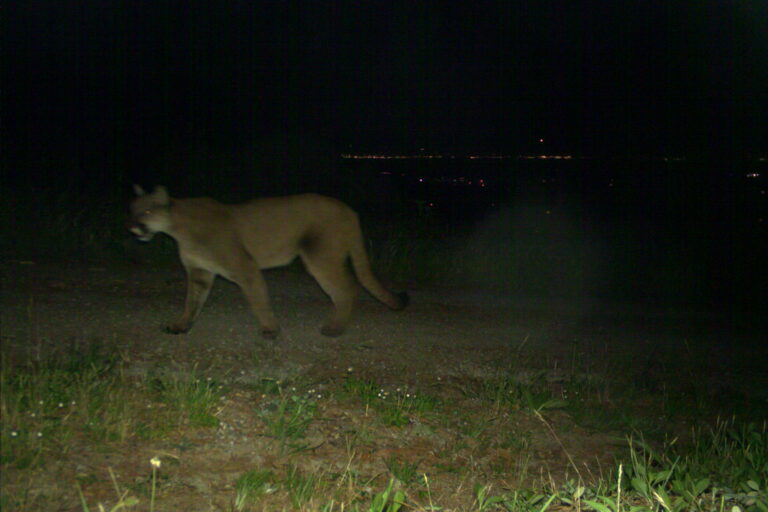
- A new study finds that bright lights at night change wildlife behavior at the edge of cities more than noise does, based on more than 35,000 days of camera footage in California’s San Mateo and Orange counties.
- Pumas and bobcats showed up less often in brightly lit areas, while mule deer spent more time in those areas at night, using the light as shield from predators.
- Artificial light shrinks pumas’ hunting grounds and pushes them into riskier places where they may encounter people, cars or pets, with potential long-term effects on body condition, reproduction and survival.
- The authors suggest addressing light pollution through shielded fixtures, motion sensors, dark-sky ordinances and connected, unlit corridors that allow wildlife to move through cities.
A new study from two California counties finds that artificial light at night is a stronger driver of wildlife behavior at the edge of urban environments than noise. This has ripple effects for predators and prey.
Researchers analyzed more than 35,000 camera-trap days from 61 stations in San Mateo county, on California’s central coast, and Orange county, in Southern California, between 2022 and 2024. They tracked an apex predator, the puma (Puma concolor); the bobcat (Lynx rufus); and an ungulate prey species, the mule deer (Odocoileus hemionus). The paper was published in Urban Ecosystems.
“While scientists have known for a while that wildlife change their behavior around cities, often becoming more nocturnal to avoid humans, our study isolated exactly what part of the urban environment is driving this,”co-author Zara McDonald, biologist and president of the Felidae Conservation Fund, told Mongabay by email. “Our key finding is that artificial light pollution is actually altering the predator-prey dynamic.”
Predators like pumas and bobcats avoided bright lights at night, such as areas lit by streetlights and other electric lighting. Mule deer, however, were more active in those same areas, though they avoided bright moonlight and noisy areas. The authors say the deer use human-modified spaces that predators avoid.


“Essentially, artificial light is acting as a spatial barrier for carnivores and a ‘protective shield’ for prey,” McDonald said. The contrast was visually striking in the images and footage captured on camera traps.
“On cameras placed deep in darker, protected areas, the nighttime feed was highly active with pumas and bobcats moving and hunting,” she said. “But on the cameras situated at the urban edge, where the skyglow and light spillover from nearby neighborhoods illuminated the landscape, the carnivores practically vanished from the nighttime hours. Instead, we would see mule deer calmly foraging in the middle of the night under the glow of the city, seemingly perfectly comfortable in an area their main predators were actively avoiding.”
Human development looks different in the study areas. Roughly 59% of Orange county’s land is classified as developed, compared with about 32% in San Mateo county, which is part of the wider San Francisco Bay Area. Orange county’s outward sprawl has produced highly fragmented habitat, while the Bay Area’s focus on building within already developed areas has preserved larger, more connected open-space networks.
The differences in these areas showed up in animal behavior. In Southern California sites, puma activity peaked around dusk, but in San Mateo it shifted earlier, peaking near 6 a.m. The authors attribute the difference to how late human activity and artificial light persist into the night: in Orange county, where lights and people remain active well after dark, pumas may delay movement until disturbance subsides, while San Mateo’s darker landscape allows them to be active closer to dawn.
Orange county’s mule deer were most active in the early morning, while in San Mateo their activity increased during evening hours. The authors suggest this reflects deer timing their activity to avoid peak puma hours.
Bobcats showed the greatest consistency between counties. Their overall daily activity patterns looked similar in both places, even though they, like pumas, avoided the brightest-lit areas.


“This study shows the value of detailed, site-specific research rather than assuming that species exhibit the same behaviors across different environments,” John Benson, an associate professor of vertebrate ecology at the University of Nebraska’s School of Natural Resources, who wasn’t involved in the study, told Mongabay.
Benson said it makes sense that pumas and bobcats react more strongly to light than to noise. Both are ambush hunters built for low light, he said, and they can deal with noise and people by changing when they’re active or hiding in thick cover.
But avoiding lit areas comes at a cost for the cats, McDonald said, because those are increasingly the places where deer are. “Their usable hunting habitat is effectively shrinking, forcing them to expend more energy to find food or pushing them into riskier areas where they are more likely to encounter humans, traffic or pets,” she said. Over time, she added, that can affect body condition, reproduction and survival.
Light pollution isn’t just an aesthetic issue,” McDonald said, “it’s a form of habitat degradation. It functions like an invisible fence, reshaping how wildlife move, hunt, and survive. As urban development expands, managing light spillover must become a standard planning priority.”
The good news, McDonald said, is that unlike other threats to animal habitat such as paved roads or cleared forests, light pollution is highly reversible. Practical steps city planners can take include using lights that point down instead of out or up, so the glow doesn’t spill into nearby wildlands; turning lights off when no one is around by putting them on motion sensors or timers; passing local rules that limit light near parks and open spaces; and keeping strips of dark, unlit land connected so animals can move through cities without running into bright zones.


The authors note that more than 230 Dark Sky-certified sites exist worldwide, including 165 in the United States. Dark Sky International certifies parks, communities and other places that meet standards for limiting light pollution through shielded fixtures, lighting curfews and other measures. Several Bay Area municipalities are developing dark sky ordinances, the authors note, but no such ordinances currently exist in Orange county.
“[W]hat gives me tremendous hope is that, unlike a paved highway or a demolished forest, light pollution is highly reversible, McDonald said. “If we change our fixtures, install light shields, and turn off unnecessary lights at night, the habitat improves instantly.”
Citation:
Granados, A., McDonald, Z., Le, C., Cohen, B., & Stoner, D. (2026). Illuminated landscapes: Urbanization’s influence on predator and prey behavior. Urban Ecosystems, 29, 82. doi:10.1007/s11252-026-01936-2
Liz Kimbrough is a staff writer for Mongabay and holds a Ph.D. in ecology and evolutionary biology from Tulane University, where she studied the microbiomes of trees. View more of her reporting here.
The European wildcat hovers between recovery and local extinction
FEEDBACK: Use this form to send a message directly to the author of this post. If you want to post a public comment, you can do that at the bottom of the page.


