



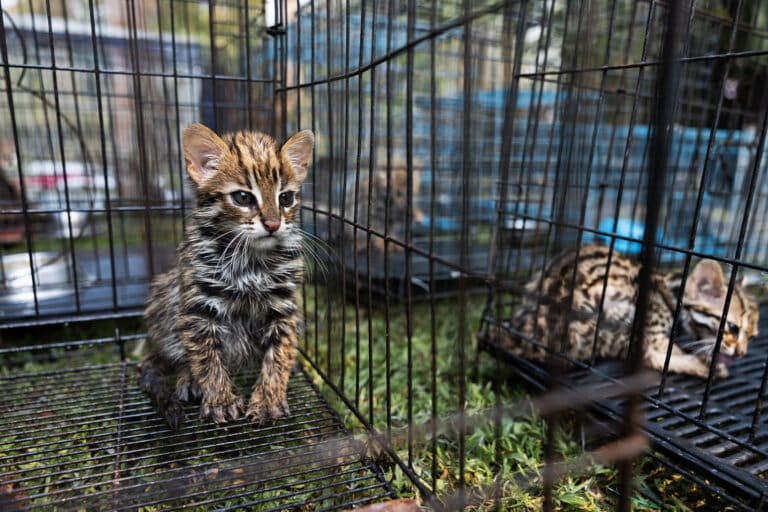
- Every crop burning season, dozens of leopard cat cubs are admitted to a wildlife rescue center in northeastern Thailand as fires tear through the sugarcane plantations where the cats shelter and hunt.
- Since 2023, admissions have risen sharply, from around 10 per year to between 40 and 65, likely driven by a combination of habitat fragmentation, high fire activity and a higher number of rescues due to a wildlife hotline introduced in 2019.
- This season’s survival rate was around 80% — markedly higher than in previous years. Fewer cubs arrived with severe burns, possibly linked to recent government regulations on agricultural burning.
- But researchers say fires reflect a deeper problem: Habitat fragmentation and climate change are pushing leopard cats into agricultural landscapes where they face compounding threats, including not just fires but also human-wildlife conflict, disease and the illegal wildlife trade.
Nuntita Ruksachat, head veterinarian at the Khon Kaen wildlife rescue center in northeastern Thailand, holds up a feline cub no larger than her hand. Part of a litter rescued just days ago, the cub’s fur is patchy, revealing blistered skin underneath. Its whiskers, clearly singed, are short and stubby. “They were rescued from a burned sugarcane plantation,” she says. Behind her, cats pace inside rows of cages.
More than 50 leopard cat (Prionailurus bengalensis) cubs are currently housed at the rescue center, which is run by Thailand’s Department of National Parks, Wildlife and Plant Conservation’s (DNP).
The youngest are kept in cages, while older ones have been moved to larger enclosures.
Leopard cats are small wild felines found across much of Asia, from Afghanistan to South Korea. Roughly the size of domestic cats, their bodies are slightly leaner, and their fur is marked with black spots and stripes.
The leopard cat is a highly adaptable species, and as forests have shrunk across its range, it has learnt to live in human-dominated landscapes. In Thailand’s northeast, sugarcane plantations provide leopard cat mothers and their litters with shelter and prey.
But every crop burning season — the period between December and April, when farmers in Thailand typically burn their fields — those same plantations can turn lethal. The rescue center receives a steady influx of leopard cat cubs from across the northeast. Most are found alone and weak on plantations or in nearby forests, some with scorched fur and whiskers.


Rising numbers
Since 2023, the number of leopard cat admissions has risen sharply, from around 10 per year to between 40 and 65. Staff at the center say this likely reflects a combination of factors: ongoing habitat fragmentation, high fire activity and the growing reach of a government wildlife hotline that has made it easier for people to report injured animals.
Farmers often use fire to clear land after harvest, as a faster and less labor-intensive method than mechanical or manual clearing. In Thailand, the practice is most widespread in the northern and northeastern regions.
Rattapan Pattanarangsan, conservation program manager of the Thai division of the international nonprofit for wild cat conservation Panthera, says that while adult leopard cats can usually escape fires, “cubs are left behind and become the most common casualties.”
The impact of fires is far-reaching. “While overall population decline may not be immediately evident,” says Rattapan, “breeding individuals likely expend additional energy to reproduce again and raise new litters.” Fires also reduce prey and degrade habitat, often spilling beyond agricultural land and into the forest — the vast majority of forest fires in Thailand are thought to be human-induced. This may force leopard cats to shift territories, increasing competition and the risk of aggressive encounters with other animals.
Fires may also contribute to the growing illegal trade of small wild cats. While rarer species like clouded leopards (Neofelis nebulosa) or Asian golden cats (Catopuma temminckii) are targeted by hunters, Rattapan says, the leopard cat trade is “largely supply-driven,” based on the “opportunistic collection of cubs, which often occurs after fires.”

Signs of change
With more than 50 rescues already carried out this year, 2026 is on par with 2024 and higher than 2025, when around 30 rescues were carried out. But Nuntita says there are signs of positive change: The survival rate among rescued cubs was markedly higher than in previous years — 80%, compared to around 40%. Better survival rates could be due in part to the growing use of the wildlife hotline, which may mean that cubs that are found are being reported sooner, before their condition deteriorates. In addition, fewer cats were brought in with severe burns, suggesting that fewer may have been caught directly in sugarcane fires.
This, says Nuntita, may have something to do with recent government regulations on agricultural burning, including increased penalties for farmers and mills, improved satellite monitoring, and subsidies to help farmers adopt alternative practices. According to the government, as of January 2026, these regulations had resulted in 90% of sugarcane bought by mills coming from unburnt fields.
At the beginning of the last burning season — between December 2025 and March 2026 — satellite data from Thailand’s Geo-Informatics and Space Technology Development Agency (GISTDA) suggested a roughly 25% decline in both total and agricultural fire activity across northeastern Thailand compared to the same period in the two previous years. But by April 2026, fire activity had sharply increased.
According to Mana Permpool, director of the DNP’s Fire Control Division, this is likely to do with changing weather patterns, a zero-burning policy that is only enforced in February and March, and accumulated biomass in forests after years of fire suppression.
Overall, fire activity this burning season was around 12% higher than last year. This increase, however, is largely driven by forest fires; fire activity in agricultural land, including sugarcane fields, has seen a small but consistent decrease across the northeast.
Mana says this distinction may help explain why fewer leopard cat cubs arrived at the rescue center with severe burns even though the overall number of wild animals — especially reptiles — affected by fires is rising.
Beyond fires
Not all of this year’s leopard cat rescues at the Khon Kaen wildlife rescue center were linked to fires. Several litters were simply separated from their mothers during harvest. At least one cat was attacked by a farmer who threw rocks to keep it away from his chickens, leaving the animal blind in one eye.
Warisara Thomas, a wildlife researcher at Kasetsart University, Bangkok, who serves as a consultant to the rescue center, says these incidents reflect a deeper problem. Habitat fragmentation, driven by agricultural expansion and accelerating climate change, has pushed the cats deeper into human-dominated landscapes. While leopard cats are often described as having a high tolerance to human disturbance, they are still vulnerable to risks that are linked to proximity to humans, such as fire, human-wildlife conflict and disease transmission. “We are very worried that leopard cats will contract diseases from domestic animals,” Warisara says. Fragmentation may also be reducing genetic diversity in isolated populations, she says, limiting their ability to adapt over time. “We just don’t have enough data to know yet.”
Under Thai law, leopard cats are a protected species. Yet, according to the global wildlife conservation authority IUCN, they are currently not considered endangered. In practice, more endangered species tend to be prioritized for conservation, along with species like elephants and monkeys, whose habitat displacement directly impacts human communities. Because of this, the rescue program, and the research it supports, struggles to attract funding. “If these threats are not addressed, we believe populations will start to decline,” says Warisara.
The 50 cubs at the center are due to be released into a nearby protected forest in June. Some of the older cubs have been placed inside larger enclosures, where they are undergoing behavioral training to learn to hunt and survive in the wild. On the ground, a chicken’s head and scattered feathers suggest they are ready.
Banner image: A rescued leopard cat cub. Image by Ana Norman Bermudez for Mongabay.
Asia’s mainland leopard cat is abundant but still cloaked in mystery


