







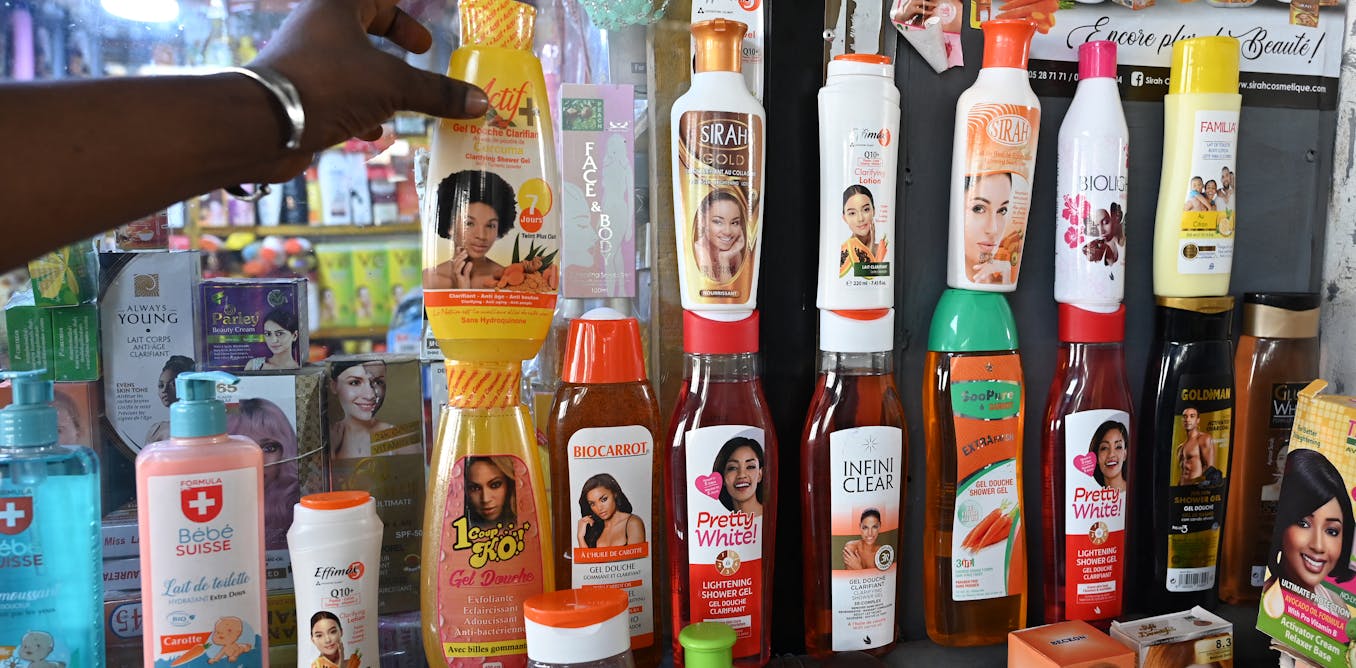
In some African countries, more than 50% of women regularly use skin-lightening products. In South Africa, the rate is 32%, while in Nigeria it’s 77%. This dwarfs rates in other regions of the world.
The health consequences are not trivial. Over-the-counter skin lightening creams and pills have been linked to severe skin discoloration, organ damage, neurological conditions, and dangerous complications during surgery.
Yet researchers still don’t have a clear understanding of why women use these products. This is an important question to answer because it should guide the design of public health solutions.
One intuitive explanation, that women bleach their skin because they are dissatisfied with their skin colour, turns out to be surprisingly difficult to confirm.
Most research on body image relies on explicit measures – essentially, surveys where participants are asked directly how they feel about their appearance. But my work as a mixed-methods researcher and counselling psychologist suggests that the method has limits. People don’t always answer accurately. In contexts where preferring lighter skin can feel like – or be viewed as – an admission of self hatred, there are strong social pressures shaping how people respond to direct questions.
Read more:
There’s a complex history of skin lighteners in Africa and beyond
To overcome this problem, my co-authors and I approached the issue differently. In our recently published study, we explored whether an implicit measure, the Skin Implicit Association Test (Skin IAT), might reveal something that self-report scales may miss.
The test, adapted from the Implicit Association Test by social psychologist Anthony Greenwald and colleagues, measures how quickly participants pair images of light and dark skin tones with positive or negative words. The logic is simple: if someone automatically associates light skin with positive words and dark skin with negative ones, that association shows up in their response time – even if they would never directly say so on a survey.
Developers of implicit measures suggest that these tests get around self-report biases by assessing automatic, instinctive associations rather than asking for expressed beliefs, attitudes, or self-evaluations. The tests may bypass the filter of what people feel comfortable admitting. Implicit association tests have also been used to assess other implicit preferences, including race, weight, religion and age.
Our findings uncovered a striking gap: nearly 79% of participants showed an automatic preference for lighter skin on the implicit test. The standard surveys in our study identified less than a third of those surveyed.
These findings matter because they underscore the fact that forces driving skin bleaching across the African continent can’t be reduced to a single psychological construct. They are embedded in centuries of colonial history, in the global circulation of Eurocentric beauty ideals, in economic systems that attach social capital to lighter skin, and in media environments that relentlessly reinforce those hierarchies.
A research design that rises up to this complexity must be equally multidimensional by combining implicit and explicit measures with qualitative approaches that create space for women to articulate, in their own terms, how skin colour operates in their lives.
Read more:
What you need to know about rebranded skin-whitening creams
Measuring unconscious responses
Our study included a sample of 221 predominantly South African Black women. This sample represented the largest share of respondents for this online survey, which was targeted to Black African women across the continent.
Respondents were asked to complete two self-report measures of skin colour satisfaction as well as the Skin Implicit Association Test. To be eligible for the study, respondents had to identify as Black African women, be at least 18 years old, and be willing to answer questions about their physical appearance.
Following the implicit test, 78.5% showed a preference for lighter skin. The two self-report measures identified far fewer (18.5% and 29.8% respectively).
The implicit test results in our study (78.5% preferring lighter skin) more closely matched the higher limit of reported rates of skin bleaching on the continent (77% in Nigeria).
This measurement gap matters. It may suggest that for a substantial number of Black African women, lighter skin preferences may be operating below the level of conscious awareness. Or, perhaps, below the level of what feels safe to express. These are women who, on a survey, may report being satisfied with their skin, but whose automatic associations tell a different story.
Read more:
Skin lighteners: fashion and family still driving uptake in South Africa
Better research
As researchers, we are not advocating that self-report measures should be abandoned. They capture things like conscious attitudes, values and beliefs. For many research questions, they remain indispensable.
Our findings, rather, point to the need to use more than one method of investigating what respondents think and feel.
Implicit measures probe associations that may operate below the threshold of deliberate reflection.
In-depth interviews, focus groups and community-based methods can reveal the varied texture of experiences that no scale, implicit or otherwise, can fully capture. Mixed methods, then, are not a compromise between imperfect tools. They are the appropriate response to a phenomenon that is at once structural, cultural, and deeply personal.
As African countries grapple with the public health dimensions of a practice that is common but poorly understood, the research community has an obligation to do better. That means investing in measurement tools developed specifically for, and with, Black African women. It means accounting for regional variety. It also means taking seriously the possibility that what women report about their bodies and their private feelings or unconscious experiences are not always the same thing.


