



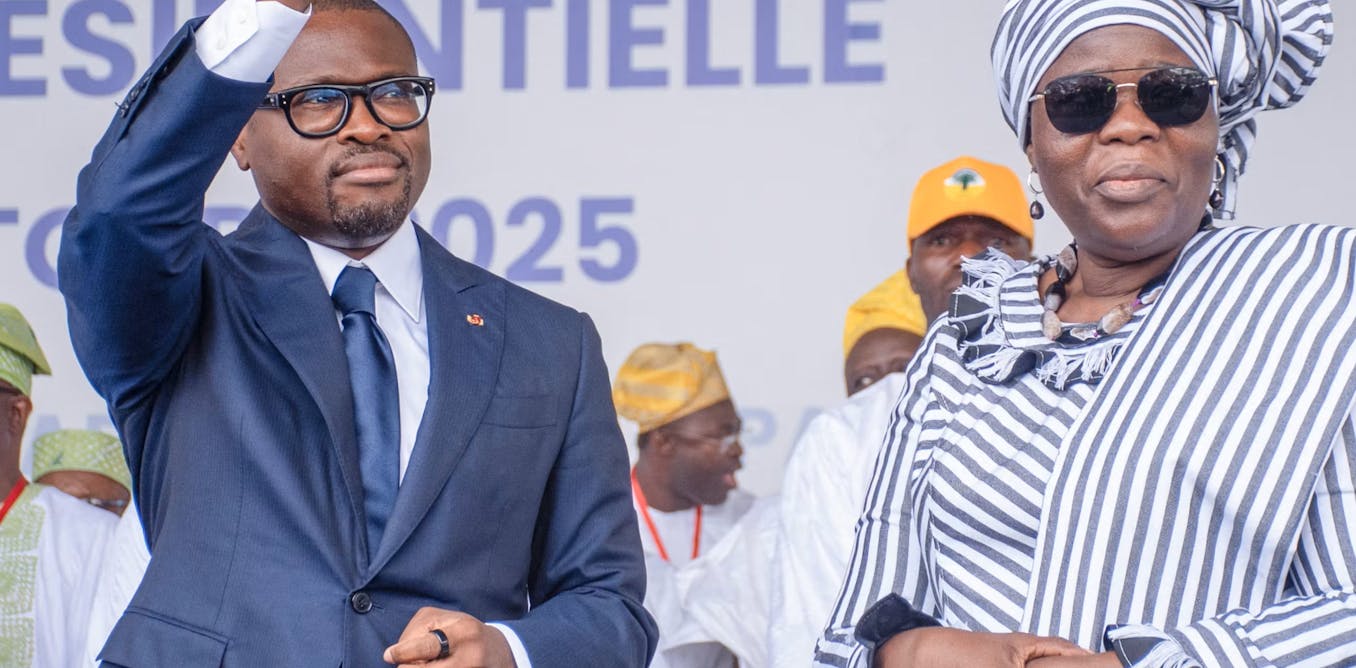
Romuald Wadagni won the 2026 presidential election in Benin with over 94% of the vote. Wadagni, 50, is a technocrat who became an influential finance minister under Patrice Talon from 2016 until his election.
The Beninese political system is a pluralist democracy organised around a presidential system, with regular elections and political alternation. It is also characterised by a strict institutional framework governing electoral competition, particularly since recent reforms.
The outcome raises questions about the current dynamics of Benin’s political system. How should the 2026 presidential results be interpreted in a context marked by reforms to the party system and the electoral framework? Political sociologist Narcisse M. Yèdji offers some insights.
How do you interpret the 94% result?
With the current national political climate, the landslide victory raises several questions. At first glance, the results suggest very strong support for the presidential majority. Statistically, this means a very low dispersion of votes between the two competing duos: the winning ticket formed by Romuald Wadagni and Mariam Chabi Talata, and the one formed by Paul Hounkpè and Rock Judicaël Hounwanou. More broadly, such a scenario is typical of electoral contexts where the opposition plays only a formal role and has no real chance of winning.
That said, the enormous margin between the two main candidates may also reflect strong support for the winning pair, giving the impression of a broad consensus in their favour.
Clearly, recent changes introduced to the country’s party system and the electoral code have tilted the balance in favour of the ruling party. Such a victory was predictable. The margin, however, was not.
A comparison with the 2021 presidential election places the 2026 result in a broader perspective. The 2021 election was won by Patrice Talon with 86% of the vote. The race was slightly more open. It involved a larger number of candidates: three pairs in total.
The statements are not contradictory. In a context where the political offer is restricted, voters have several options: either to stay at home, or to cast a default vote. Therefore, the 94% may reflect strong popular support. Or, given the limited set of choices, it may reflect the option of a default vote. The 2026 landslide victory can thus be read as a reflection of growing electoral support for the incumbent administration.
The latest complete overhaul of the rules of political competition left voters without meaningful and credible alternatives, thereby increasing the likelihood of people voting by default.
However, what might appear to be a gradual consolidation of electoral support for the ruling party could, in fact, be the effect of these reforms. The endorsement system, in particular, has played a key role in shaping how votes are distributed. It is a system that requires any presidential candidate to obtain the formal support of a certain number of elected officials (members of parliament or mayors) in order to be eligible to run. The threshold, initially set at 10% (16 endorsements), was raised to 15% in 2024 (28 endorsements), making it harder for the main opposition party to enter the race, as it was unable to secure the required number of endorsements.
It is therefore misleading to view the presidential ticket’s success as mere coincidence. A more realistic reading points to a long-matured political project, executed with cold calculation by those in power.
There are two issues at stake. First, avoiding any risk of retaliation from a resentful successor. The long siege of more than 50 days imposed by security forces on former president Thomas Boni Yayi’s residence after the controversial 2019 legislative election lends weight to this argument. Second, to enable reforms and economic transformation projects to continue, while reducing political uncertainty.
In 2025, Talon had, in fact, hinted at his wish to pass the baton to a successor who would “not undo” his reform programme.
From this perspective, Wadagni’s success is no accident. It is the planned outcome of political system designed to ensure its own continuity.
How do you interpret the voter turnout?
A comparison with previous presidential elections highlights a mixed trend in voter turnout. The 2026 turnout was 63.57%. That is higher than 2021’s 50.17% turnout. However, civil society disputes that 2021 figure, claiming it was actually 26.47%. These turnout rates (for the 2021 and 2026 presidential runs) contrast sharply with recent legislative elections. Turnout was 27.12% in 2019; 38.66% in 2023; 36.74% in 2026.
This contrast reveals a hierarchy among elections. Presidental elections draw stronger turnout, even without real electoral options. For many citizens, electing the head of state is a central political moment.
However, the higher turnout for 2026 (63.57%) should not be interpreted as a revival of political interest. Voter participation has steadily declined since 2006. It averaged at 74.85% in 2006 and 84.82% in 2011.
There is another important reading from the 2026 presidential elections. The relatively high voter turnout of 63.57% happened at the same time as the electoral choices narrowed. In other words, turnout does not appear to be conditioned by the perception of effective pluralism in the electoral process.
Ultimately, these changes reflect how citizens relate to elections. Presidential votes still hold some appeal. Yet, the broader electoral trend remains one of growing abstention and mistrust.
This trend can clearly be linked to a limited belief in the effectiveness of the voting process. It may also stem from a narrower range of electoral choices. If a restricted political offer appears not to affect electoral participation, this does not imply that those who went to vote fully trust the electoral process.
It is entirely possible to be distrustful of the system while still voting, especially when abstention is not perceived as the best option.
Finally, it may be indicative of shifting social expectations regarding political representation.
What are the main challenges facing the new president?
Several challenges await the new president. The first is political legitimacy. Many see his term as a direct continuation of Talon’s rule. For them, Wadagni is his designated successor.
Read more:
Au Bénin, le bilan de Patrice Talon à l’épreuve des élections législatives
From this perspective, the new president appears to be both heir and hostage. He inherits the previous administration’s achievements. But he also inherits its liabilities. This raises a central question: can he build an independent authority of his own?
The central challenge of his term, therefore, is to distance himself from this divisive political legacy. He must build an image as an independent president. Wadagni has stated that his predecessor would “step aside” if he wins. But, doubts remain about whether this promised distance will become reality.
On the institutional front, the new president inherits a fragile executive branch. Parliament owes full allegiance to Talon. The Senate could also limit his room for action.
From the first challenge stems the second: restoring trust between politics and people. The outgoing president will sit in the Senate and is likely to remain, for years to come, one of the country’s most influential political figures. Meeting this challenge will undoubtedly depend on how the public will perceive Talon’s influence on government affairs from within the Senate.
Restoring trust between the political sphere and the people means winning back voters who have walked away from electoral processes. This will require credible actions that must prove renewed approach to governance.
The legitimacy of the new president’s policies may depend on this effort.
Beyond that, the deepest challenge might be national reconciliation. Recent political dynamics such as the electoral reforms appear to have contributed to deepening divisions among Beninese citizens. To ensure long term stability, the new president will need to take credible actions to ease tensions and rebuild social cohesion.
For this to happen, strong actions are expected quickly after his inauguration, especially on highly sensitive issues:
-
security issues in the northern border regions exposed to terrorist threats
-
economic and social issues, including the cost of living, improving purchasing power, youth employment, and reducing wage inequalities
-
political and institutional issues, including “political prisoners”, exiles, and those in similar situations; easing the tax burden; and rebuilding public trust in institutions.
Amid the profound political and institutional changes underway, Wadagni’s ability to meet all these expectations will shape his legitimacy. It will also determine the overall success of his seven-year term.


