






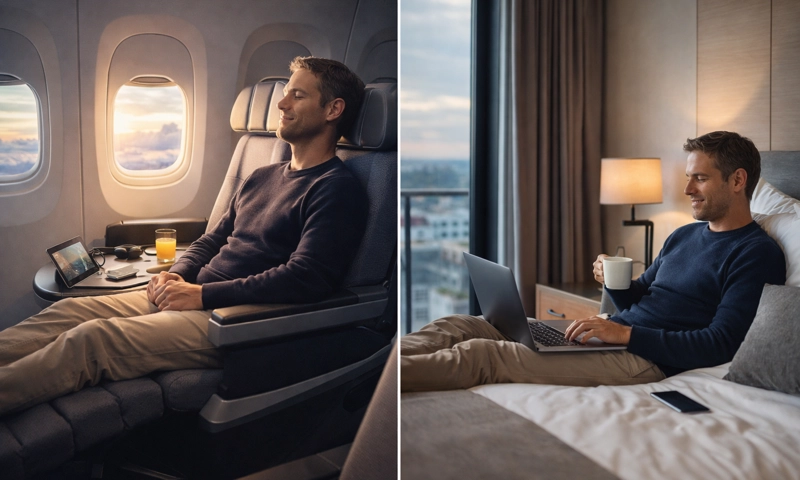
In Brief: Thomas Wahl’s article discusses the escalating competition in the hospitality industry, where airlines and hotels are innovating to provide unique customer experiences, from offering couch-like seating in flights to reinventing hotel services.
-

The Experience Arms Race: From Airline “Couches” to Hotel Reinvention – Image Credit HNR News

The travel industry is entering a new phase of competition centered on experience rather than category, as airlines and hotels move to capture travelers who want more comfort and flexibility without paying full premium prices.
Published March 25, 2026 | By Thomas Wahl
The Middle Is No Longer What It Used to Be
For decades, travel has been structured around clear product tiers: economy, premium economy, and business class in the air; select-service, upscale, and luxury on the ground. That framework is now breaking down.
Airlines are leading the shift. Carriers are introducing hybrid products designed to attract travelers willing to pay more for comfort, but not enough to justify traditional premium pricing. Flexible seating concepts, expanded premium economy cabins, and bundled add-ons are all aimed at redefining the middle of the market.
According to Expanded food-and-beverage concepts designed to attract both guests and locals
These are not cosmetic changes. They are attempts to redefine what the middle of the market looks like.
Why This Matters for Hotel Economics
The implications go beyond branding. This is ultimately a revenue and margin story.
The traditional model relied on upselling guests into higher categories. The new model is about capturing incremental spend within the stay—through upgrades, add-ons, and differentiated experiences that do not require full repositioning of the asset.
That can be attractive for owners. Enhancing perceived value without dramatically increasing capital intensity offers a path to higher revenue per guest. But it also introduces risk. If expectations rise faster than pricing power, margins can come under pressure.
This is where execution matters. The winners in this shift are likely to be those who can align product, pricing, and experience without overextending operational complexity or capital investment.
The Competitive Set Is Expanding
Another implication is that competition is no longer confined to traditional categories. A well-designed midscale hotel can now compete with an upscale property in terms of experience. A premium economy airline product can influence how travelers perceive value across their entire trip.
That blurring of boundaries makes differentiation both more difficult and more important.
In practical terms, hotels are no longer competing only against other hotels in their segment. They are competing against the broader travel experience a guest encounters from booking to return.
Outlook
The “experience arms race” is not about adding luxury. It is about redefining value.
Airlines have already moved in this direction, using hybrid products to capture the growing pool of travelers who want more, but not everything. Hotels are following, but the transition is still uneven.
The next phase of competition will likely be won not by brands that move guests up the ladder, but by those that redesign the ladder itself.
For hotel operators, the message is straightforward: the middle of the market is no longer stable ground. It is where the real competition is happening.


Thomas Wahl is the founder of HNR News and Nevistas, a leading online information and knowledge base for the hospitality & travel industries.


