






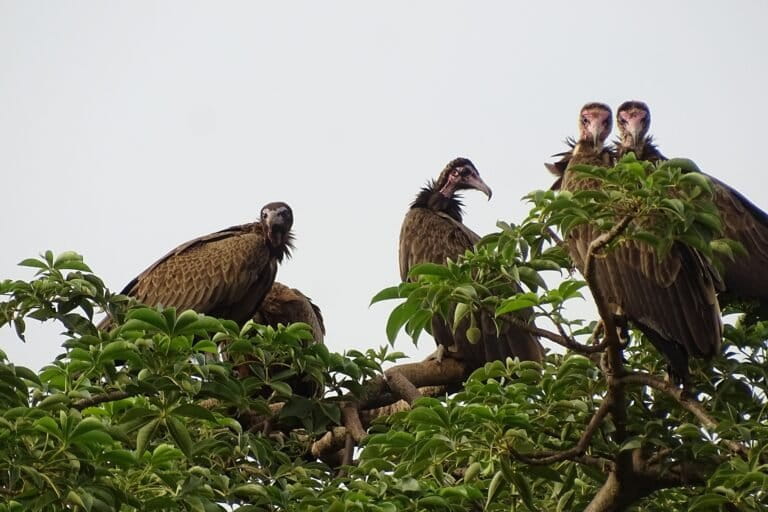
- Hundreds of critically endangered hooded vultures and their parts are being illegally sold in markets in Benin, according to recent research. The birds are coveted for their supposed supernatural properties by many practitioners of the traditional Vodùn faith.
- During a four-month study, researchers counted 522 birds for sale. Vendors sold them as dried carcasses, heads or live birds in nine markets across southern Benin. and claimed to have sourced them from at least 10 West African countries.
- Although hunting and selling hooded vultures in Benin is illegal and cross-border trade is regulated under an international treaty, demand is driving widespread commerce.
- Hooded vultures are one of the most threatened raptors, with their numbers declining by 50-96% in recent years. The trade, along with accidental poisoning and habitat loss, could wipe them out, and experts call for greater awareness and better law enforcement in Benin to combat illegal trade.
The hooded vulture, a small, scruffy-looking raptor native to sub-Saharan Africa, gets its name from a patch of beige feathers on its head: It appears to be wearing a hood. Unlike other vulture species, hooded vultures (Necrosyrtes monachus) love human hubbub more than forests. They’re often seen around villages, scavenging for meat and garbage near abattoirs and landfills.
“They’ve always been close to people … they’re kind of like the pigeons of West Africa,” said Nico Arcilla, president and research director at the International Bird Conservation Partnership (IBCP). Arcilla has studied many West African bird species, including hooded vultures.
But that proximity to people has cost the birds a great deal. Since they don’t shy away from humans, they’re easily caught — often with poisoned or tobacco-laced bait on a fishhook — and sold.
In parts of Nigeria, people eat hooded vultures. But the greatest demand comes from belief-based users such as practitioners of Vodún, a traditional religion that gave rise in the Western Hemisphere to voodoo. Many believers hold that vultures have magical superpowers that can influence luck, act as harbingers of rain, or signify misfortune. They use powdered vulture parts to make soaps to wash, and some display dried vulture carcasses or heads in their homes to bring good fortune, wealth and protection against witchcraft. Others say the birds have medicinal properties.
There’s no recent estimate on the demand, but somewhere between 5,800 and 8,700 birds were traded illegally between 2008 and 2013 across West and Central Africa.
In 2019, this species was the victim of the world’s biggest mass killing of vultures. Nearly 2,000 hooded vultures were killed for belief-based uses in Guinea-Bissau, a West African stronghold for these birds, using poisoned baits.
The birds are already threatened as their prey dwindles and their nest trees are felled for plantations or human settlements. Across the region, they’re suffering alarming declines, with the species now listed as critically endangered on the IUCN Red List, the highest threat category before extinction. Over the last three generations, their numbers have nosedived by about 80% across their range.
Darcy Ogada, Africa program director for the Peregrine Fund, a raptor conservation NGO, calls the belief-based trade the “biggest threat” hooded vultures face. “A lot of these birds are being captured through poisoning,” she says. “I can’t describe it any more than just a horror story.” Ogada also serves as Africa chair for the Vulture Specialist Group at the IUCN, the global wildlife conservation authority.


‘Staggering’ trade in Benin’s markets
In 2023, Nico Arcilla and her colleagues investigated the scale of the illegal trade in hooded vultures in southern Benin, where markets selling animal parts are plentiful. Abiola Sylvestre Chaffra, a member of the team who grew up near one of them, visited nine markets where he interviewed more than 150 vendors.
Speaking to them in their native tongue, he collected information on who sells vultures, where the birds come from, and which parts consumers want most. The findings are published in the journal Bird Conservation International.
Chaffra counted 522 vultures for sale in these markets during the four-month study period. Most — 383, about three-quarters — were dried bird carcasses; 90 heads were on offer; and about 10% were live birds.
Some people buy living birds for their parts — specifically the liver, heart, feathers or feet — and consume them to gain purported superpowers. The birds are also used in traditional medicine to treat various maladies, including blurred vision, earaches, toothaches, anemia and infertility in women.
Belief-based trade in hooded vultures may have traditional roots, but it’s grown from a small, local trade to an expanding regional commerce, researchers say. Just 10 years ago, somewhere between 975 and 1,462 hooded vultures were sold each year in all of West Africa. Benin’s current numbers indicate that’s surging.
Part of that growth, researchers say, can be attributed to new beliefs. Some people are invoking Vodún practices — using hooded vultures — to increase their luck in the lottery or an election. Chaffra reported that nearly half of the buyers at the markets he investigated were businessmen and politicians seeking success and wealth, rather than people looking to ward off witchcraft.
Arcilla called the trade “staggering,” adding that “the demand for fetish animals in Benin can drive them extinct.”
As a slow-reproducing species — laying just one egg per year and then caring for the chick for nearly a year — hooded vultures can’t easily recover from steep declines.

A widespread regional trade
The price of hooded vulture parts in these markets ranged from 7,000 West African CFA francs for a head to as much as 500,000 CFA francs for a live bird, or about $12 to $884.
Chaffra learned that most vendors were witch doctors or fetish priests. All were Fon, the largest ethnic group in Benin, who widely practice Vodún, often entwined with Christianity and other religions. While nearly half of Benin’s people identify as Christians, the government supports Vodún, the country’s official religion, as its cultural heritage.
Vendors also shared information with Chaffra about the origins of the birds, which came from across West Africa. A quarter came from Benin; almost 60% came from Ghana, Burkina Faso, Nigeria and Niger; and the rest were shipped from Cameroon, Côte d’Ivoire, Gabon, Guinea, Mali and Togo.
In addition to hooded vultures, Chaffra also found four other threatened vulture species displayed at the markets: the white-headed vulture (Trigonoceps occipitalis), white-backed vulture (Gyps africanus) and Rüppell’s griffon vulture (Gyps rueppelli), all critically endangered, as well as the lappet-faced vulture (Torgos tracheliotos), an endangered species. Previous studies have documented at least 268 bird, 96 mammal and 59 reptile species in the Vodún trade, with vultures featuring prominently.
On-the-ground studies like this are relatively rare. Ogada, who wasn’t involved in the study, said the findings highlight the scale of trade in these markets — crucial information that’s often hard to get from non-English-speaking African countries and communities.

Vanishing vultures: An ecological concern
The impacts of the relentless trade are already visible. A 2024 field study in Benin found just 52 hooded vultures after scanning nearly 1,500 kilometers (930 miles) of highway in areas that once had hundreds of these birds every 100 km (60 mi). The authors predicted that if the current trend continues, these vultures will vanish within the next two decades.
Ogada said the birds have already been extirpated from southern Benin. Arcilla recounted her experience of finding zero hooded vultures at a site in neighboring Togo where she once recorded nearly 60.
As “nature’s janitors” vanish from the wild, their disappearance will have serious impacts. “They’re critically important for the ecosystem, given their role in cleaning up carcasses, consuming organic waste,” Ogada said. “Vultures are extremely specialized for what they do … in terms of being able to ingest microbes and other potentially harmful organisms that would maybe kill other birds or infect humans and livestock.” Studies show that carcasses take longer to rot without these natural scavengers, and disease-carrying flies multiply.

Illegal trade needs to stop, conservationists say
International trade in all six West African vulture species is legal under CITES, the international wildlife trade treaty, but quotas and permits are required.
Within Benin, it’s illegal to hunt, capture, possess or trade vultures. Violators could be jailed for up to three years and fined up to 500,000 CFA francs ($883) — the price of a live bird uncovered in the recent study. Most vendors interviewed for the study said they knew selling vultures was illegal, yet did it anyway.
The trade is so lucrative that profits far outweigh the fines, and law enforcement in the country is weak, Arcilla said. “There’s no political will” to stop the trade, she said, because “a lot of high-level politicians are involved in this sort of thing, and so it’s completely against their interest to prosecute.”
That needs to change, the researchers say. They suggest educating both the public and vendors about the vulture’s precarious state. But Ogada said she worries it’s already too late for that: The vultures could be gone before people realize the harm. “We don’t have the time to go through generations of people and educate them.”
As vulture populations rapidly disappear, researchers say the government should act and enforce its laws.
“There is no future, to be honest, for hooded vultures right now in West Africa,” Ogada said, “unless something really dramatic is done.”

Banner image: Hooded vultures are small, scruffy-faced vultures native to sub-Saharan Africa. Image by Florentin66 via Wikimedia Commons (CC BY-SA 4.0).
Spoorthy Raman is a staff writer at Mongabay, covering all things wild with a special focus on lesser-known wildlife, the wildlife trade, and environmental crime.
Citations:
Buij, R., Nikolaus, G., Whytock, R., Ingram, D. J., & Ogada, D. (2015). Trade of threatened vultures and other raptors for fetish and bushmeat in West and Central Africa. Oryx, 50(4), 606-616. doi:10.1017/s0030605315000514
Chaffra, A. S., Arcilla, N., Yabi, B. F., Lissagbé, H. M., Honfo, E. E., Houéssou, M. G., & Murgatroyd, M. (2025). Conservation implications of the illegal trade in Hooded Vultures Necrosyrtes monachus for belief-based use in Benin, West Africa. Bird Conservation International, 35. doi:10.1017/s0959270925000073
Hounnouvi, F. E. K., Obandza-Ayessa, J., Gandaho, S. M., & Thompson, L. J. (2025). Cultural significance and conservation challenges of the hooded vulture (Necrosyrtes monachus) and other vulture species in northeastern Benin. Journal of Ethnobiology and Ethnomedicine, 21(51), doi:10.1186/s13002-025-00806-z
Zanvo, S., Dognimon, S., Djagoun, C. A. M. S., Akpatchémè, J., Azihou, A. F., Djossa, B., . . . Sinsin, B. (2024). Wildlife trade at the interface between deeply rooted animal-based traditional medicine and unregulated harvesting of wild animals in West Africa. Frontiers in Conservation Science, 5. doi:10.3389/fcosc.2024.1481791
Daboné, C., Adjakpa, J. B., Dansi, M. F., Thompson, L. J., Dissou, F. E., & Weesie, P. D. M. (2024). Hooded Vultures Necrosyrtes monachus are at risk of extinction in Benin: A result of poaching for belief‐based use and decreasing food availability. Ecology and Evolution, 14(4), e11184. doi:10.1002/ece3.11184
Grootaers, J., Hernández Campos, G., Marie Montenegro, V., Vega Quispe, R., Wicks, S., Campos Landázuri, S., … Beirne, C. (2025). Vulture exclusion halves large carcass decomposition rates and doubles fly abundance. Ecology and Evolution, 15(5), e71408. doi:10.1002/ece3.71408
FEEDBACK: Use this form to send a message to the author of this post. If you want to post a public comment, you can do that at the bottom of the page.
More to explore:
Hooded vultures in Ghana and South Africa on the brink, study says
A nest with a chick brings rare hope for hooded vultures in South Africa


