







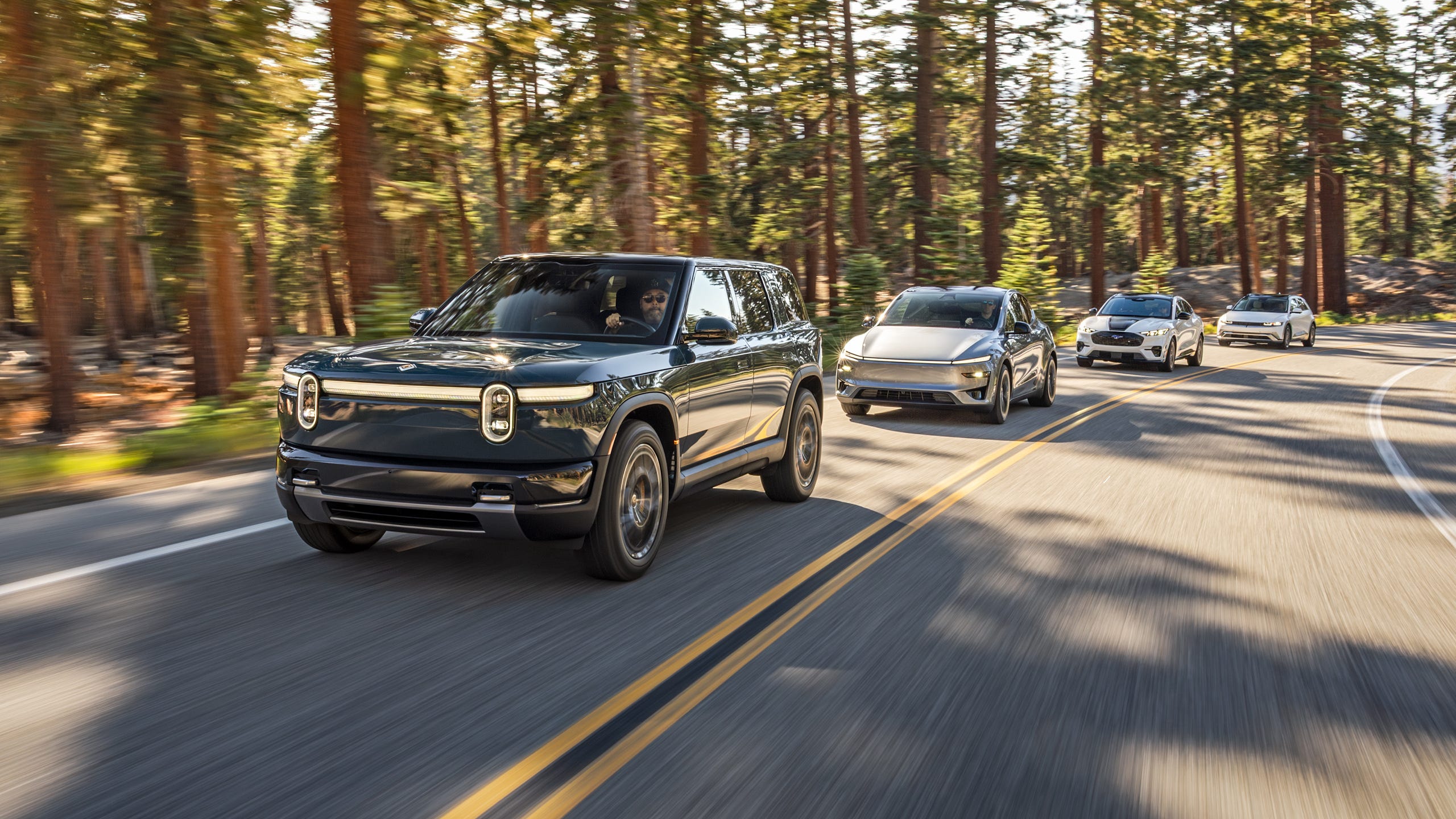
Let’s Go Drive Like Idiots
There are some great curvy roads just off Highway 395, and after a quick charging stop in Lone Pine—not so quick, actually, more on which in a moment—we broke our journey for a little tire-squealing fun through Onion Valley. We figured the Ioniq 5 would be disadvantaged here, and it was. Stable and predictable, it was easy to drive in the curves, but pushing hard set off a tug-of-war between stability control and the oversteering chassis.
The Model Y felt notably quick and was by far the grippiest vehicle here thanks to its staggered performance-oriented tires. (Only the Mustang Mach-E was quicker than the Y in our figure-eight handling test.) Driving the Tesla fast felt like playing a video game that never lets you leave the road. Before the tires gave the barest hint of giving up grip, stability control seamlessly took action. That sounds sensible and gave a smoother run than the Hyundai, but it reduced the seat-of-the-pants fun factor to near zero.
The Rivian R2—now that was our idea of fun. It felt ridiculously quick across the speed range, though it pitched and rolled like the big, boxy SUVs it’s trying to be. It gripped the road better than the Hyundai and let go the same way, tail-first. When we set stability control to its more permissive setting, the R2 would give a happy little tail-wiggle, correcting itself if we didn’t take immediate action. Performance brands expend much engineering time and money to make cars act this playful. Granted, this is not the kind of thing you might do on the school run, but once you drop off the kids, all bets are off, right?
Still, nothing can top the Mustang Mach-E for an electric SUV that feels like a sports car. Along with its 700-lb-ft wallop, the GT Performance pack adds the Unbridled Extended drive mode. In regular Unbridled, the Mach-E followed our intended path like a field hunter after the hounds. Unbridled Extended felt like we could power-slide the tail like pros. No question, this is an SUV engineered by true gearheads.
Resting and Recharging
All these shenanigans took a toll on the batteries, so it was time (again) for a charge-up. We knew what to expect, having subjected all four to our MotorTrend Road-Trip Range (RTR) test, which tells us a battery’s range at a steady 70 mph from 100 percent capacity down to 5 percent, as well as our recharging tests.
The Mach-E has the biggest battery, but it’s also the least efficient. Its 280-mile EPA range is lowest among the extended-range variants, but it delivered just 208 miles in RTR, a 26 percent shortfall. It also had the slowest Level 3 charging rate at 150 kW. A 15-minute fast charge yielded just 77 miles, little more than half what the others gained.
The Rivian’s 330-mile EPA-rated range is the longest here, but it also underperformed in our RTR test by 20 percent, delivering 263 miles. At least it recharged quickly, adding 130 miles in 15 minutes. The Tesla came closest to its promise; it missed its 306-mile EPA range by just 9 percent, with 279 miles. A quarter-hour charge added 126 miles, a third-best performance. Also, no car offered more enjoyable diversions than the Tesla, with video games, a virtual whoopie cushion—no, really—and the opportunity to chat with Grok AI, which you may also do while driving. The Ioniq 5 should have been at a disadvantage, with a test-lowest EPA range of 269 miles. It’s RTR was 13 percent lower at 234 miles, but it was the quickest to juice, picking up 138 miles in 15 minutes.
Our road trip quickly began to center around keeping the Mustang charged. While the other cars could have made it to the next charger along the way with 10 or 15 minutes of plug time, the Mustang always needed half an hour or longer, and it was the only car we plugged in at the hotel when we made it to Mammoth. In fact, after our curvy road drive, we had to backtrack to the chargers in Lone Pine because the Mustang didn’t have enough battery to continue to Bishop. The other SUVs would have made it.


