



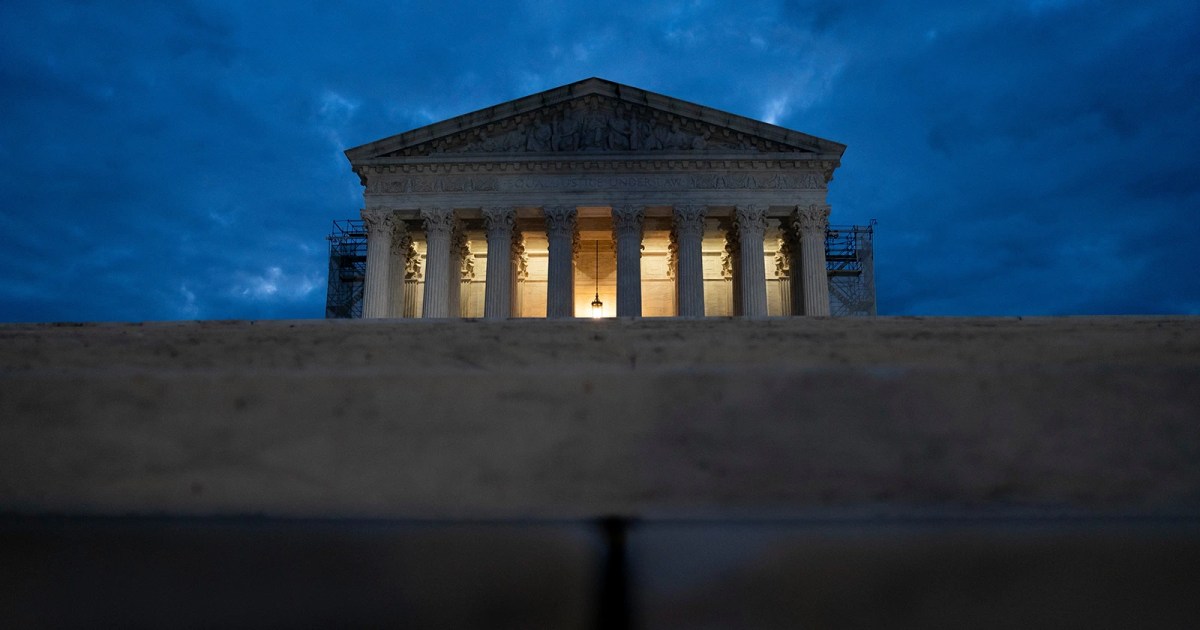
The Supreme Court on Tuesday is set to hand down its final opinions in cases argued this term, with three big matters left: birthright citizenship, campaign finance and bans on transgender athletes.
Announcements in the trio of closely watched issues will cap a high court term that has already featured several significant rulings on tariffs, voting rights, immigration and more.
The Republican-appointed court majority, which includes three justices appointed by Trump, has broadly empowered the president in his second term in office but hasn’t always sided with him. Monday’s 5-4 ruling on mail-in ballots, authored by Trump appointee Amy Coney Barrett, was one of the latest examples.
The president himself has said he expects the birthright citizenship case to join his short list of big losses, but as always, we won’t know the answer until the opinion comes. Here’s a recap of the cases in which we expect rulings when the justices take the bench Tuesday morning in Washington, D.C.
Birthright citizenship in Trump v. Barbara
When Trump returned to the White House last year, he signed an executive order that purports to end automatic citizenship for babies born in this country. The order hasn’t taken effect because it’s “blatantly unconstitutional,” as one of the several judges who ruled against Trump in the lower courts observed.
Now, the Supreme Court must decide whether to maintain the status quo or to green-light one of the president’s most lawless moves yet.
Campaign finance in NRSC v. FEC
The court is considering whether to loosen campaign finance restrictions further, in a GOP challenge to limits on political parties’ coordination with candidates on campaign spending. The case was brought by Vice President JD Vance when he was a Senate candidate, along with national senatorial and congressional committees of the Republican Party and former Ohio GOP Rep. Steve Chabot.
Their appeal questions the precedent that upheld those limits in 2001 by a 5-4 vote. They called it a “5-4 aberration” that was “plainly wrong the day it was decided.” The only justice still on the court from that 2001 case is Clarence Thomas, who dissented at the time. The current majority is more aligned with his view.
Transgender athletes in West Virginia v. B.P.J. and Little v. Hecox
The court is also set to rule on whether states can ban transgender women and girls from competing in women’s and girls’ sports. There are two separate cases, regarding bans in Idaho and West Virginia, respectively. The court seemed likely to rule against the athletes on the issue that affects similar laws in more than half the states in the country.
Last term, the majority upheld a ban on gender-affirming care for minors in the Skrmetti case. Earlier this term, the majority sided with California parents who were against school policies to prevent outing transgender students.
Jordan Rubin is the Deadline: Legal Blog writer. He was a prosecutor for the New York County District Attorney’s Office in Manhattan and is the author of “Bizarro,” a book about the secret war on synthetic drugs. Before he joined MS NOW, he was a legal reporter for Bloomberg Law.


