

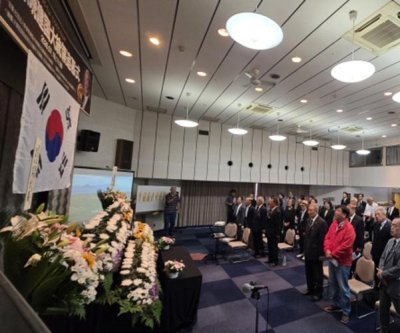
1 of 3 | Participants attend a memorial ceremony marking the 61st anniversary of former South Korean President Syngman Rhee’s death in Tokyo on Sunday. Photo by Asia Today
July 19 (Asia Today) — A memorial ceremony marking the 61st anniversary of the death of former South Korean President Syngman Rhee was held Sunday in Tokyo.
Participants reviewed Rhee’s involvement in Korea’s independence movement, the establishment of the South Korean government, the signing of the South Korea-U.S. Mutual Defense Treaty and land reform.
The Japan chapter of the Syngman Rhee Memorial Association held the ceremony at 11 a.m. local time in the international hall of the Korean YMCA in Japan in Tokyo’s Chiyoda Ward.
The program included a ceremony honoring the South Korean flag, a video introducing Rhee’s career, memorial speeches, the presentation of appointment certificates, a commemorative lecture and a floral tribute.
The Korean YMCA in Japan carries on the tradition of the Joseon YMCA, where Korean students in Tokyo proclaimed the Feb. 8 Declaration of Independence in 1919.
The declaration helped inspire the March 1 Independence Movement against Japanese colonial rule. The building now houses a memorial exhibition room dedicated to the declaration.
Political commentator Ko Sung-kuk delivered the commemorative lecture.
“The history of the founding of the Republic of Korea is more dramatic and miraculous than even the founding of Israel,” Ko said. “President Syngman Rhee was the person who began that history.”
Ko described South Korea’s current political situation as a “crisis of liberal democracy,” but devoted most of his lecture to Rhee’s life and the process of building the South Korean state.
He portrayed Rhee as a leader with the foresight to anticipate developments decades in advance, the determination to act on his judgments and the political realism to assess international and domestic conditions.
Ko said Rhee developed a new worldview while attending Pai Chai School, spending time in Hanseong Prison and studying in the United States during Korea’s transition from the late Joseon era to the modern period.
He said Rhee used the academic credentials and personal connections he developed in the United States to pursue diplomatic efforts for Korean independence and later lead the establishment of the South Korean government.
Ko cited Rhee’s 1946 speech in Jeongeup, in which he called for establishing a government through elections in southern Korea even without the participation of the Soviet-occupied North, as an example of political realism.
The proposal was criticized at the time as potentially cementing the division of the Korean Peninsula. Ko said Rhee chose what he considered a realistic course based on conditions in northern Korea and the growing confrontation between the United States and the Soviet Union.
Ko also described the South Korea-U.S. Mutual Defense Treaty as one of Rhee’s principal diplomatic achievements.
He said the security foundation created by the treaty allowed South Korea to reduce the resources it otherwise would have devoted to an arms race and instead concentrate on industrialization and economic development.
Organizer cites defense treaty and land reform
Han Jae-eun, head of the association’s Japan chapter, identified the bilateral defense treaty and land reform as central parts of Rhee’s legacy.
“The strong security alliance allowed the country to escape the threat of war and concentrate on economic development,” Han said.
He said land reform based on the principle that farmland should be owned by those who cultivate it helped resolve long-standing land disputes and created a foundation for broader economic participation.
“We must help the tree of freedom and prosperity planted by President Syngman Rhee grow even larger,” Han said.
He called for South Koreans to move beyond conflict and division and work toward peaceful unification based on liberal democracy.
Rhee became the first president of South Korea after the government was established in 1948.
He resigned in 1960 following the April 19 Revolution, a nationwide student-led uprising triggered by electoral fraud and government repression.
Rhee died in Honolulu on July 19, 1965.
— Reported by Asia Today; translated by UPI
© Asia Today. Unauthorized reproduction or redistribution prohibited.
Original Korean report: https://www.asiatoday.co.kr/kn/view.php?key=20260719010006526
