

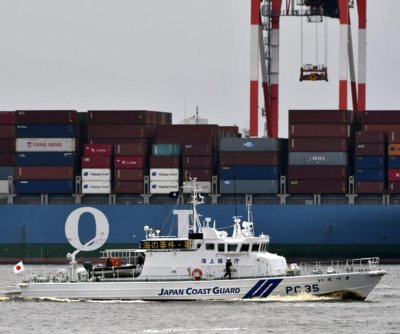
A Japan Coast Guard ship passes before a container terminal in Tokyo, Japan. Photo by FRANCK ROBICHON / EPA
July 19 (Asia Today) — Japan plans to develop uncrewed surveillance vessels for its Coast Guard as it seeks to monitor China’s expanding maritime activities and address a growing shortage of personnel.
The vessels would become part of an integrated surveillance system combining uncrewed aircraft, crewed patrol vessels and autonomous ships capable of operating for extended periods in waters far from Japan.
The Japanese government will begin research and development with domestic shipbuilders and other companies in fiscal 2027, the Yomiuri Shimbun reported Sunday.
The government plans to include related expenses in its fiscal 2027 budget proposal. It also intends to outline the introduction of the vessels in three key security documents, including its National Security Strategy, that are scheduled to be revised by the end of this year.
The development program will include technology allowing vessels without crews aboard to operate remotely or autonomously.
Japan also plans to develop camera and radar systems that can identify and monitor nearby vessels. Equipment that could be used to stop ships suspected of illegal activity is also under consideration.
The Japan Coast Guard currently operates five uncrewed aircraft to monitor waters around the country. Their limited flight endurance, however, makes prolonged surveillance of distant waters difficult.
Uncrewed vessels could remain at sea for extended periods and monitor the movements of Chinese Coast Guard ships without requiring personnel to live aboard.
Japan seeks to address China and staffing shortages
The government plans to assign uncrewed vessels to areas with relatively little marine traffic, allowing crewed patrol ships to focus on responding to Chinese Coast Guard vessels and conducting maritime rescue operations.
Chinese government vessels repeatedly enter waters around the Japanese-administered Senkaku Islands in the East China Sea.
China also claims the islands, which it calls the Diaoyu Islands.
The Chinese Coast Guard said July 4 that it had regularized law-enforcement patrols in waters east of Taiwan.
The Japanese government believes the scope of Chinese maritime activity is expanding from the Senkaku Islands to waters surrounding Taiwan. It plans to revise its policy for strengthening Coast Guard capabilities in December for the first time in four years.
The proposed vessels are also intended to ease personnel shortages at the Japan Coast Guard.
The agency is authorized to employ 14,788 people, but it was 665 personnel below that level at the end of 2024. It was the first time the shortage had exceeded 600.
The number of employees leaving the agency before retirement has also increased, partly because Coast Guard personnel can be required to live aboard vessels for extended periods.
The International Maritime Organization has established an initial safety framework for autonomous ships and is continuing work on mandatory international standards expected to take effect in 2032.
Japan aims to begin testing the uncrewed surveillance vessels at sea that year.
South Korea also develops maritime systems
South Korea is also seeking to use uncrewed systems for maritime surveillance and rescue missions.
The Defense Acquisition Program Administration and the South Korean Navy began developing uncrewed surface vessels in 2015 for port and coastal surveillance, initial responses to maritime emergencies and the identification of vessels engaged in illegal fishing.
The Korea Coast Guard, Ministry of Oceans and Fisheries, Navy and Korea Institute of Marine Science and Technology Promotion agreed in 2022 to conduct joint research aimed at testing maritime uncrewed systems and drones before deploying them in the field.
The Korea Coast Guard has also established an organization responsible for planning the introduction and operation of uncrewed systems.
Japan’s plan combines surveillance of Chinese ships, maritime rescue operations and personnel shortages under a single automation strategy.
The approach could offer lessons for South Korea as it expands efforts to combat illegal fishing in the Yellow Sea and conduct search-and-rescue operations farther offshore.
South Korea may need to accelerate efforts to connect uncrewed vessels, aerial drones and Coast Guard ships through an integrated maritime surveillance system.
— Reported by Asia Today; translated by UPI
© Asia Today. Unauthorized reproduction or redistribution prohibited.
Original Korean report: https://www.asiatoday.co.kr/kn/view.php?key=20260719010006515
