


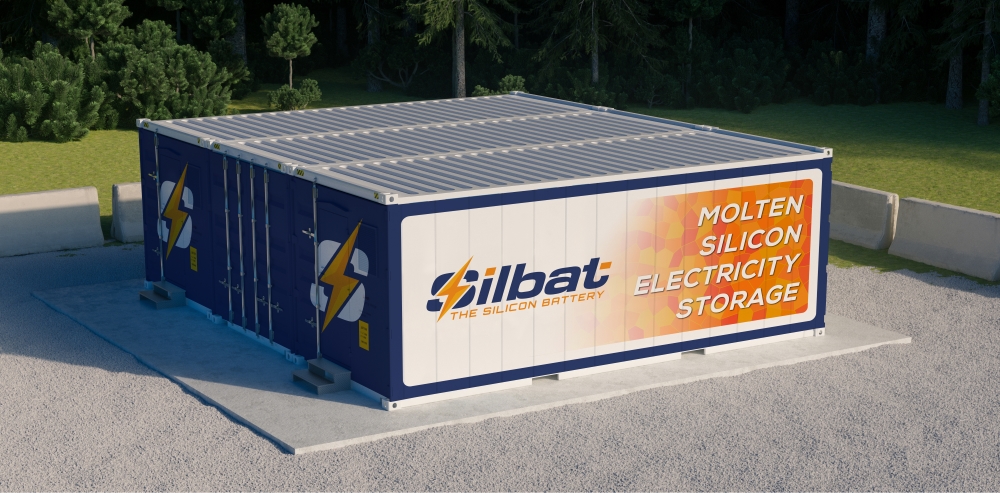
The silicon batteries developed by the Spanish startup Silbat are spearheading the Research and Analysis of Long-Duration Energy Storage for Operational Resilience in Critical Military Infrastructures (ARMIC) project, covering Technology Readiness Levels (TRL) 7 to 8.
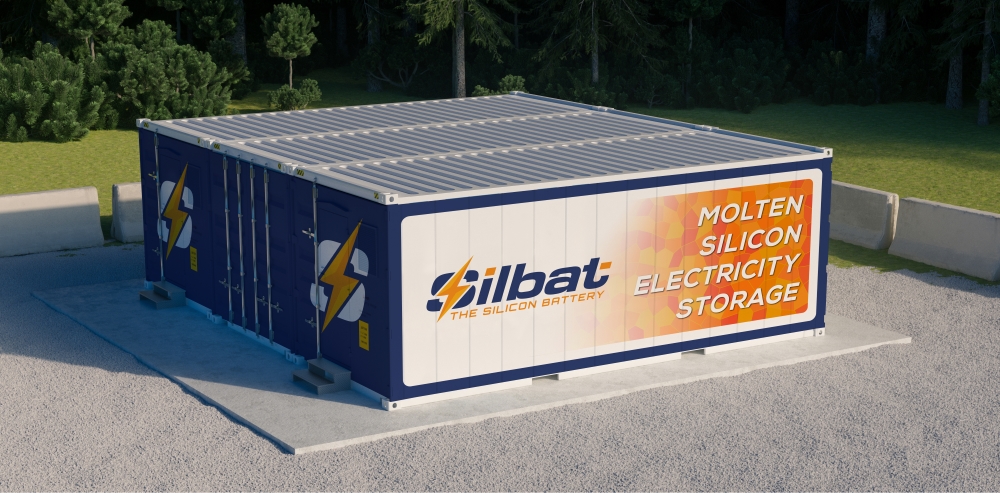

Image: Silbat
From ESS News
Silbat is a Spanish startup developing a long-duration energy storage (LDES) technology based on silicon. The company’s battery technology stores electricity as latent heat in molten silicon, using low-cost, widely available metallic-grade silicon. Silicon has the second-highest latent heat of fusion of any element, after the much rarer boron. In Silbat’s design, metallic silicon is held in a refractory container within a thermally insulated crucible. Electricity is converted into thermal energy through resistive (Joule) heating, and when the temperature reaches 1,410 °C, the silicon begins to melt. The battery is fully charged once the silicon is completely molten.
Silbat recently announced the launch of the Research and Analysis of Long-Duration Energy Storage for Operational Resilience in Critical Military Infrastructure (ARMIC) project. The initiative aims to support resilient and self-sufficient energy supply for critical military installations, addressing strategic vulnerabilities associated with reliance on civilian power grids. The project will run for three years.
“Aim of the ARMIC project is to ensure a reliable electricity supply for at least 14 consecutive days, in line with military resilience standards,” a company spokesperson told pv magazine. “It also offers cost savings while meeting heating and cooling needs through integrated heat storage and cogeneration capabilities. Our goal is to achieve competitive energy storage costs and promote national technological sovereignty, applicable in both military and civilian contexts.” The project focuses on TRL 7–8 for battery technology, representing the stage immediately preceding full commercialization and operational deployment (TRL 9).
To continue reading, please visit our ESS News website.
This content is protected by copyright and may not be reused. If you want to cooperate with us and would like to reuse some of our content, please contact: editors@pv-magazine.com.
Popular content