







A Power of Siberia natural gas pipelines facility in Heihe, Heilongjiang province, China, on Tuesday, March 21, 2023.
Bloomberg | Getty Images
Russian President Vladimir Putin met with Chinese leader Xi Jinping in Beijing on Wednesday, with the long-stalled Power of Siberia 2 natural gas pipeline on the agenda, as the Iran war disrupts energy supplies.
Kremlin foreign policy aide Yuri Ushakov said Tuesday that the project “will be discussed in great detail between the leaders.”
The planned 2,600-kilometer pipeline would carry 50 billion cubic meters of gas annually from Russia’s Yamal fields to China via Mongolia. Moscow and Beijing signed a legally binding memorandum to advance construction in September 2025, but pricing, financing terms, and a delivery timeline remain unresolved.
China reportedly wanted pricing terms for the new pipeline to match Russia’s domestic rate of around $120-130 per 1,000 cubic meters, while Moscow is seeking terms closer to Power of Siberia 1, which analysts estimate would more than double that figure.
China has been a major buyer of Moscow’s energy, with its imports of Russian oil jumping 35% year over year in the first quarter, according to official customs data.
The proposed additional pipeline would complement the existing Power of Siberia 1 system, which delivers about 38 billion cubic meters of gas to China annually, and both countries agreed to expand its annual capacity further.
Joint energy projects
At a joint press conference on Wednesday, the Russian president said his country was ready to continue supplying China with energy and that there is “big potential in joint renewable energy projects,” in comments translated by Reuters.
“Russia and China are actively cooperating in the energy sector. Our country is one of the largest exporters of oil, natural gas, including liquefied gas, and coal to China. We are, of course, ready to continue to reliably ensure uninterrupted supplies of all these fuels to the rapidly growing Chinese market,” Putin said in comments reported by Russian state news agency TASS.
The leaders earlier signed a joint statement on strengthening their “comprehensive partnership” and advocated “for a multipolar world and a new type of international relations,” news agency Xinhua reported.
Putin said talks with Xi had been “friendly, warm, and constructive” with relations between the two states at an “unprecedented level.”
Putin made no mention of the Power of Siberia 2 pipeline, but the Kremlin’s Press Secretary Dmitry Peskov later said Russia and China had “reached an understanding on the project’s main parameters”.
But “some nuances remain to be ironed out,” with no clear timeframe on the project, he added, in comments reported by news agency RIA Novosti.
Key considerations
The U.S.-Iran war that started late February has effectively led to a closure of the Strait of Hormuz, disrupting half of China’s oil imports and nearly a third of its LNG supply.
Power of Siberia 1 system delivered approximately 38 billion cubic meters of gas to China in 2025 and both countries agreed to expand its annual capacity further.
CNBC
While that energy shock creates fresh incentives for Beijing to consider an additional overland pipeline that bypasses maritime chokepoints entirely, analysts remain skeptical that it would alter Beijing’s negotiating calculus.
China holds around 1.23 billion barrels in onshore crude inventory — sufficient for roughly 92 days of refining needs, according to Kpler senior oil analyst Muyu Xu. Its domestic gas output also rose 2.7% in the first four months of the year, with central Asian pipelines, other than the Russian system, providing additional supply.
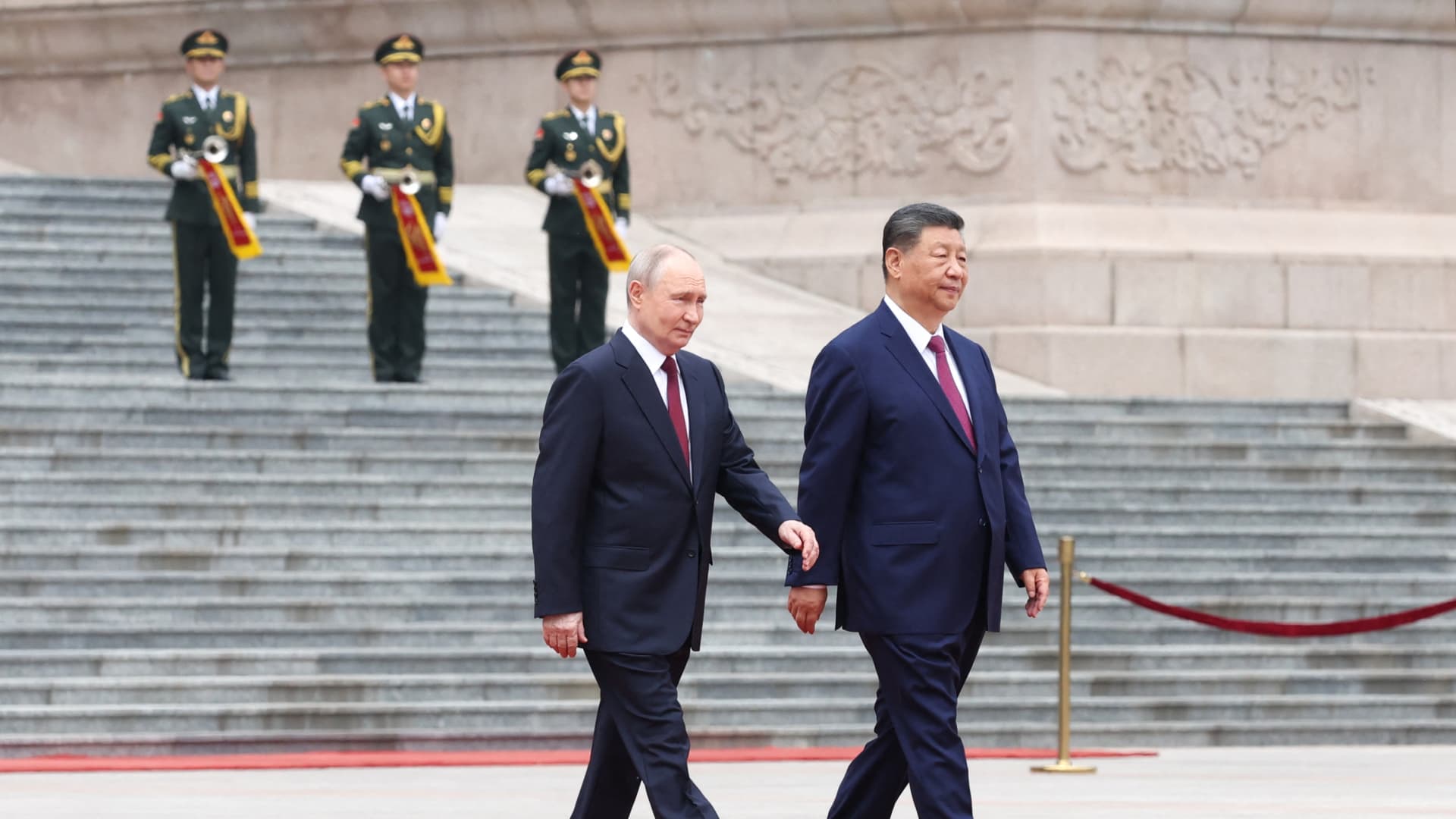
In this pool photograph distributed by the Russian state agency Sputnik, Russia’s President Vladimir Putin (L) and China’s President Xi Jinping walk together during a welcome ceremony at the Great Hall of the People in Beijing on May 20, 2026.
Alexander Kazakov | Afp | Getty Images
Russia’s gas exports to Europe have collapsed since its 2022 invasion of Ukraine, with state-owned energy giant Gazprom seeing shipments reportedly plunge 44% last year to their lowest level in decades.
Power of Siberia 2, given its scale, could leave Moscow dangerously exposed to a single customer, while Beijing would be trading Hormuz maritime vulnerability for dependence on Russian-controlled energy, said Michael Feller, chief strategist at Geopolitical Strategy.
“A deal would signal not just trust, but a decision that co-dependency is safer than the alternative,” Feller added. “For the rest of the world, it would make the Sino-Russian relationship harder to unpick.”


— CNBC’s Holly Ellyatt contributed reporting to this story.


