

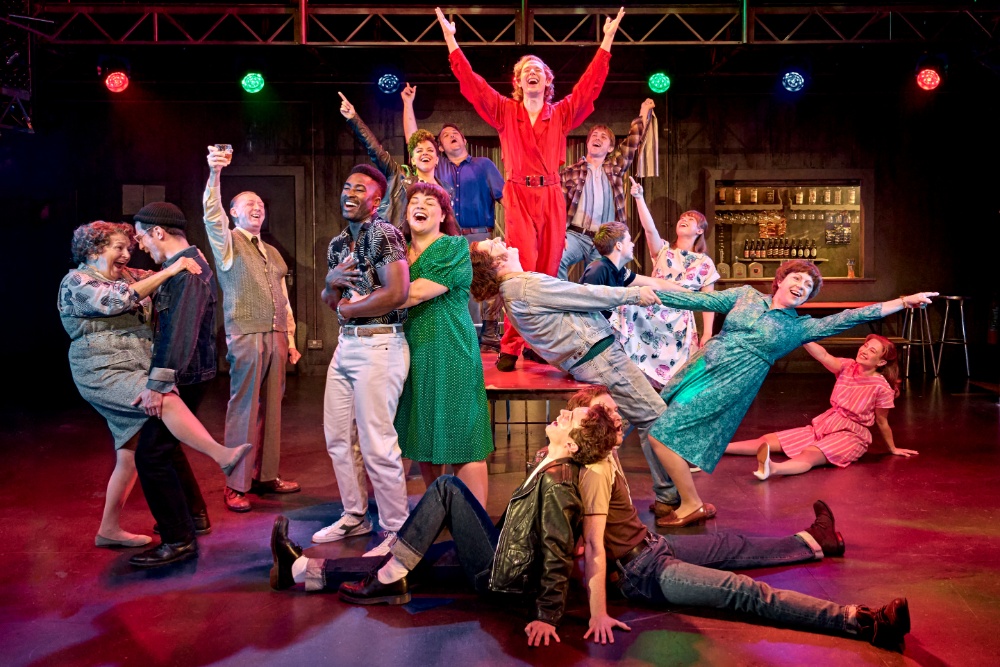
“Pride,” the joy-filled British musical based on the true story of Lesbians and Gays Support the Miners (LGSM), will transfer to London’s Bridge Theatre from Nov. 12, following sold-out seasons at Cardiff’s Sherman Theatre and the National Theatre’s Dorfman space.
The production will mark the inaugural show at the Bridge Theatre, a 900-seat venue on the Thames near Tower Bridge, under its new ownership by Trafalgar Entertainment.
“Pride” reunites the creative team behind the acclaimed 2014 film of the same name: director Matthew Warchus (“Matilda the Musical”) and writer Stephen Beresford (“The Last of the Haussmans”), who wrote the musical’s book and lyrics. Set during the 1984 U.K. miners’ strike, the show follows 24-year-old activist Mark Ashton as he rallies LGSM to form an alliance with a striking mining community in South Wales.
Popular on Variety
The musical features an original score by Christopher Nightingale, Josh Cohen and DJ Walde, drawing on protest anthems, pop, rock, disco and the Welsh choral tradition. The transfer cast includes Samuel Barnett as Jonathan, Matthew Durkan as Mike, Gillian Elisa as Gwen, Chris Jenkins as Gethin, Darren Lawrence as Cliff, Kirsty Malpass as Hefina, Madeleine Morgan, Sarah Pugh as Siân, Caroline Sheen as Maureen, Courtney Stapleton as Steph and Matthew Woodyatt as Dai, with further casting to be announced.
Speaking with Variety ahead of the transfer, Warchus says he always treats a remount as a chance to “get access to it again and make little fiddly improvements and changes.” He never approaches an opening night as a finished product, he says: “The opening night is a record, a document of where you got to in the amount of time you had and with the resources that you had.”
The move to a bigger house, he says, will also change how the production’s comedy and sound design land. “The difference between 800 people laughing and 400 people laughing is more than double,” Warchus says. “I think the comedy will really benefit from more people watching.” He points to the show’s layered sound design – the birds of Wales, chapel bells, the chants of striking miners, the cheers of the Pits and Perverts benefit concert – as an element he expects to intensify rather than dilute in a larger room. “Sound design always works better in larger spaces,” he says.
Warchus adds that the production’s essential character, built on simplicity rather than spectacle, will not change with the move. “It’s still going to be a story that’s got a handmade feel to it,” he says. “Very basic props, no glitzy automation or hydraulics or anything like that.”
The “Pride” film bowed at Cannes – where it won the Queer Palm – and went on to be distributed globally. Beresford draws a parallel to audience reactions when the film was first released. “There were reports in cinemas all over the world that at the end of the screening people would applaud as though it were a stage production,” he says, adding that theater audiences have taken to hugging strangers and sharing tissues by the end of a performance.
Asked whether the story, set 40 years ago, has taken on new relevance, Beresford points to a line from a review of the film that has stayed with him: “Prejudice cannot survive proximity.” He says the story’s emphasis on LGSM members physically showing up for a community unlike their own still resonates. “It’s the proximity that matters,” he says.
Warchus recalls watching a performance alongside recently appointed U.K. Prime Minister Andy Burnham and noticing how the audience responded whenever the word “hope” appeared in the lyrics. “It was like a bell being rung,” he says.
The stage adaptation followed two decades after Beresford first tried to get the story told on screen. “It took me 20 years to get the film made,” he says. “Nobody would touch it, the film, with a bargepole.” Warchus says the pair spent a couple of years weighing whether to attempt a musical version at all, wary of tampering with a project both are proud of. “You have a strong sense of why what kind of idiot messes with something,” he says. “But then, on the other hand, it’s quite painful if some other putz messes it up and you don’t get a chance to do it.”
Warchus credits Beresford’s writing as the reason he has anything to direct in the first place. “I wouldn’t have known the story if Stephen hadn’t written it up and added his own angle to it,” he says. Beresford, in turn, says what drew him to Warchus was an aversion to visual spectacle for its own sake. “Directors who say, ‘I’m going to CGI this and the camera’s going to swing underwater and then it’s going to’ I just it’s white noise to me. I’m not really interested,” he says, adding that their work together on the film centered on character. “We talked about who they were and what they wanted and what they didn’t want,” he says.
“And in making a musical – Matthew has made a lot of musicals – but he has a fantastic detailed eye. And I think we complement each other very well and have the same taste, largely,” Beresford adds.
Asked how the show balances the AIDS crisis and the defeat of the strike against its comedy, Beresford says the two are inseparable. “One of the most subversive and powerful weapons at our disposal is humor and cheerfulness and the particular black humor that comes from living through adversity,” he says. He recalls a 2015 Pride march where Anne Scargill, then the wife of former National Union of Mineworkers president Arthur Scargill, approached him. “She said, ‘You’ve made the truest film about the miners’ strike that’s ever been made,’” Beresford says. “And I said, ‘Anne, we both know that is not true.’ And she said, ‘It is. Because it’s funny.’”
On the decision to commission an original score rather than build the musical around existing songs, as the film’s beloved soundtrack had done, Warchus says jukebox musicals tend to interrupt their own storytelling. “The songs stop the story every single time they turn up, because they can’t carry the story,” he says. “A true musical is a completely different thing, and that’s what we wanted to do.”
Designer Bunny Christie’s set, built around the idea of a touring production that has “come out the back of a minibus,” was a deliberate choice, according to Warchus, who says he grew up watching similar scratch-built touring shows in the 1980s. “That’s definitely in my blood,” he says, adding that the production also layers in “a rock-and-roll lighting rig” to give the show the feel of a live concert during its Pits and Perverts sequence. Warchus says he gave Christie a physical brief during an early workshop, taping off a square around a crowd of test performers to demonstrate how much stage space the show’s crowd scenes would require. “I need it to be this crowded when we’re doing the Pride march or an event happening,” he recalls telling her. “Therefore, I need the stage to be this small, this size.”
Beresford and Warchus also address criticism that the musical understates the role of LGSM’s lesbian members, a group that in real life numbered around 40 to 50 people, some of whom broke away to found the support group Lesbians Against Pit Closures. Beresford says the real-life group had to be condensed for the stage, with composite characters like Reggie and Steph standing in for several real activists. Warchus says the show’s small ensemble size, which has to account for understudies across both the Welsh and LGSM characters, further limited how many roles could be written. “We worked out we could have seven people,” he says. Beresford notes the production made a point of casting an all-female band. “They’re the lesbian band,” he says. “They represent the lesbians.”
Asked what Ashton, who died of an AIDS-related illness in 1987, might make of the musical, Beresford describes him as a natural showman. “He was a huge, huge theatric,” Beresford says. “He loved camp … his whole political process was about making things fabulous.” He adds that Ashton would likely have one specific complaint. “He would be frustrated that I do not have a song which literally is the entire Communist Manifesto set to music, perhaps to a samba beat,” Beresford says. Warchus says he expects Ashton’s reaction would mirror those of LGSM members who have already seen the show. “I hope that he would laugh uproariously, and I’m sure that he would cry,” he says.
“Pride” previewed to sold-out houses at the Sherman Theatre before opening at the National Theatre’s Dorfman in June, where it runs through Sept. 12. The musical is produced by P&P Productions in association with the National Theatre, Pathé, Calamity Films and David Binder Productions.
