


Matthew Smith
Matthew Smith is Oilprice.com’s Latin-America correspondent. Matthew is a veteran investor and investment management professional. He obtained a Master of Law degree and is currently located…
Set us as your preferred Google source
Premium Content
By Matthew Smith – Feb 21, 2026, 4:00 PM CST
- Colombia is experiencing a severe energy crisis due to a sharp decline in its proven natural gas reserves, which now stand at less than a six-year production life.
- Domestic natural gas production is falling due to rising decline rates at mature fields and new government policies, such as ceasing new exploration contracts and hiking taxes, which has discouraged foreign investment.
- The widening gap between rising demand and plunging domestic supply is forcing Colombia to ramp up costly liquefied petroleum gas imports, which is causing natural gas prices to soar and impacting the national economy.


Strife-torn Colombia is facing an energy crisis of gargantuan proportions. Decades of mismanagement and insecurity, coupled with radical changes to energy policy by Gustavo Petro, Colombia’s first-ever leftist president, are wreaking havoc with the country’s natural gas reserves and production. This is making the Andean country increasingly reliant upon costly natural gas imports while threatening the stability of Colombia’s energy grid and risking critical energy shortages. There are no signs of an easy solution for a country struggling under the weight of a growing fiscal crisis.
Colombia’s proven natural gas reserves are dwindling. Since 2012, when those reserves hit a multi-year high of 5.7 trillion cubic feet, they have fallen every year except for 2021. By 2024, Colombia’s natural gas reserves stood at just over two trillion cubic feet, nearly a third of what they were in 2012, with a production life of a mere 5.9 years. This is particularly worrying because, for the same period when reserves declined, consumption of fuel has risen sharply.
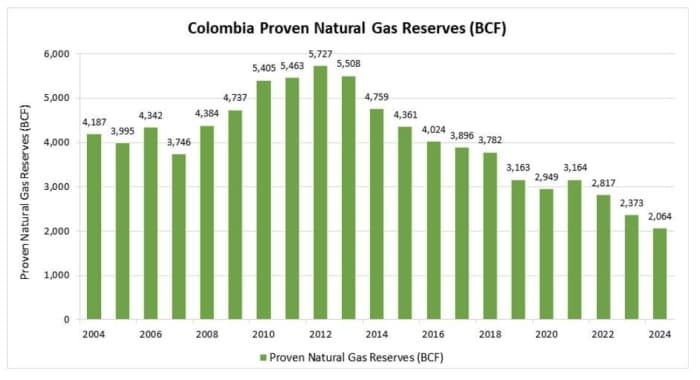

Source: Colombia National Hydrocarbons Agency (ANH).
Natural gas is a crucial fuel for Colombia’s gas-fired power plants and households, which use it for heating and cooking. Until recently, when the Andean country’s self-sufficiency ended, natural gas was a highly affordable fuel for households in a nation where roughly a third of the population lives in poverty. Colombia is becoming increasingly reliant on natural gas-fired electricity generation. While the Andean country has long been reliant on hydropower, which provides around 60% of Colombia’s electricity, there is a rising reliance on gas-fired plants. Rising electricity demand, coupled with sustained intermittent declines in hydroelectricity output due to poor hydrology, increased the need to generate power from traditional thermal plants.
Set OilPrice.com as a preferred source in Google here.
This, coupled with President Petro’s policy of weaning Colombia off fossil fuels is behind the plan to replace Colombia’s fleet of aging, inefficient coal-fired plants. These are being progressively replaced by natural gas-fired facilities through refits or the construction of new plants. Shortages of electricity caused by changes in water levels, combined with soaring demand and strained grid infrastructure, are responsible for outages and brownouts in major towns and cities across Colombia. Those events are placing pressure on constrained natural gas supplies, particularly with thermal facilities responsible for generating over a fifth of Colombia’s electricity.
For these reasons, demand for natural gas is far outstripping supply. Domestic production of the fossil fuel has fallen sharply since hitting a multi-year high of 1.1 billion cubic feet per day in February 2020, just before the COVID-19 pandemic. Data from the national hydrocarbon regulator, known by its Spanish initials as the ANH, shows for December 2025 a mere 693 million cubic feet of natural gas was lifted in Colombia. That number is a whopping 9% lower than November 2025 and a whopping 23% less than a year earlier.
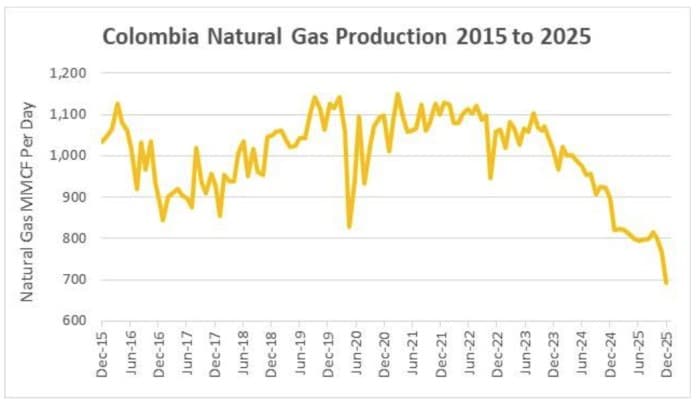

Source: Colombia National Hydrocarbons Agency (ANH).
A key driver of this sharp decline in Colombia’s natural gas output is the rising decline rates at mature fields. You see, a considerable portion of the fossil fuel lifted in the Andean country is associated gas, a byproduct of oil production. The growing volume of mature fields in Colombia, where decline rates are peaking, means drillers are forced to implement enhanced oil recovery methods, such as water flood and gas injection techniques.
One of the most cost-effective enhanced recovery practices is to reinject the natural gas extracted from oil wells into the underlying reservoirs to boost pressure and lower viscosity, making the petroleum easier to extract. It is estimated that somewhere between 50% an 80% of all associated gas produced in Colombia is reinjected for those reasons. This is weighing on domestic commercially available natural gas volumes, with Bogota seeking commitments from drillers to free up associated natural gas for commercialization.
A lack of major natural gas discoveries, combined with declining exploration and falling investment in Colombia’s hydrocarbon secto,r are other key contributors to the marked decline in production and reserves. Policies introduced by Petro, notably ceasing to award new exploration and production contracts as well as hiking taxes for extractive industries, are responsible for the sharp drop in drilling activities. As a result, many foreign energy companies are reducing their operational footprint and even withdrawing from Colombia due to the impact of those policies on profitability.
For these reasons, Bogota is ramping up costly liquified petroleum gas (LPG) imports, which began in 2016, to fill the shortfall. By 2024, Colombia was importing record volumes of LPG, setting both monthly and annual all-time highs. The Andean country for that year imported 94.33 billion cubic feet (BCF) or nearly triple the 36.3 BCF received a year earlier. According to Bloomberg, those volumes continue to grow. The news agency recently reported that during 2025, Colombia imported 3.1 million metric tons or 153.93 BCF of LPG, or 1.6 times more than a year earlier.
That marked uptick occurred despite the end of the El Niño weather phenomenon in 2024, which sparked a major drought and was responsible for a sharp reduction in hydroelectricity generation because of significantly decreased water flows. This forced Bogota to fire up gas-fired power plants to make up for the shortfall in electricity, which threatened the stability of the country’s grid. The amount of LPG being imported by Colombia is forecast to expand further as the gap between rising demand and plunging domestic supply widens.
Even the Sirius natural gas project situated in the Andean country’s territorial waters in the Caribbean, long touted as a solution for diminishing reserves and production, is incapable of filling the supply gap. Recent forecasts expect supply constraints to weigh so severely on the amount of natural gas available in Colombia that the deficit will widen to 56% of demand by 2029, if new domestic sources of the fossil fuel are not brought online. The growing dependence on costly LPG imports is causing natural gas prices to soar, which is impacting an already fragile economy.
According to government data, several major cities, including Colombia’s capital Bogota, experienced price inflation for natural gas above the national average. Colombia’s capital, while not the hardest hit saw natural gas prices surge by a worrying 16.98% in the December 2025 consumer price index. There are fears the growing reliance on imported natural gas will drive prices higher, impacting economic activity and households, which are already suffering from a spiraling cost of living.
National oil company Ecopetrol has pinned its hopes on the Sirius natural gas discovery in the Guajira Basin situated in the Caribbean Sea off the port city of Santa Marta. The gas field is in the GUA OFF 0 Block, formerly the Tayrona Block, where Ecopetrol controls 55.6% with Brazil’s national oil company Petrobras, which is the operator, holding 44.4%. The project, which is targeting reservoirs containing 6 billion cubic feet of natural gas, will cost $5 billion to develop. The Sirius gas field will come online by 2030. The block is believed to hold six trillion cubic feet of natural gas, which, if accurate, will significantly boost Colombia’s natural gas reserves and production.
By Matthew Smith for Oilprice.com
More Top Reads From Oilprice.com
- FT Uncovers $90 Billion Russian Oil Smuggling Operation
- Denmark Seizes Blacklisted Container Ship Tied to Iran’s Shadow Fleet
- The Quiet Revolution Reshaping America’s Energy Future
Download The Free Oilprice App Today



Matthew Smith
Matthew Smith is Oilprice.com’s Latin-America correspondent. Matthew is a veteran investor and investment management professional. He obtained a Master of Law degree and is currently located…