




Advertisement


NWDC Unveils Plan to Tap $10bn Agric Economy in North-West
The Northwest Development Commission (NWDC) has unveiled a comprehensive plan to tap into the North-West’s $10 billion agricultural economy through a new regional framework aimed at driving food security, job creation and GDP growth.
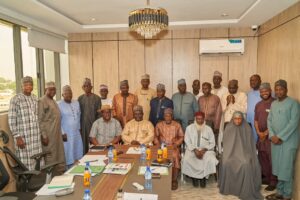
The Managing Director/Chief Executive Officer of the Commission, Prof. Shehu Abdullahi Maaji, disclosed this on Tuesday at the Commission’s headquarters in Kano during a strategic economic roundtable convened with leading agricultural research and development institutions.
The meeting brought together experts from the International Institute of Tropical Agriculture (IITA), International Crops Research Institute for the Semi-Arid Tropics (ICRISAT), HarvestPlus, Centre for Dryland Agriculture (CDA), East-West Knowledge Transfer, Sasakawa Africa Association, Institute for Agricultural Research (IAR) and the National Agricultural Extension and Research Liaison Services (NAERLS).
Speaking on behalf of the Board and Management, Prof. Maaji said the framework is not just about farming, but about economics.
He noted that the North-West — comprising Kano, Jigawa, Kaduna, Katsina, Sokoto, Kebbi and Zamfara — has 186 Local Government Areas, 2,003 electoral wards and over 70 million people, representing more than one-third of Nigeria’s population and landmass. The region also boasts about 62 million hectares of arable land, over 20 major dams with a combined irrigation potential of more than 1.5 million hectares, and a youth population of about seven million aged 15 to 30.
According to the National Bureau of Statistics [NBS], agriculture contributes about 25 per cent to Nigeria’s GDP and employs over 70 per cent of the rural population in the North-West, yet less than 15 per cent of its irrigation potential is currently utilised. The region that once powered Nigeria’s economy with groundnut pyramids, cotton and hides and skin now accounts for over 45 per cent of the country’s post-harvest losses, estimated at N3.5 trillion annually.
Prof. Maaji said the Commission’s strategy seeks to reverse that trend.
“If you are not out of food insecurity, you are still a slave. If you are still battling to feed yourself, you are not a free man. There is nothing you can achieve without food security,” he said.
He added: “Agriculture is not just a social programme; it is an economic pillar. We are looking at how to turn our vast land, water and human capital into jobs, exports and industrial raw materials. Our target is to build a framework that can unlock at least $10 billion in agricultural value chain opportunities for the North-West within the next decade.”
He explained that the NWDC, established in 2024 by President Bola Ahmed Tinubu after signing the NWDC Establishment Act on July 24, 2024, has seven mandate pillars — Security, Agriculture, Education and Health, Environment, Industry and Energy, Infrastructure, and Youth and Women Development — with agriculture positioned as the quickest lever for inclusive growth.
The proposed framework will focus on three economic drivers: commercialising the region’s vast fertile land, activating year-round irrigation farming using its numerous dams, and deploying its seven million youths as extension agents, agripreneurs and value-chain operators.
Under the plan, the partner institutes will provide research-driven solutions for high-yield seeds, climate-smart agriculture, post-harvest loss reduction, extension service reform and market linkage — all aimed at moving farmers from subsistence to surplus and from surplus to export.
Participants commended the Commission for its proactive economic vision and pledged full technical support to develop a practical roadmap that will modernise agriculture, strengthen value chains and convert the North-West from a food-deficit zone into Nigeria’s food and agribusiness hub.