




- Mennonite families in Belize could pay millions to settle on around 24,000 hectares (59,300 acres) in Para, Suriname, a district with around 90% forest cover.
- Community leaders from Shipyard and Indian Creek, Belize, have taken multiple trips to Suriname to analyze soil quality and learn about the country’s farming regulations. Members from Spanish Lookout, another Mennonite community, have also started looking into a Suriname relocation.
- The move is being facilitated by Braganza Marketing Group, run by Ruud Souverein, a Dutch national living in Suriname who was involved in a previously failed government program to bring Mennonites from Bolivia in 2023.
- Environmental groups have expressed concern about Mennonites’ tendencies to expand into forested areas, circumvent environmental regulations, and settle on land without proper titles.
SHIPYARD, Belize — Mennonite families in Belize are preparing to move to Suriname to establish massive farming communities in a heavily forested area, multiple sources told Mongabay, raising concerns that they may soon be cutting down trees to grow crops.
The deal could cost millions of dollars and cover more land than the U.S. city of Baltimore, according to documents reviewed by Mongabay.
The potential move comes amid debate by officials in Suriname over how to increase domestic food production without compromising one of the highest levels of forest cover in the world.
Belizean Mennonites have traveled to Suriname at least six times in recent years to scout thousands of hectares of land and learn about local regulations, working with businessmen who have spent the past several years trying to attract the famously agro-savvy Mennonites from different parts of Central and South America.
Across Latin America, Mennonites have also been criticized for illegal deforestation, circumventing environmental regulations, and settling on land with disputed or unclear titles. Some critics say the arrival of Mennonites in Suriname could threaten the rainforest, which covers about 93% of the country.
“Any activity by Mennonites in Suriname to me is disturbing,” said Ben D’Leon, a member of the NGO Amazon Conservation Team, Guianas, speaking in a personal capacity. “I’m simply basing that on the factual evidence on this continent. If you look at anywhere that they’ve been active, I don’t believe we can see a trend of positive outcomes for nature and Indigenous and tribal communities.”
Many Mennonites migrated from Europe to North America in the 18th century and later spread from Mexico to Belize in the late 1950s, seeking large tracts of land to establish farming communities and maintain a traditional lifestyle with limited technology.
Today, Mennonites are a largely closed community and operate some of Belize’s most productive farms, supplying much of the country’s chicken, eggs and produce. But farmland has become scarce in such a small country, and environmental groups have pushed back against efforts to expand into forested areas.


There have also been disagreements within some communities as certain families begin to adopt modern conveniences like cellphones, cars and electricity. For more conservative families, moving to Suriname offers a way to preserve traditional practices while tapping into a largely underdeveloped agricultural sector.
“A lot of people here don’t want to continue with the religion that we’ve maintained,” said Henry Penner, one of the leaders of Indian Creek, a Mennonite community in northern Belize.
Leaders of the Indian Creek and neighboring Shipyard communities have traveled to Suriname multiple times, several Mennonite residents told Mongabay. They looked at different plots, analyzed the soil quality and learned about the country’s farming regulations. For now, they plan to purchase around 24,000 hectares (59,300 acres) in Para district, according to maps of the land deal assembled by a company assisting the prospective land buyers and reviewed by Mongabay. That’s an area a little larger than the city of Baltimore in the United States.
Around 14,800 hectares (36,500 acres) would be for Shipyard families and around 9,400 hectares (23,200 acres) would be for Indian Creek families, the maps show. The exact size of the land varies by several hundred hectares across different documents.
Penner said he doesn’t know how many families would go to Suriname at first, but that the plan would be to arrive by early 2027 and continue bringing more people over in waves, expanding landholdings in future generations. He has 10 children — five boys and five girls — who are deciding whether they want to follow him to Suriname.
The families would grow soy, corn, beans and sorghum while also raising cattle, he said.
Para district has around 90% forest cover, according to Global Forest Watch (GFW). The Mennonites plan to develop an area that could be primary or secondary forest, according to the GFW satellite imagery. That means there might be old-growth forest, with high rates of biodiversity, or an area that was partially cleared and later regrown, with less biodiversity compared to the surrounding forest.

Many conservation groups in Suriname have advocated for agribusiness development on degraded land, which would be the case if the Mennonites use secondary forest areas. But in this case, groups said they are less concerned about clearing that specific site than about potential expansion into primary rainforest. In other countries where Mennonites have settled, communities have split and expanded into forested areas, resulting in clearing that has been difficult to control.
The communities would have to receive approval to clear the forest from the Foundation for Forest Management and Production Control (SBB), a government agency that oversees forestry activity in Suriname. But in some cases, land clearing has moved forward without SBB approval.
SBB didn’t respond to a request for comment.
“What we’re seeing is an entry strategy, and we know that and they’ve said it’s not going stop there,” John Goedschalk, a climate adviser to Suriname’s president, told Mongabay. “Now there are these seemingly innocent little pockets [of development] and then all of a sudden — boom, they’re going to come and take more.”
Some Mennonites in Belize pushed back on that assessment, telling Mongabay they’re careful about soil erosion and areas with high biodiversity, and even set aside forested areas because of the hydrological benefits they serve.
Others said conservation groups take forest conservation too far, sacrificing food security and the agricultural needs of the country.
Suriname has historically imported a significant portion of its food, and some officials have said the country is well-positioned to be the future “food basket” of the Caribbean.
“All these environmentalists, guess who feeds their stomachs? It’s the destruction of forest and the farmer that destroys the environment that feeds their stomachs,” Allen Reimer, former mayor of Spanish Lookout, another Belizean Mennonite community farther south, told Mongabay. “There has to be a balance.”
Reimer said Spanish Lookout is still in the “information gathering stage” about a Suriname relocation. Community members traveled to Suriname in February and had a meeting about their findings, he confirmed.
He added, “If everything was virgin forest and intact — no food, you’d go hungry tonight.”
A familiar business deal
Plans to bring Mennonite farmers to Suriname have circulated for years, promoted by government officials and a small group of agribusiness investors.
In 2023, the company Terra Invest Suriname & Guyana was in talks with government officials to purchase as much as 30,000 hectares (about 74,000 acres) for Bolivian Mennonite families planning to grow soy, maize, sorghum and wheat. The plan sparked backlash due to concerns about forest loss, leading then-President Chandrikapersad Santokhi to cancel the agreement.
Two businessmen were working on the land deal: Ruud Souverein, a Dutch national living in Suriname, and Adrián Barbero, an Argentinian agribusinessman who has traveled to Suriname, Guyana and other parts of South America for agriculture and livestock projects.
Around the time of the cancellation, Barbero said he began speaking with Mennonites in Belize. But a different company run by Souverein, Braganza Marketing Group NV, has a memorandum of understanding with the Mennonites. It says Braganza is helping with immigration to Suriname as well as obtaining contacts with the public and private sectors.
The memorandum of understanding doesn’t reference Terra Invest. However, maps of the land deal bearing Terra Invest’s name that were shared with Mennonite leaders closely match the land areas described in the memorandum of understanding with Braganza.
Barbero said Terra Invest is no longer active in Suriname and that he’s not associated with Braganza. Souverein declined to comment.
“The Mennonites have a lot of knowledge and experience in large-scale agriculture and livestock farming and want to use this knowledge and experience in Suriname and invest in land and set up farms in this context,” said the memorandum of understanding, which was dated November 2025 but not yet signed by the Mennonites when Mongabay reviewed it in March.


Braganza has spoken about the proposed land deal with government officials, including the Department of Agriculture, Livestock and Fisheries, according to the memorandum and screenshots of text conversations reviewed by Mongabay.
A department representative didn’t respond to Mongabay’s request for comment. A National Environmental Authority official said it hadn’t had any contact with the company.
A spokesperson for Suriname President Jennifer Geerlings-Simons didn’t respond to multiple requests for comment. In an interview with Mongabay last year, Geerlings-Simons said there was enough degraded land on Suriname’s coast to develop agriculture without sacrificing the forest.
Mennonites in Shipyard have already transferred $250,000 to Braganza for the approximately 9,400 hectares, as part of a four-part payment plan totaling $1.69 million, according to the memorandum. It doesn’t mention how much the other, 14,800-hectare section of land would cost or how payment would be made.
Mennonites often manage their funds collectively through corporations or churches, which oversee the division of community land. The Shipyard leaders didn’t say whether they were using this structure or private funds to acquire the property in Suriname.
Once the four payments are made, shares would be transferred to them from the Suriname company Agriculture New Surland, according to the memorandum. It’s unclear what Agriculture New Surland’s role is in the deal or who the seller is.
If the deal moves forward, conservation groups said they’re ready to fight development and protect the forest.
“I, for one, am going to bring it to the fore,” said Goedschalk, the presidential adviser. “I’m going to keep on pushing against this.”
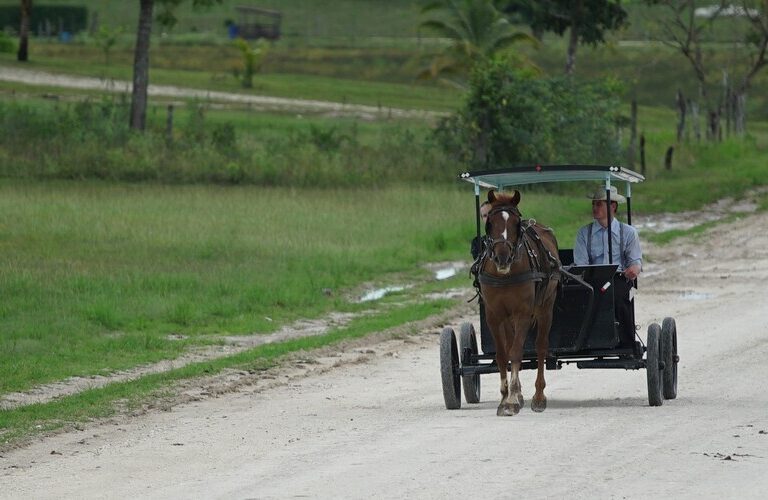
Banner image: A Mennonite rides a traditional horse and buggy in Belize. Image by Brent Toombs.
See related from this reporter:
FEEDBACK: Use this formto send a message to the author of this post. If you want to post a public comment, you can do that at the bottom of the page.