




Every guitarist has their own unique approach to playing. From the way we strum to how we set up our instrument, the guitar is an inherently subjective experience, driven by feel and personality.
That means, sometimes, you can stumble across a surprising tip that can drastically alter the way you play – and, for me, that happened more than 10 years ago, when a British blues guitar hero completely changed my relationship with the humble guitar pick.
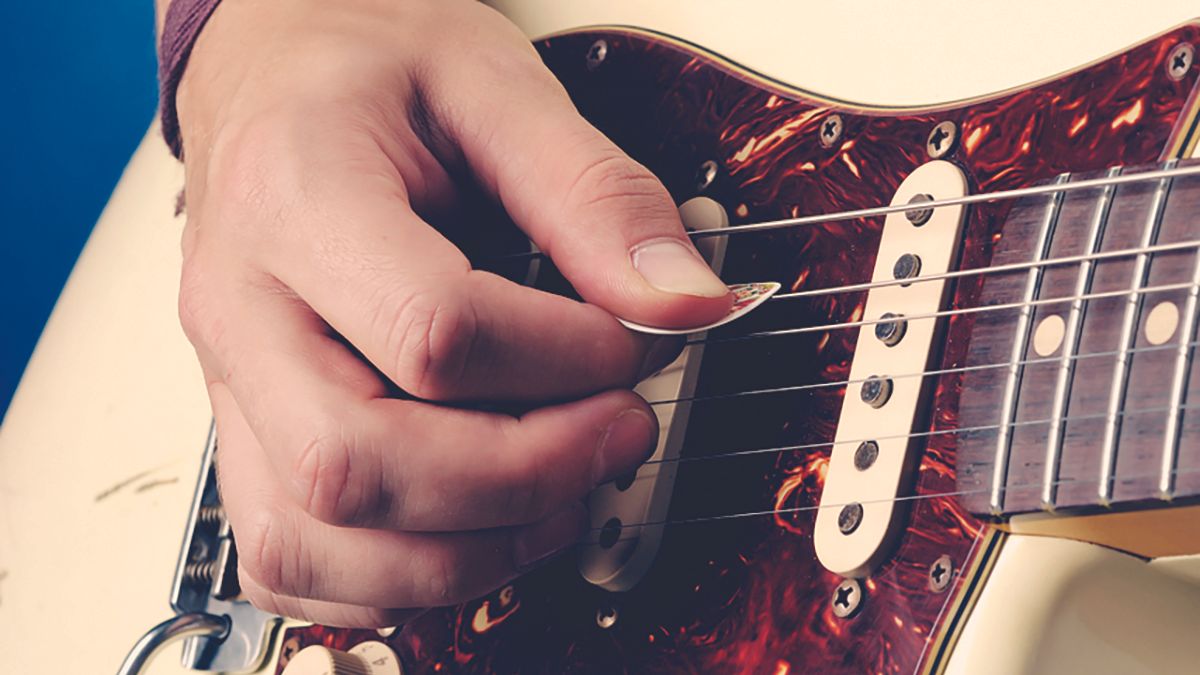
Conventional wisdom dictates that the pointy end of a pick is what you use to pluck the strings. The broader top is where you hold it. And this makes sense. The wider part offers greater surface area for the thumb and forefinger to hold securely. The tapered end has a smaller point for reduced contact and thus a more pronounced and precise ‘pluck’.
Article continues below
Up until the age of 16, this is how I held a guitar pick. I didn’t know any different, and every teacher I’d had at that point had encouraged me to do just that.
However, that changed when I attended a guitar masterclass in Bristol, England, hosted by Matt Schofield. After a few hours, I’d learned plenty of licks, and took onboard some sage advice for hitting chord tones in your solos (younger me was obsessed with the blues), but the biggest thing I took away from the event had nothing to do with my left hand. It was all about my right.
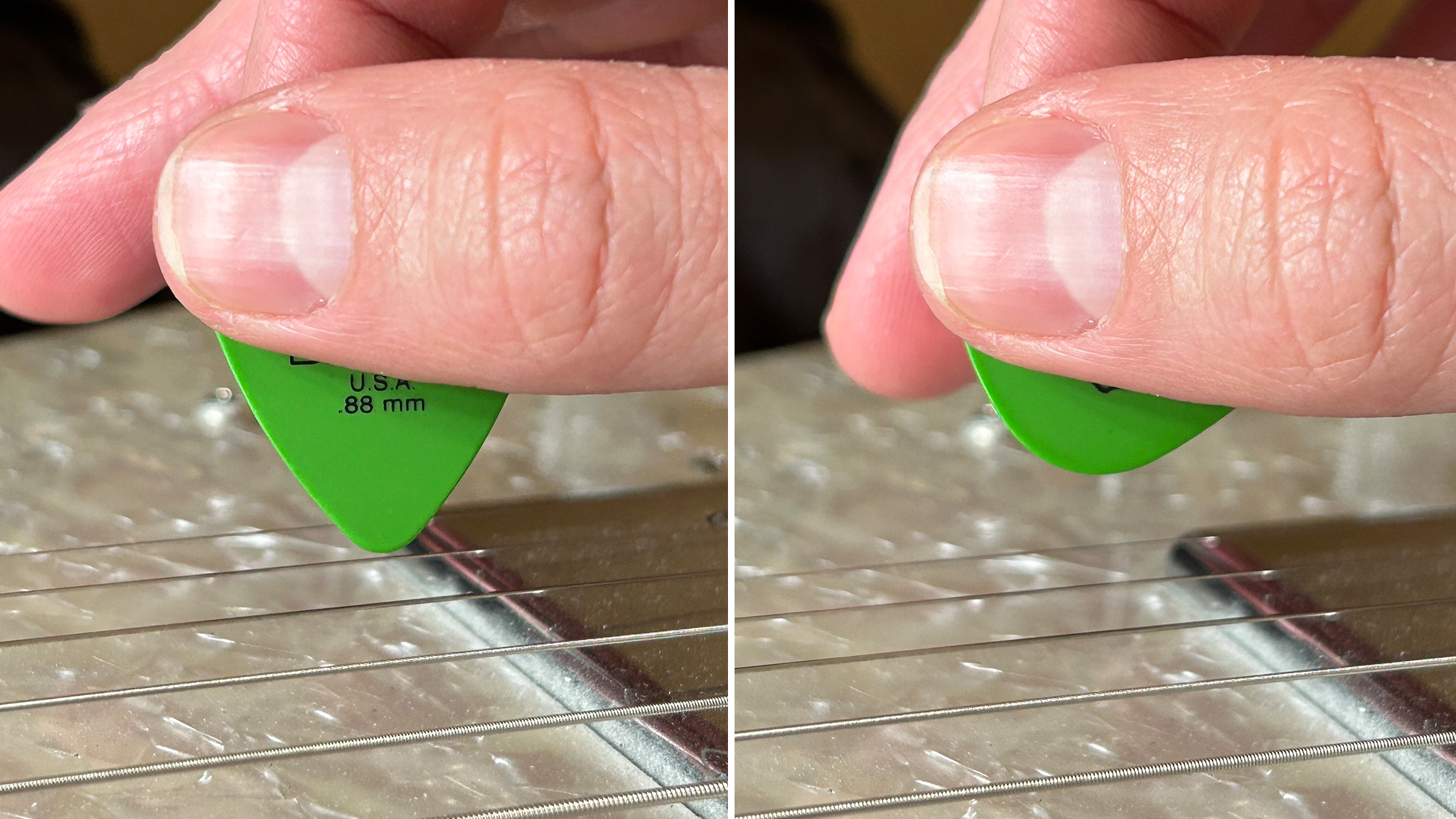

During that workshop, Schofield shared how – and why – he held a guitar pick on its side. Contrary to popular practice, Schofield rotated the pick 90 degrees anti-clockwise, so the pointy end was directed towards his palm. This meant he was striking the string with the flatter shoulder of the pick.
The thinking, at least as I understand it, goes something like this: the increased contact between the string and pick offers a softer picking tone, as opposed to the sharp point delivering a more pronounced and ‘stabby’ attack.
It was a bit of a lightbulb moment for me, and after trying it for the first time I’ve never looked back. In fact, using the sharp end of a pick now feels weirdly alien to me. I am 10 times the player when I hold a guitar pick the ‘wrong’ way.
I’ve not scientifically tested it, but from my own anecdotal evidence, the pick transients are so much softer when using the shoulder of a plectrum. As a player who likes to try and be as dynamic as possible, this softer attack felt far more natural and usable. There was a larger range of expression to play with.
“I struggled to play with the pointy end,” Schofield once said in an online lesson video. “This just felt right to me from the beginning and I preferred the sound of it. It instinctively sounded better – fuller and richer.”
I’ve since come to learn this isn’t a completely new philosophy. Pat Metheny is a famous champion of the shoulder picking, as was Stevie Ray Vaughan. Robben Ford uses this trick, too. Modern-day session greats Tom Bukovac and Guthrie Trapp both swear by it. That’s no coincidence.
There’s something that links all these players together: they are all immensely dynamic, known for their feel and phrasing. They can go from softer-than-softer solos to pummeling lead lines and chord strumming in the blink of an eye. I think a large part of that comes from the way they all hold the pick.
For me, the shoulder of the pick serves as something of an additional de facto gain stage, or at the very least a tool for tempering my tone. If I angle the pick against the string, I can almost brush against it for a more textural, tangible feel with nice overtones, whereas when I square it off to the string, I get greater presence and precision.
Tom Bukovac and Guthrie Trapp: Nashville’s Hottest Guitar Gunslingers – YouTube


That, right there, already opens up a world of playing possibilities even before you start throwing amps, effects, and other tone-shaping tools in the signal chain. It made me realize that guitar picking isn’t literally just ‘picking the string’. It’s another concept that can be leveraged for feel and sound.
This method also allows me to ‘step away’ from the string faster, thus letting me play a bit quicker and move around at pace. Bukovac concurs – “I definitely think you can play faster with the shoulder,” he once told Rick Beato.
Again, I’m not a ‘speed’ kinda player, but it’s a nice happy bonus. The true value of the shoulder method, for me, lies in the fact I feel closer to my strings – physically and mentally – and helps me get closer to that intangible sense of touch and feel that so many players (myself included) so often strive for.
After all, that blissful simplicity of the human touch is something that’s conveyed through the guitar rather uniquely, and an aspect that the greats of the instrument have all mastered. In the end, to become more dynamic, I didn’t need a new guitar or pedal, nor did I have to relearn certain techniques. I just had to flip my guitar pick 90 degrees.
” data-join-the-conversation-text=”Join the Conversation”>
You must confirm your public display name before commenting
Please logout and then login again, you will then be prompted to enter your display name.


