

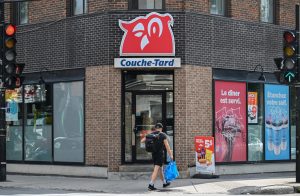
Convenience store stocks are having their moment, riding a wave of investor demand for more defensive plays as angst over the sustainability of the artificial intelligence boom and the ongoing conflict in Iran drive increased market turbulence.
Shares of the group’s biggest names — Alimentation Couche-Tard Inc., Casey’s General Stores Inc., and Murphy USA Inc. — have surged to near record levels and are all up at least 24% this year. The leader of the pack, Casey’s, is up more than 54% and on track for its best annual performance in 35 years. The stock was also added as a member of the S&P 500 Index four months ago.
Deemed defensive value plays as investors seek to hedge against unpredictability in the AI trade, the cohort is getting a boost from changing consumer habits and most notably — fuel prices. Energy markets have been roiled since the US attacked Iran in late February and the subsequent closure of the Strait of Hormuz.
“Gas prices moving up and down and being very volatile is a benefit just because the convenience store has to keep prices fairly elevated but they can be more opportunistic on when they buy,” said William Blair analyst Phillip Blee.
Large-scale convenience stores like Circle K owner Couche-Tard recently reported large gains in fuel margins after the war. So far this year, shares of the Canadian company climbed 22% in Toronto.
“There is public-market demand for convenience-store exposure, even outside the established public names,” Melius Research analyst Jacob Aiken-Phillips wrote in a note to clients, pointing to the results of April’s initial public offering of Yesway Inc. That offering was 10 times oversubscribed and shares of the firm, which is backed by private equity firm Brookwood Financial Partners, are up 22% since their debut.
Last month, Cumberland Farms Ltd, a Charlotte, North Carolina-based gas station and convenience store operator, filed for a US initial public offering. The company, which is backed by buyout firm TDR Capital, is considering seeking a valuation of about $9 billion in the IPO, Bloomberg News reported in June.
That same month, the Roundhill HALO ETF, which focuses on high-asset, low-obsolescence stocks as a diversification strategy from AI, purchased shares of Casey’s, marking the fund’s sole convenience store investment.
”As investors look for growth opportunities away from tech, we think that a company like Casey’s is a great expression of that,” said Roundhill Financial Chief Executive Officer Dave Mazza.
Best known for its pizza, Ankeny, Iowa-based Casey’s focuses on towns with 20,000 people or less across 19 states, a strategy that analysts say sets it apart from peers. Casey’s recently announced a three-year strategic growth plan that involves expanding its chicken wing business and adding at least 400 stores in places such as Texas and other parts of the South.
“The cash flows that they earn are coming from essential daily demand for things like fuel and food and other staples,” said Mazza.
Beyond gas, nicotine pouches, beverages, and foodservice were common callouts as sales growth drivers for the cohort, according to JPMorgan analyst Thomas Palmer.
New nicotine products are helping contribute to higher sales margins. Murphy said in its second-quarter earnings call that it sees nicotine pouches and a “continued resurgence in that cigarette category” driving growth in the second half of this year. Shares of Murphy are up nearly 40% this year.
Some analysts warn, however, that convenience stores face challenges when oil prices and geopolitical uncertainty eventually normalize. Acknowledging those risks, 7-Eleven/Seven & i said it would delay the planned listing of its US operation to fiscal year ending February 2027.
Last week, Murphy also released a “deliberately conservative” guidance for 2026.
“When thinking about retail margins for the rest of the year, it’s very difficult to predict where we’re going to land because we’re in the middle of a lot of heightened volatility with a crisis that continues to ebb and flow and don’t know where that will end,” said Murphy CEO Mindy West during its earnings call.
As geopolitical volatility subsides, investors will be focused on same-store sales and gas-margin sustainability, according to Irene Nattel, an RBC analyst. Both Couche-Tard and Casey’s are slated to report earnings next month.
“The big debate in the industry right now is whether 2027 is a down year across the board,” said Aiken-Phillips, pointing out that the strength this summer can support the group.
“We’re probably not gonna see as much growth next year,” he added. “Some of them might even be down on EBITDA, but it has structurally raised the profit floor.”
