

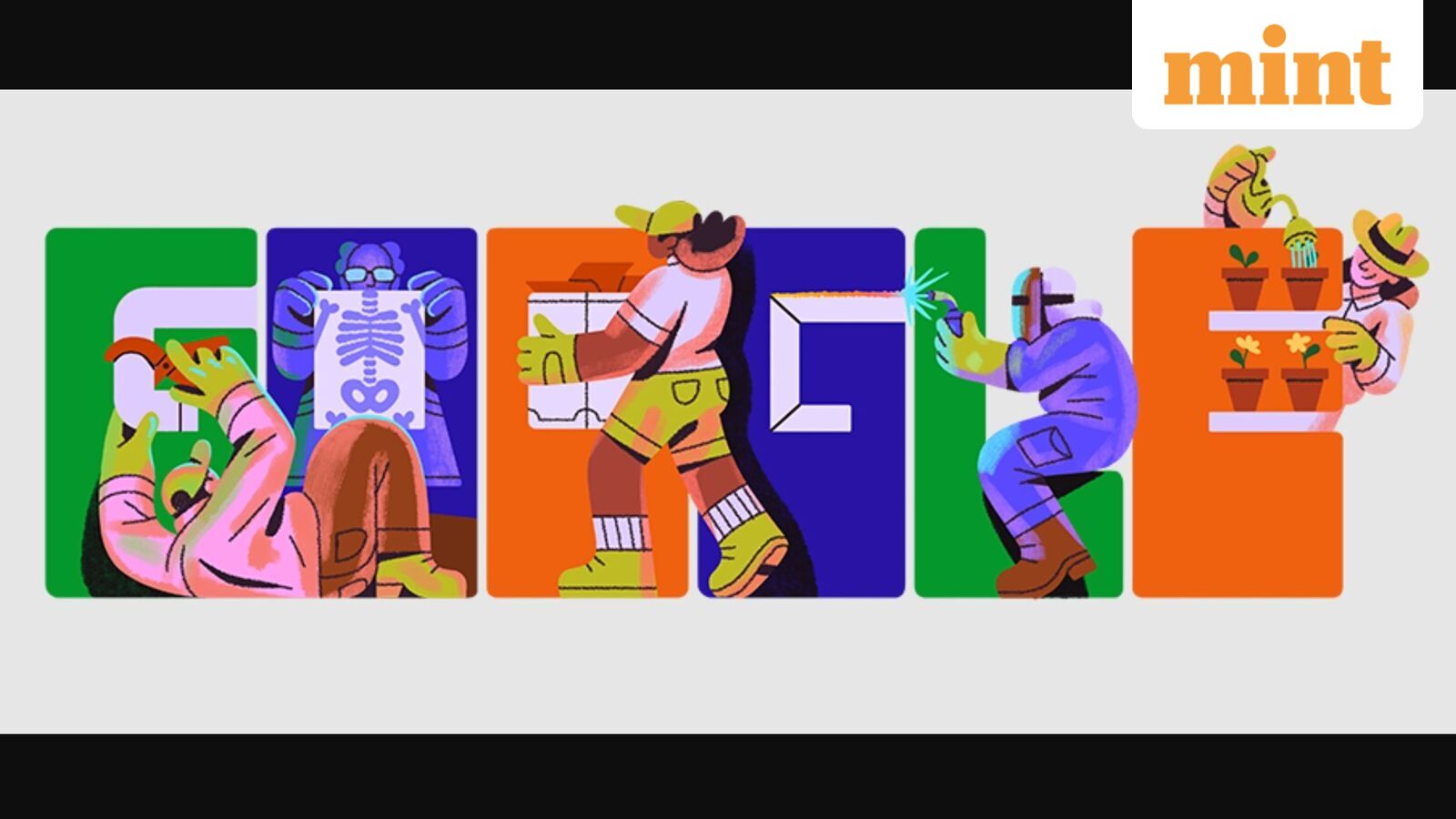
Google’s doodle for International Labour Day highlights the importance of all workers, celebrating their contributions to society. Each letter symbolizes different professions, emphasizing diversity and collective effort.

Google released a doodle on the occasion of International Labour Day which is celebrated every year on 1 March. This illustration will be visible to users across the world. This doodle emphasizes that society functions because of collective effort, every job—big or small—is important. It recognizes workers’ contribution across all sectors as the image in bright, bold colors is symbolic of energy and diversity.
The description with this doodle states, “In honor of Labour Day, this Doodle recognizes the workers and advocates who helped shape the modern workplace.”
The first letter ‘G’ shows a worker involved in maintenance work as he can be seen repairing a pipe. The second letter ‘O’ shows person holding an X-ray image, symbolizes healthcare workers and medical staff. The third letter ‘O’ depicts a delivery or logistics worker carrying a box, representing supply chain, delivery, and warehouse workers. The fourth and fifth letters ‘G’ and ‘L’ have a combined depiction of a technician fixing or installing something, symbolizing technical workers, electricians and field engineers. The last letter ‘E’ shows a person arranging plants on shelves, representing farmers, gardeners, and agricultural workers.
All you need to know about International Labour Day
Also known as May Day, International Labour Day is a celebration of labourers and the working classes. It is a day to recognize the contribution, hard work, perseverance and dedication of the working class that has shaped societies and economies across the globe.
History and significance of Labour Day
The origin of this day can be traced back to the late 19th century, to the time when the Industrial Revolution was at its peak. On 21 April 1856, Australian workers in Melbourne undertook a mass stoppage as they lobbied for eight-hour workday, according to the UN. This day commemorates eight-hour day movement, which advocated eight hours for work, eight hours for recreation and eight hours for rest. This inspired Indian workers in Chennai to celebrate first Labour Day on 1 May 1923 which was organised by the Labour Kisan Party of Hindustan.
May 1 is observed as a public holiday in several countries, including Austria, Belgium, Bulgaria, Croatia, Czech Republic, France, Germany, Greece, Italy, South Africa, Tunisia, Tanzania, Zimbabwe, Russia and China.
International Labour Organization on work environment
Advocating for a healthy psychosocial working environment, International Labour Organization states, “The psychosocial working environment is defined by how work is designed, organized and managed, and the organizational practices that shape everyday working conditions. Psychosocial factors – such as workload and working time, role clarity, autonomy, support, and fair and transparent processes – strongly influence how work is experienced and affect workers’ safety, health and performance.”
It further notes, “When psychosocial factors harm workers, they become hazards which, alongside physical, chemical and biological types, must be addressed and managed to ensure safe and healthy working environments.”
International Labour Day theme
The International Labour Day 2026 theme is “Ensuring a Healthy Psychosocial Working Environment,” which focuses on addressing modern workplace issues like burnout, stress and mental health challenges.
About the Author
Fareha Naaz
Fareha Naaz is a Delhi-based journalist and Content Producer at LiveMint, where she has built nearly three years of experience in digital journalism. She covers a diverse range of topics, including national news, education, entertainment, lifestyle trends science, global health and international news.
With a background in Economics and Education, she focuses on providing insightful, thoroughly researched coverage that bridges the gap between breaking news and in-depth analysis. In addition to breaking copies, legal and political news, her reporting blends editorial rigour with search-driven storytelling. With a keen eye-on-global events, she provides insightful coverage on latest developments. Her reporting combines editorial rigour with in-depth coverage and search-driven storytelling provide valuable insight and context to readers, ensuring accuracy and relevance.
Her newsroom experience helped her in combining her critical thinking skills with real-time editorial decision-making. Over the years, she has been presenting complex stories with clarity for a digital-first audience amid fast-paced news cycles. Her thoroughly researched stories, with well-structured and engaging content, provide readers with clear understanding of the context and background.
Fareha holds a Master’s degree in Economics, in addition to a Bachelor of Education degree.
When not in the newsroom, she enjoys painting and sports, reading books and current developments.
