



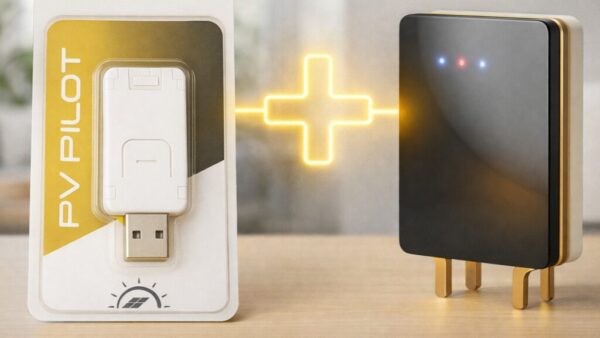
Access to France’s reduced 5.5% VAT rate for residential solar installations is conditional on the use of low-carbon panels and a home energy management system. Toulouse-based PvPilot said the fourth version of its software orchestrates household electrical devices in real time according to solar production and consumption patterns.
The system is offered under a business-to-business-to-consumer (B2B2C) model aimed at photovoltaic installers and their customers. Delivered via a USB device that connects to equipment such as set-top boxes or televisions, it operates using relay contactors installed in the electrical panel. The platform measures solar generation and electricity demand simultaneously, controlling devices including water heaters, batteries and electric vehicle charging stations.
“The great strength of our platform is that it’s compatible with all types of equipment – inverters, batteries, charging stations – from all brands, within a fully open ecosystem,” Florian Lizon, CEO of PvPilot, told pv magazine France. “Our ambition isn’t just to sell another device, but to provide a tool that evolves with the industry.”
The company said more than 500 systems are already in operation and aims to reach 3,000 homes by year-end. Users can access the platform via a mobile app to monitor and adjust consumption in real time.
Lizon cited research from National Center for Scientific Research indicating that simply visualising energy data can increase solar self-consumption by around 15%.
Installation can be configured manually or automatically by assigning a target share of solar production to each appliance. As residential storage deployment expands, the system is also designed to optimise AC-coupled batteries.
For example, if a household has a 500 W solar surplus but a pool pump requires 1,000 W, the system can first charge the battery. After storing 0.5 kWh, the pump operates using 500 W from the panels and 500 W from the battery, enabling fully solar-powered operation without drawing from the grid.
This content is protected by copyright and may not be reused. If you want to cooperate with us and would like to reuse some of our content, please contact: editors@pv-magazine.com.