

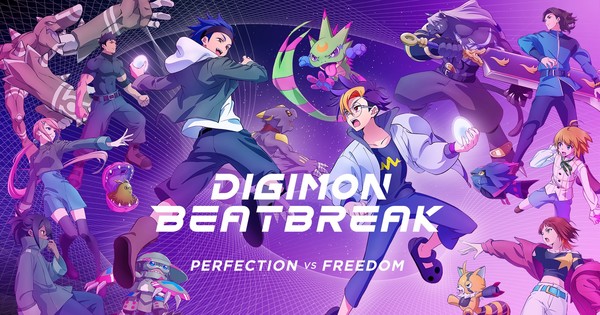
With its first dozen episodes, DIGIMON BEATBREAK successfully proved to not only be a solid modernization of the Digimon franchise, but also one capable of capitalizing on the ideas inherent to cyberpunk fiction. Good as they were, their scope was limited to largely episodic stories, and even by the time we got to the end of the first arc, it still felt like the central plot of the show had only barely gotten started. This stretch of the series sees Beatbreak making its first big dip into a longer story arc, and while it isn’t without its missteps, it does enough to build on the show’s themes to make for one of the strongest showings the anime side of the Digimon franchise has ever seen.
Beatbreak‘s second arc sees the Glowing Dawn facing off against Tactics: a group of Cleaners that functions like a paramilitary organization, with the members of its seventh squad to be considered its most talented soldiers. At first glance, they seem to be an odd fit with the show’s futuristic aesthetic, but good cyberpunk is all about critiquing systems of control, and we get a lot of that in how Tactics operates. Whereas the Glowing Dawn value living by their own rules and see each other as family, the members of Tactics Team Seven value themselves on discipline and efficiency, with any instances of breaking rank or acting against orders being met with physical punishment. This ideology also makes it easier for them to operate more ruthlessly, whether it be in seeing kids as collateral damage towards completing one of their operations, assisting in human trafficking, or even trying to kill deserters, making them a pretty easy set of antagonists to root against.
At the same time, the show takes care to explore how each of the Tactics members suffers within this environment, and uses them as solid foils to our protagonists to dig deeper into its social commentary. One of the most interesting examples of this in practice is with a young woman named Hotaruko, who joined Tactics to lift her family out of poverty, a decision that has left her increasingly trapped in a job that often forces her to compromise her morals to avoid putting any financial strain on her family. While that makes her initially resentful of someone born into privilege like Makoto, and his willingness to lean on others, as the two start to interact more, his desire to share in other people’s burdens is what ultimately helps her become more compassionate.
Tomoro, on the other hand, is paired off against a cocky boy named Raito who prides himself on his ability to avoid being too emotional and follow any orders he’s given to the letter, which stands in stark contrast to how Tomoro lives as he pleases while wearing his heart on his sleeve. While these traits make Raito come off as one of his team’s coldest members, we also see how he’s been shaped by his environment. Where Kyo and the rest of the Glowing Dawn helped to provide Tomoro with a support structure he needed to start thinking for himself, Raito’s superior, Naito, frequently abuses him whenever he fails on the job. As such, the more he clashes with Tomoro, the more we can see how much he actually envies Tomoro’s sense of freedom and how that gradually influences him to start acting more freely himself. This sharp commentary even extends to the arc’s main villain Klay Arslan, a member of the Five Stars who presents himself as a suave capitalist, and is one whose desire for wealth comes from being an ex-royal whose nation was stripped of its resources, leaving him with a burning desire to take power from others the same way everything he had was taken from him. It demonstrates how easily societal forces can shape people. While Beatbreak‘s early episodes had already shown it to be perfectly capable of operating as a good piece of cyberpunk media, the extent to which this arc successfully tackles all of the themes attached to that manages to elevate it into a great one.
Excellent as all these episodes are, they aren’t without a few caveats. While they generally do a good job of drawing parallels between the members of Tactics and the Glowing to improve our understanding of the characters on both sides, this doesn’t quite extend to Reina, getting paired off against a young boy named Granit. In contrast to how Reina was abandoned by her family before finding a new one in Kyo, Granit had his family ripped away from him when the refugee camp he lived in was bombed in a military conflict, with this loss leaving him feeling as though he had nothing to live for. While the show handles Granit’s character fairly well, Reina’s role in helping him to break out of his suicidal mindset doesn’t really do much to advance her own, and even by the time we reach the halfway mark for this show’s run, she feels like the member of the Glowing Dawn who’s gotten the least development. Additionally, given the darker topics that a lot of these episodes end up juggling, it is a little jarring when in-between all of them, we get one involving the Cleaner gang of mushroom themed goofballs trying to plot revenge on the Glowing Dawn, While this episode is decently entertaining for what it is, and eventually gives these characters an actual reason to stick around, it feels a little out of place in this stretch of the show and is easily the weakest of the batch. Lastly, while the show is still highly consistent on the animation front for a Digimon title, it is a bit disappointing that after waiting a dozen episodes before Beatbreak started featuring any insert battle songs, it goes right back to omitting them until the final episode of this cour, which combined with how repetitive some of the show’s regular battle tracks are, leaves Beatbreak‘s musical score feeling a bit unmemorable compared to some of the other Digimon entries.
Aside from those quibbles, DIGIMON BEATBREAK is continuing to fire on all cylinders. While a lot of the subject matter here is heavy for a kids’ show, and is heavy even by the standards of other Digimon titles, it’s managed to explore all these topics gracefully, while still presenting them in a way that still feels comprehensible to younger audiences. This show is continuing to be the most ambitious anime offering the Digimon franchise has had in a long time, and if the second half of the series can maintain this level of momentum, it could easily end up being one of its strongest.
