
- The Canadian Dollar fell even further against the Greenback on Friday.
- Trump has pivoted back to tariff threats on Canada as trade deals remain limited.
- The tariff deadline of August 1 is fast-approaching, and Canada has shown little movement thus far.
The Canadian Dollar (CAD) took another hit on Friday, extending into a two-day backslide against the US Dollar (USD) as Loonie traders hunker down for a fresh bout of tariff-fueled tirades from United States (US) President Donald Trump. The Trump administration’s self-imposed deadline of August 1 for steep “reciprocal” tariffs, which have been announced, delayed, and then delayed again, is approaching quickly. However, the Trump team has had significant difficulty securing meaningful trade deals so far.
US Durable Goods Orders fell slightly less than expected in June, providing a questionable amount of support for the Greenback. Rumors are swirling that some sort of headway will be made on trade between the US and the European Union (EU) over the weekend, but nothing is set in stone.
Daily digest market movers: Trade talk returns to the top of the Canadian Dollar pile
- A sharp, two-day reversal in Loonie bidding has pushed the US Dollar even higher against the Canadian Dollar.
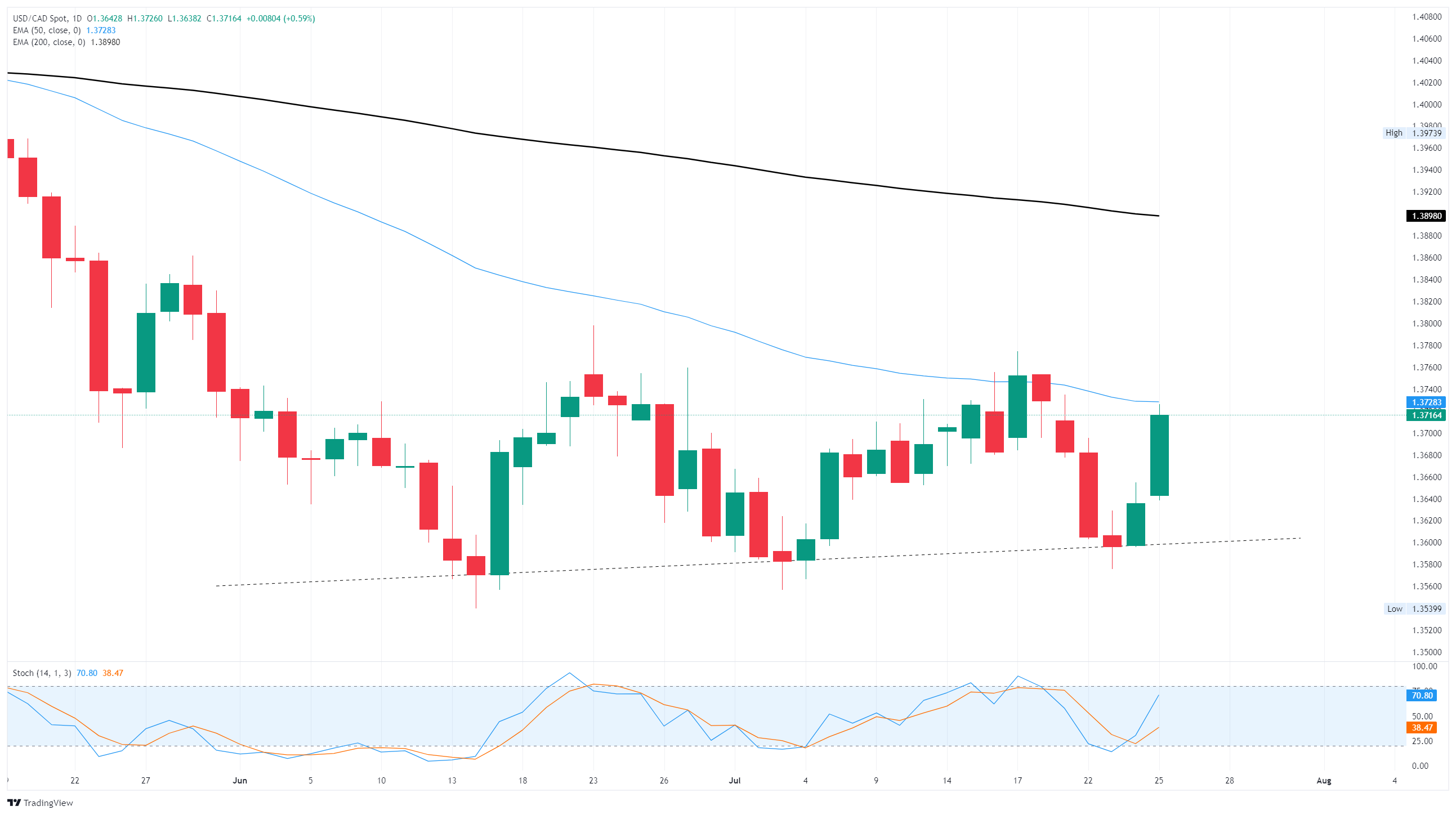
- Despite a firm bullish pivot near-term, USD/CAD is still trading within a stubborn congestion zone, and price action is knocking on key technical resistance levels.
- Trump mused about his lack of luck in trade talks with Canada, citing a lack of “negotiation” from Canadian Prime Minister Mark Carney’s government.
- The terms of trade between the US and Canada remain largely governed and unchanged from the USMCA trade deal that Trump himself renegotiated out of the long-standing NAFTA agreements during his first term.
- US Durable Goods Orders fell slightly less than expected, and markets are eating the -9.3% contraction with grace, brushing off the sharpest month-to-month decline in Durable Goods Orders since the COVID pandemic.


Canadian Dollar price forecast
Despite a firm bullish tilt in the USD/CAD pair, the Canadian Dollar is still holding strong against the US Dollar overall. USD/CAD has risen sharply in a two-day turnaround, rising back above 1.3700 for the first time in nearly a week, but the 50-day Exponential Moving Average (EMA) has priced in a firm technical ceiling near 1.3730.
USD/CAD daily chart

Canadian Dollar FAQs
The key factors driving the Canadian Dollar (CAD) are the level of interest rates set by the Bank of Canada (BoC), the price of Oil, Canada’s largest export, the health of its economy, inflation and the Trade Balance, which is the difference between the value of Canada’s exports versus its imports. Other factors include market sentiment – whether investors are taking on more risky assets (risk-on) or seeking safe-havens (risk-off) – with risk-on being CAD-positive. As its largest trading partner, the health of the US economy is also a key factor influencing the Canadian Dollar.
The Bank of Canada (BoC) has a significant influence on the Canadian Dollar by setting the level of interest rates that banks can lend to one another. This influences the level of interest rates for everyone. The main goal of the BoC is to maintain inflation at 1-3% by adjusting interest rates up or down. Relatively higher interest rates tend to be positive for the CAD. The Bank of Canada can also use quantitative easing and tightening to influence credit conditions, with the former CAD-negative and the latter CAD-positive.
The price of Oil is a key factor impacting the value of the Canadian Dollar. Petroleum is Canada’s biggest export, so Oil price tends to have an immediate impact on the CAD value. Generally, if Oil price rises CAD also goes up, as aggregate demand for the currency increases. The opposite is the case if the price of Oil falls. Higher Oil prices also tend to result in a greater likelihood of a positive Trade Balance, which is also supportive of the CAD.
While inflation had always traditionally been thought of as a negative factor for a currency since it lowers the value of money, the opposite has actually been the case in modern times with the relaxation of cross-border capital controls. Higher inflation tends to lead central banks to put up interest rates which attracts more capital inflows from global investors seeking a lucrative place to keep their money. This increases demand for the local currency, which in Canada’s case is the Canadian Dollar.
Macroeconomic data releases gauge the health of the economy and can have an impact on the Canadian Dollar. Indicators such as GDP, Manufacturing and Services PMIs, employment, and consumer sentiment surveys can all influence the direction of the CAD. A strong economy is good for the Canadian Dollar. Not only does it attract more foreign investment but it may encourage the Bank of Canada to put up interest rates, leading to a stronger currency. If economic data is weak, however, the CAD is likely to fall.
Information on these pages contains forward-looking statements that involve risks and uncertainties. Markets and instruments profiled on this page are for informational purposes only and should not in any way come across as a recommendation to buy or sell in these assets. You should do your own thorough research before making any investment decisions. FXStreet does not in any way guarantee that this information is free from mistakes, errors, or material misstatements. It also does not guarantee that this information is of a timely nature. Investing in Open Markets involves a great deal of risk, including the loss of all or a portion of your investment, as well as emotional distress. All risks, losses and costs associated with investing, including total loss of principal, are your responsibility. The views and opinions expressed in this article are those of the authors and do not necessarily reflect the official policy or position of FXStreet nor its advertisers. The author will not be held responsible for information that is found at the end of links posted on this page.
If not otherwise explicitly mentioned in the body of the article, at the time of writing, the author has no position in any stock mentioned in this article and no business relationship with any company mentioned. The author has not received compensation for writing this article, other than from FXStreet.
FXStreet and the author do not provide personalized recommendations. The author makes no representations as to the accuracy, completeness, or suitability of this information. FXStreet and the author will not be liable for any errors, omissions or any losses, injuries or damages arising from this information and its display or use. Errors and omissions excepted.
The author and FXStreet are not registered investment advisors and nothing in this article is intended to be investment advice.
Editors’ Picks


AUD/USD gathers strength to above as traders await US-China trade talks
The AUD/USD pair edges higher to near 0.6570 during the early Asian session on Monday. Optimism surrounding the US-China trade deal provides some support to the Australian Dollar against the US Dollar. US Treasury Secretary Scott Bessent and Chinese Vice Premier He Lifeng are scheduled to meet on Monday in Stockholm.


EUR/USD: Powell to defy Trump as trade deals deadline looms
The EUR/USD pair resumed its bullish trend and settled at around 1.1730, extending its recovery from the monthly low set at 1.1555 on July 17. The pair peaked at 1.1789 amid mounting pressure on Federal Reserve Chair Jerome Powell to resign and progress in trade negotiations.

Gold: Bullish breakout fails as risk mood improves
Gold failed to stabilize above $3,400 after bullish breakout. The technical outlook highlights bulls’ hesitancy in the near term. The Fed’s policy announcements, US-China trade talks could trigger the next big action in Gold.

Is the Fed behind the curve?
Fed is under increasing scrutiny about its decision to delay rate cuts. Ongoing tariff uncertainty and resilient economy support Fed’s case for pause. But Fed may have left it too late amid some cracks in labour market.

Best Brokers for EUR/USD Trading
SPONSORED Discover the top brokers for trading EUR/USD in 2025. Our list features brokers with competitive spreads, fast execution, and powerful platforms. Whether you’re a beginner or an expert, find the right partner to navigate the dynamic Forex market.