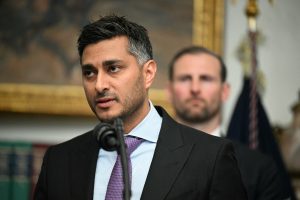





CEO Tarek Mansour said he feels “pretty good” about the pending outcome of the current legal fight over who has the right to regulate prediction markets.


- The CEO of prediction markets firm Kalshi, Tarek Mansour, said that if the U.S. court side with states who claim gambling authorities over such businesses, they’ll be forced offshore.
- Though a couple of federal courts have issued decisions against his view, Mansour suggested he feels “pretty good” about his company’s legal standing in the U.S.
ARLINGTON, Va. — The CEO of Kalshi, the company at the center of a high-profile legal battle over the future of prediction markets in the U.S., said the clash won’t ultimately decide whether the rapidly growing industry is overseen by states or a federal agency, but whether it’s overseen by the feds here or is forced overseas.
“We feel pretty good about where we stand overall,” Kalshi CEO Tarek Mansour said Wednesday at the DC Fintech Week event near Washington.
Mansour rejected arguments that sports betting — the explosively growing element of the event-contracts space — doesn’t have significant economic consequences that justify the trades’ status as federally regulated financial contracts.
“The notion that sports does not have economic consequence is ludicrous,” he said.
A growing list of states have challenged Kalshi and other prediction markets firms in court, accusing them of engaging in illegal sports wagering that belongs under the authority of state gambling regulators. But Kalshi and the federal regulator of its exchange, the Commodity Futures Trading Commission, have countered in courts that the federal agency is the appropriate sole watchdog of prediction markets.
So far, the dispute has risen to a number of federal appellate courts, where the courts have now split, with one major ruling on Kalshi’s side and two backing the states’ view. As a result, New Jersey asked the U.S. Supreme Court to take the case, and prominent groups have been sharing their views with the high court, including the National Football League.
Mansour said, “It’s not a choice of state versus federal market. It’s a choice of whether prediction markets exist in the U.S. or whether they go offshore.”
He argued that he’s considered Kalshi’s regulatory relationship since its beginnings, and “it really elegantly fit under definitions of commodity.” He said the Commodity Exchange Act was a “truly beautiful statue” that allowed a shift from agricultural futures to oil and metals to less tangible financial products like swaps.
Mansour also responded Wednesday to accusations of inflated trading volume in bitcoin and ether perpetual-futures markets on his platform. He said that “there’s a lot of crazy” on social media site X, formerly Twitter. The questions focused on often-recurring trade sizes that represented a significant portion of Kalshi’s volume. Mansour pointed again at the Washington event to fixed-size orders from market makers.