

It’s decidedly strange to spend all day sitting in a dark room, eating popcorn, when it feels like the rest of the country is on fire. While waiting in line to see The Gallerist at the Sundance Film Festival on Sunday, I got to chatting with the woman standing in front of me, an attorney who was wearing two Minnesota state flag pins—one on her shirt and one on her coat. She was from Minneapolis and had been uneasily tracking the news out of the city while attending panels and screenings in picturesque Park City.
“The shooting yesterday happened a block and a half away from my mom’s house,” the lawyer said, referring to federal agents’ killing of Alex Pretti, an ICU nurse. She told me about her grandmother, who was active in the civil rights movement decades ago and has been sitting on her front porch in subzero temperatures holding a whistle, which she blows to warn neighbors when ICE agents approach. The nonagenarian can’t walk anymore, said her granddaughter, but she still feels an urge to help.
And here we were, watching movies. The attorney, who requested I not use her name since she hadn’t asked her grandmother’s permission to share her story, shrugged. Even if she weren’t at Sundance, she said, watching a bunch of movies would “probably be my trauma response anyway.”
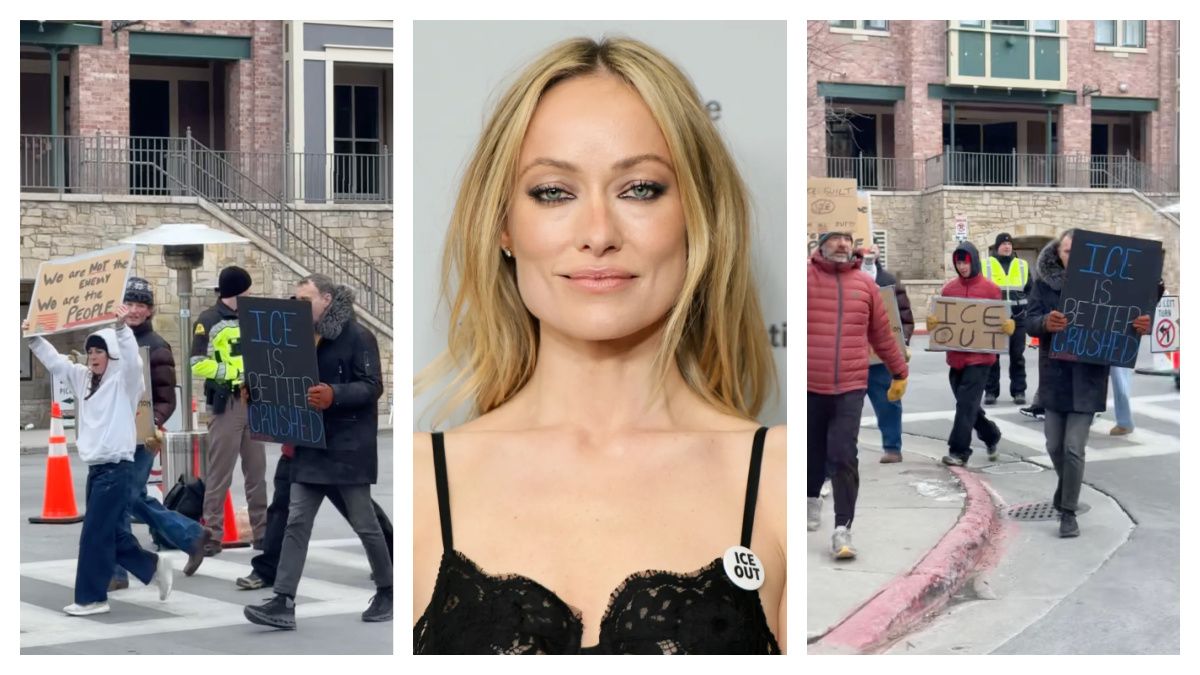
That was the prevailing mood at Sundance this weekend: celebration tinged with discomfort, revelry shaded with despair. Festivalgoers watched cell phone and social media videos of Pretti getting shot until the lights in their theater dimmed, signaling that they had to put their phones away. Stars, including Natalie Portman and Olivia Wilde, wore “ICE Out” pins to premieres and parties, taking momentary breaks from promoting their movies to speak out against the violence. Donald and Melania Trump drew criticism for not canceling a private screening of Brett Ratner’s documentary, Melania, on Saturday night; Sundance, too, didn’t stop because of what was happening in Minnesota.
Edward Norton, star of Wilde’s new comedy, The Invite, pinpointed the cognitive dissonance in an interview with The Hollywood Reporter: “We are sitting here talking about movies while an illegal army is being mounted against US citizens.” Ryan Coogler expressed a similar sentiment at an event Saturday, noting how odd it felt to go deep on his newly Oscar-nominated film, Sinners, as unrest roiled the Midwest. “This is crazy, with all the horrific shit that’s happening in Minneapolis,” he told the audience.
Sundance has never been an apolitical festival. Though the program this year does include a surprising number of raunchy sex comedies, the Sundance lineup often skews toward works of conscience—particularly its documentary slate, which this year includes a blistering look inside a Gaza hospital (American Doctor); a portrait of lawyer Jennifer Robinson, who fights defamation laws designed to muzzle survivors of sexual assault (Silenced); and a close examination of three Black Baltimore teens who spent 36 years wrongly incarcerated (When a Witness Recants, directed by Dawn Porter and executive-produced by Vanity Fair senior staff writer Ta-Nehisi Coates and his wife, Kenyatta Matthews, among others).
Still, it can be difficult to reconcile attending Sundance with the knowledge of what’s happening several states away. “I couldn’t sleep last night because I read the news before I went to bed,” a woman named Elizabeth Gifford told me in a different line for a different movie: Alex Gibney’s Knife: The Attempted Murder of Salman Rushdie.
Gifford doesn’t work in the film industry, but was attending the festival with a group of friends who do. “I’m actually trying to shield them” from the news, Gifford said. “These are all people who are very politically active, and their films are politically active. They’re documentarians. They have got to try to focus for this period of five days. I don’t have that obligation, so I am reading the news, which is why I’m crying in line.”
Even those who tried to ignore the news this weekend might have found the task impossible. Reality rudely intruded on a private party thrown by talent agency CAA Friday night, where Democratic Florida congressman Maxwell Frost was allegedly punched by a man who crashed the event. Police say that 28-year-old Christian Joel Young allegedly told Frost, “We are going to deport you and your kind,” before yelling a racial slur and striking the representative. (Young, who has been denied bail, faces charges of aggravated burglary, assault, and assaulting an elected official.)
On Sunday afternoon, Vanity Fair even stumbled across a very small protest—about seven people marching down Main Street, anti-ICE signs in hand. None of the participants appeared to be directly affiliated with Sundance, but their message seemed geared toward those at the festival. “You have a voice!” one cried. “Use it!” That evening, even more people gathered on Main Street, holding their phone flashlights aloft in a show of solidarity against ICE.
In yet another line on Sunday, Park City local Michele Glicken told me that she usually experiences Sundance as something of a bubble. “I spend so much attention on the movies and the logistics,” she said, “that it’s almost like I put my mind on hold.” Still, she and her friends didn’t seem to be bothered when a pushy journalist punctured that bubble. A film festival is not the real world—but manufactured as the experience might be, it’s a communal one nevertheless. Processing difficult moments is always harder in isolation. So is survival.
Perhaps nobody understands that last point better than Rushdie. The writer received a sustained ovation when he appeared onstage at The Ray Theatre with his wife, poet-novelist Rachel Eliza Griffiths, and Gibney following the premiere of their documentary, which follows Rushdie through the aftermath of the 2022 knife attack that almost killed him.
Though the subject matter is heavy, the movie is leavened by Rushdie’s wry sense of humor. He cracked several jokes during the post-screening Q&A as well, including when Gibney steered the conversation toward the present moment. The movie, Gibney said alongside Rushdie, Griffiths, and Sundance director Eugene Hernandez, feels especially resonant right now, as it’s about “how violence unleashed by an irresponsible political leader could spread out of control.”
“I don’t know who you’re talking about,” Rushdie said dryly, earning a big laugh.
Then he got serious. At this moment, said Rushdie, “maybe all of us now are feeling the risk of violence. All of us are feeling that danger is just around the corner.” And not just physical danger: “I really believe that for the authoritarian, culture is the enemy,” he said.
Gibney spoke up, noting that he felt anxious about asking Rushdie to relive this painful experience both onscreen and again onstage. “And yet somehow,” the director said, “the film helps us kind of work through it, to a certain extent, even though it doesn’t relieve the pressure or the stress. But it helps us think about it maybe a little differently.”
“Well, this is what art is for,” Rushdie replied. “It’s to help us think, and to help us understand, and to help us feel.”