

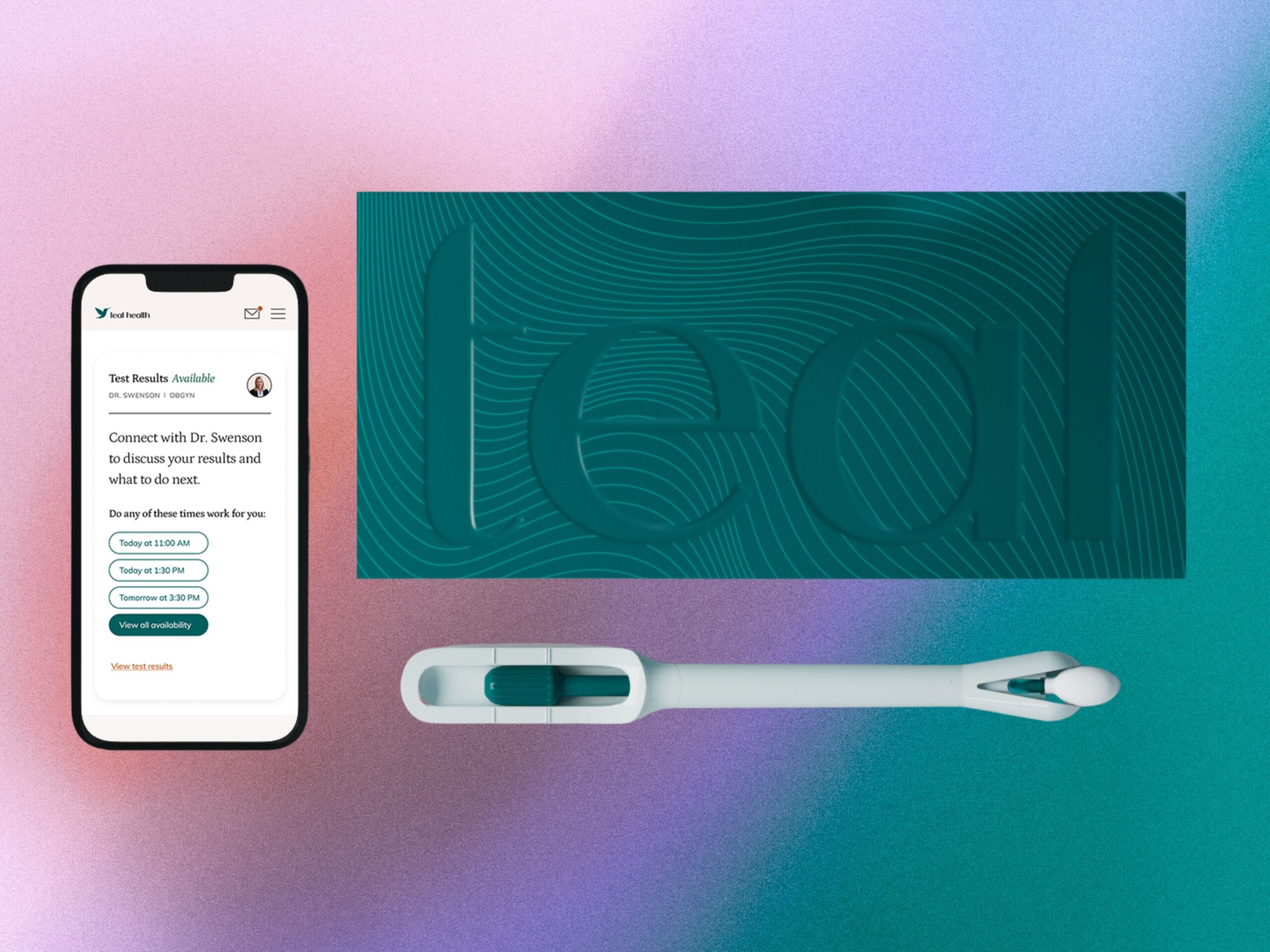
Plenty about a Pap smear—the airborne straddle, the clunky metal speculum—can make it, at best, awkward, and at worst, painful or traumatizing. And thanks to a new type of cervical cancer screening created by Teal Health, it will soon be a thing of the past for some women. Approved by the FDA in May 2025 and launched in select states last fall, the company’s at-home test is now available nationwide. It involves using a tampon-like device to gently swab the wall of your vagina and mailing that sample to a lab, which checks it for human papillomavirus (HPV), the primary culprit behind cervical cancer.
Teal’s device is the natural next step on a path of innovations in cervical cancer screening. While the Pap was invented in the 1940s and involves inspecting cervical cells for precancerous or cancerous shifts, in the early 2000s doctors realized they could also scan those samples for strains of HPV itself. In 2014, the FDA approved the first primary HPV test—for use in place of a Pap in some people—but the cells still had to get plucked from your cervix by a doctor via a pelvic exam, so the experience stayed the same.
However, recent game-changing research determined that cells swiped from the vagina (instead of way up in the cervix) work just fine for an HPV test. That made it possible for women to swab their own samples, which led to the FDA approval in 2024 of two self-collect HPV tests—but women were still required to do them in a health care setting, like a doctor’s office. Now, Teal is the first to adapt that tech for easy at-home usage. And in the past two months, both the American Cancer Society (ACS) and the Health Resources and Services Administration (HRSA) have changed their guidelines for cervical cancer screening to recommend FDA-approved self-collect HPV tests, the latter of which will require most insurers to fully cover Teal Health by January 1, 2027.
Teal’s launch is poised to solve a few pain points, some literal with the current testing paradigm that has led nearly 30% of folks to fall behind on regular screenings. Yes, there’s the dreaded speculum and all the fear, discomfort, and shame it can bring, but there’s also the difficulty of securing and attending appointments amid a provider shortage, Kara Egan, cofounder and CEO of Teal Health, points out. All of these challenges disproportionately affect Black and Hispanic folks and those of low socioeconomic status, which experts say contributes to thousands of preventable deaths from cervical cancer every year in the US.
Can the Teal Health at-home cervical cancer screening replace a Pap smear for everyone?
Technically, Teal’s device replaces an in-office HPV test—but that’s probably what you think of as a Pap. As noted above, an HPV test looks for the specific virus, while a Pap detects wonky cell changes; guidelines have shifted in recent years to recommend the HPV test over the Pap for most women (since it’s been shown more effective), but because both have historically been done with a pelvic exam, that change hasn’t meant much in practice…yet.
With an option like Teal on the table, however, anyone who’s recommended to get an HPV test could trade the in-office speculum ordeal for the at-home device. According to ACS, that includes average-risk women between the ages of 25 and 65, who it suggests should test for HPV every three years with self-collection or every five years with an in-office test; HRSA recommends either type of HPV test every five years, but for an age range of 30 to 65.
Teal used the ACS guidelines in its testing, so people ages 25 to 65 are eligible for it. What does that mean if you’re in your early 20s? ACS actually suggests no testing under age 25; people in this demo commonly get HPV and clear the infection on their own, so the risk of developing cervical cancer at this age is low, and detecting the virus wouldn’t offer much actionable intel. Meaning, your doctor might not suggest any screening until age 25. HRSA, however, recommends women ages 21 to 29 get a Pap smear every three years to look for evidence of cell changes (which might be a better indicator of precancer or cancer than merely having the virus at this age). So there’s a chance your doctor may still suggest you get a routine Pap starting at 21; and then at 25, you could switch to the Teal test, so it’s something to discuss with your provider if you’re interested.
Folks who are at higher-than-average risk for cervical cancer—for instance, those who are immunocompromised or have a history of treatment for precancerous spots—also shouldn’t bypass a Pap or in-office HPV test for Teal. (And people in this camp also generally need to screen more often than the suggestions above indicate.) You can think of Teal as comparable to Cologuard, an at-home screening test for colon cancer, Egan says: “Anyone who falls in the typical or average testing flow can use it.”
But just because you might be able to handle cervical cancer screening from home doesn’t mean you should fully stop seeing your ob-gyn—after all, the Pap smear or HPV test is just one part of gynecological care. A pelvic exam (involving, yes, a visual look at your cervix by way of a speculum, as well as pressing on your pelvis externally) can also help detect vaginal, vulvar, uterine, ovarian, and fallopian tube cancers, Christie Cobb, MD, a board-certified ob-gyn in Little Rock, Arkansas, who is not affiliated with Teal Health, points out. So while Teal’s test may replace your in-office cervical cancer screening, it’s not a one-for-one substitute for preventive care visits, she says.
How does the Teal Health at-home cervical cancer screening work?
Getting screened with Teal involves using a self-collection device and connecting with either a nurse practitioner or ob-gyn via the brand’s telehealth platform. You’ll head to the Teal site, request to get started, and then will get synced with a provider who will prescribe the wand (if you’re eligible), explain how it works, and order the lab test, Egan explains.
The device itself works a lot like a tampon applicator: You insert it into your vagina, push the back portion forward to extend a soft sponge, and turn the base to rotate the sponge 10 times to collect your sample. Then, you remove the device and send the sponge in an included mailer to a lab. There, it’ll be tested for 14 different strains of HPV that are most often associated with cancer, just like how a sample collected by your doctor would be.
If your Teal test comes back positive for HPV, that doesn’t mean you have cancer. Just like a positive result on a typical in-office HPV test or an abnormal Pap, it means you may be at greater risk and need in-person follow-up care (like additional testing and potentially a procedure to remove funky cells). Once your results come back, you’ll have a telehealth visit with a Teal provider, during which they will explain what they mean and either refer you back to your ob-gyn or to one based on your location, insurance, and doctor availability. This part is key, given that an estimated one in eight cases of cervical cancer springs from lack of follow-up care after an abnormal screening. Meanwhile, seeking that care gives you very good odds of avoiding cancer outright or effectively treating it.
How much does Teal cost?
The current price for both the wand and the telehealth consults is $99 with insurance—the company is in-network with Cigna, Aetna, Anthem Blue Cross, Blue Shield of California, and United Healthcare. But again, the recent addition of self-collect HPV tests to the HRSA guidelines will require most insurers to completely cover Teal starting next year. (The new recommendations also go a step further, mandating that any additional testing required after an HPV test, like a colposcopy or biopsy, also be fully covered.) “This change removes a major obstacle,” Egan says, “and brings us closer to a future where cervical cancer is preventable for everyone,” not just those who can easily access and afford care.
Without insurance, the price for Teal is $249 (and it’s FSA- and HSA-eligible). The company also plans to offer financial assistance to uninsured women in the future via grant programs like the National Breast and Cervical Cancer Early Detection Program.
Whether it’s by making the process more seamless, comfortable, or convenient, Egan hopes Teal can close the screening gap for cervical cancer—a measure that, alongside HPV vaccination, could fully eliminate cervical cancer as a public health threat within our lifetimes.
Related:
- I Was Told I Had an STI. It Was Actually Cervical Cancer
- Breast Cancer Is Rising in Young Women—Here Are 5 Signs You May Need a Mammogram Before 40
- My Mother Died of Cervical Cancer. Now I’m an HPV Vaccine Advocate.
Get more of SELF’s great service journalism delivered right to your inbox.
