



Loneliness can feel heavy, but even small acts of care can cut through it. These 12 moments show how wisdom, kindness, compassion, empathy, support, care, and human connection helped people overcome isolation and rediscover happiness in unexpected ways.
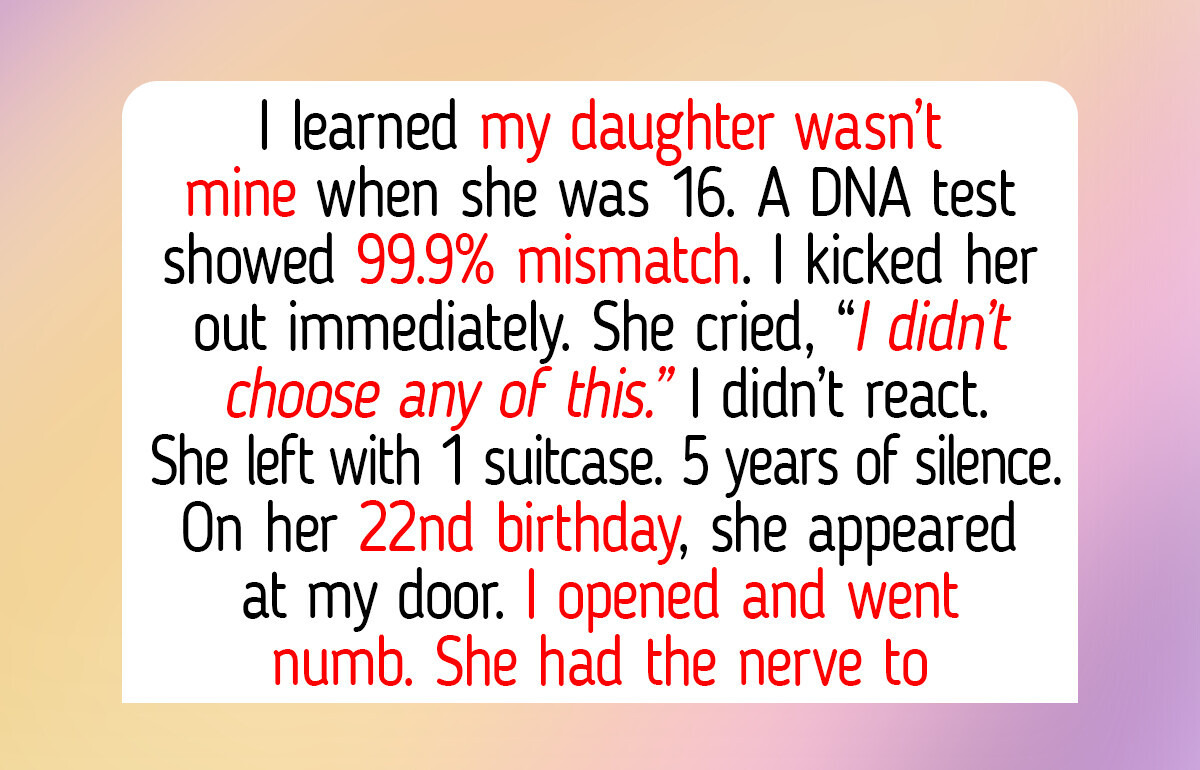
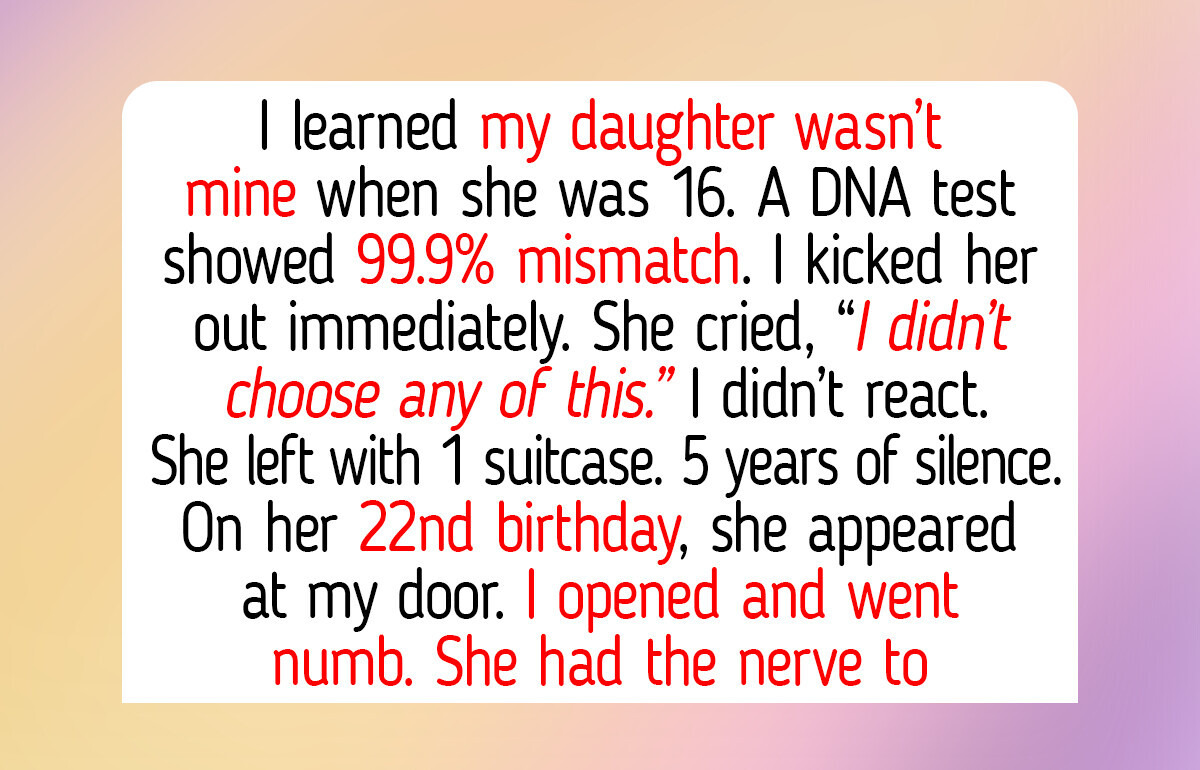
- I found out my daughter Sally wasn’t mine when she was 16. A DNA test, 99.9% mismatch. Her mother had passed years before — no one left to explain anything. I kicked my daughter out. She cried, “I didn’t choose this.” I didn’t care. She left with one suitcase. Five years of silence. On her 22nd birthday, she showed up at my door. I yelled, “Go away!” She slowly rolled up her sleeve. And I screamed. On her wrist was a birthmark — the same one I have on my shoulder, shaped like a little bug, the one people always mistake for a tattoo. I checked. It was real. It hadn’t been there before.
She explained through tears: her boyfriend had given her a bracelet that morning, and as she put it on, she saw the mark for the first time. She left her own birthday party mid-celebration and ran straight to me — convinced this was proof, that the test had been wrong. We redid it. It wasn’t wrong. She still wasn’t my biological child. But I kept seeing her face from that doorway — the hope in her eyes, after everything I’d done to her. No grudges. No blame. Just a kid, twenty-two years old, who’d run through the streets on her birthday because some part of her still needed me to be her father.
And I understood, finally, that she loved me. Despite all of it. She was ready to stay — to be there for me as I grew old, as my daughter, no matter what any test said. Nothing else mattered after that. I held her, and she cried on my shoulder the way she did when she was small. We reunited that night. I still call her “daughter” — because that’s what she is, and what she always was. Some bonds were never written in DNA. They were written in everything else.



Finally, finally you got the word “love” correct! Do you stop loving adopted children? Do you stop loving foster children? NO! You love and raise ALL children


- My father and I hadn’t spoken in three years. Old argument, the kind that calcifies because neither person wants to be the one who calls first. He had an attack. My sister called me from the hospital. I drove through the night. When I got there, a nurse pulled me aside before I went in. She said, “He’s stable. He’s going to be okay. But I want you to know — he’s been asking for you since he woke up. Before he asked about anything else. Before he asked about his job, his house, anything. He asked if you were coming.” I stood in that hallway and she just let me stand there. She didn’t rush me in. She said, “Take whatever time you need. He’s not going anywhere. I’ll let you know if anything changes.”
She gave me five minutes to be a person who hadn’t spoken to his father in three years before she let me become a son again. I went in. He looked smaller than I remembered. He said my name like it was the only word he had left.
We’ve talked every week since. The argument doesn’t even feel real anymore — like something that happened to two other people. That nurse will never know what those five minutes in the hallway gave me. I needed them more than I knew.
- I was seventeen and expecting and terrified and sitting in a clinic waiting room not knowing what I was going to do. The woman next to me was maybe sixty. She had a knitting project on her lap. She didn’t look at me with anything — not judgment, not pity, not knowing. After a while she said, “Do you want to learn a stitch? It helps with waiting.” I said I didn’t know how to knit. She said that was fine, it was a good time to start. She taught me one stitch for twenty minutes. Just one stitch, over and over, until I had something small and imperfect and mine.
She was called in before me. She tucked her knitting into her bag, pressed the needles and a small ball of yarn into my hands, and said, “Keep practicing. You’ll figure out the rest.” I’ve thought for years about whether she meant the knitting. I don’t think she only meant the knitting. I kept the needles. I have a daughter who is eleven now. I taught her that same stitch last winter, sitting at the kitchen table, the way you pass things forward without always knowing the whole story of where they came from.
- After my wife left I couldn’t sleep. For months I’d lie awake at 3am with a brain that wouldn’t stop processing. I started going to a 24-hour diner nearby because silence in a house you used to share is a different kind of noise. The night cook — a man about my age — worked alone in the back and we’d exchange a few words through the pass-through when I ordered. One night, maybe three months in, he came out with a cup of coffee and sat across from me. On his break. He said, “You come in every night. You want to talk or you want company that doesn’t talk?” I said company that doesn’t talk. He nodded and sat there for fifteen minutes and then went back to the kitchen. He did that most nights after that. Sometimes we talked. Mostly we didn’t. He’d come out on his break, sit, drink his own coffee, go back.
By summer I was sleeping again. I stopped coming in as often. The last time I went I told him I thought I was okay now. He said, “I know. You’ve looked better for a while.” He’d noticed before I had. That’s the thing about someone who sits with you quietly — they see you more clearly than you see yourself, because they’re not inside it. They’re just there, steady, watching you come back.
- I was 19, first year of college, first time living away from home, first time understanding that homesickness is a physical condition. It lives in your chest. It changes the taste of food. I called my grandmother every Sunday. She was 78, barely left the house, talked on the phone like it was still a formal occasion. One Sunday she didn’t answer. I tried again. Nothing. I spent the afternoon in a low-grade panic I pretended was fine. She called me back at 9pm. She said she’d been at the neighbor’s. Then she said: “I’m going to call you every Wednesday from now on. So you have something in the middle of the week.”
She was seventy-eight years old and she restructured her week around the loneliest part of mine. She called every Wednesday for four years until she passed. Always at 7pm. Always starting with “It’s Wednesday” as if I might have forgotten, as if she was marking something on a calendar we shared. I still feel Wednesday evenings differently. There’s still a particular quality to 7pm on a Wednesday that belongs to her. She put herself there and I can’t take her out, and I don’t want to.


- I grew up very poor. Not the romantic kind of poor that gets described beautifully in memoirs. The kind with cold rooms and skipped meals and the specific shame of clothes that aren’t quite right. When I was ten a teacher noticed my coat wasn’t warm enough for the winter. She didn’t pull me aside. She didn’t make an announcement. She started keeping the classroom two degrees warmer than usual. I know this because she told me, thirty years later, at a school reunion. I had no idea.
She said, “I couldn’t fix everything. But I could fix the temperature.” I stood there trying to figure out how many mornings over that winter I had walked into her classroom and felt the warmth and thought nothing of it. She’d just done it. Without telling anyone. Without asking for anything. She fixed the temperature. For a whole winter she fixed the temperature. I’ve thought about almost nothing else since she told me.
- I was a nurse for thirty years before I retired, and the last patient I had before I left was a man with a severe condition. He couldn’t speak anymore. He communicated by blinking at letters on a board. It took twenty minutes to spell out a sentence. Most staff didn’t have twenty minutes. I understood that. The unit was short-staffed and everyone was running. But on my last week I sat with him and let him spell out whatever he wanted, no matter how long it took. It took him an hour to spell: “Tell my daughter I forgive her. She thinks I don’t know why she stopped visiting. I know. Tell her anyway.”
I found his daughter’s number in his file. I called her that evening, off the clock, on my own phone. I told her what he’d spelled. She was quiet for a long time. Then she said she’d stopped visiting because she couldn’t watch him disappear. She said she hadn’t known he understood that. She came the next day. I’d already retired by then, technically. But I came in anyway, just to be there when she walked in. He passed away four days later. She was there. He got the last hour. That’s all any of it was — an hour nobody else had time for.
- My son is autistic and nonverbal. We go to the same playground every day because routine matters to him, and because most other parents have stopped inviting their kids to play with him, gently, the way these things happen — not cruelly, just by attrition. There’s a little girl, maybe six, who started showing up around the same time we do. She doesn’t try to get my son to play her games. She just sits near him and does her own thing — draws, plays with rocks, whatever she’s into that day. One day I asked her, gently, if she wanted to play with the other kids on the climbing structure. She said, “I like sitting with him. He doesn’t need me to be anything.”
A six-year-old said that. I had to walk away for a minute. Her mother told me later that her daughter had said something similar at home — that she liked my son because being around him didn’t require performing. No expectations, no social calculus, just two kids existing in the same patch of sunlight. I don’t know where that girl learned that kind of peace. But my son has a friend now. A real one. And it happened because a child decided that someone’s silence was a place she wanted to sit.


- I work the overnight shift at a 24-hour pharmacy. Most of what comes through at 3am is either an emergency or someone who can’t sleep and needs something small to feel less alone in the world. A woman came in at 3:40am buying baby formula, diapers, and a single greeting card. She paid in coins and small bills, counted carefully. I rang it up. The total came to two dollars more than what she’d counted out. She started putting things back — the card first. I told her the formula was on a promotion that wasn’t actually running, and the new total matched exactly what she had.
She didn’t question it. She was too tired to question it, I think. She thanked me and left with everything, including the card. I think about that card sometimes. Two dollars stood between a woman and a greeting card at 3:40am. I don’t know who it was for. I don’t need to know. I just know that whatever message was inside it mattered enough that she’d tried to keep it until the very last item, and I wasn’t going to be the reason she put it back.
- After my separation, I got the house and my ex got almost everything in it. I was thirty-nine years old sleeping on an air mattress in an empty living room, eating off paper plates, telling myself this was temporary and fine. A coworker I barely knew — we’d maybe had three conversations in two years — texted me one evening: “Random question, do you have a kitchen table? I’m getting rid of mine and it’s a hassle to haul to the dump.” I said sure, I’d take it off her hands. She showed up that weekend with the table, four chairs, a box of dishes, and a lamp. All of it “stuff she was getting rid of anyway.”
I found out months later, by accident, that none of it was being thrown away. She’d bought the table secondhand that week. The dishes were new, still had price tags hidden in the box, which she’d missed removing from one plate. She never mentioned it. I never brought it up. We still work together. We eat lunch at that table sometimes — well, the lunch is at work, but you know what I mean. I mean: I have a table because someone decided an empty apartment was a problem worth quietly solving.
- I’m a hairdresser. A regular client of mine — a woman in her fifties — started losing her hair. She came in and asked me to shave it before it could fall out in clumps, because she said she wanted to control at least that part of it. I did. She cried a little, not from sadness exactly — more like relief, like getting ahead of something instead of being chased by it. Before she left, I gave her three wigs. Different styles — one close to her natural hair, one a complete departure, something fun she’d never have tried otherwise, and one in between.
I told her they were samples I needed feedback on. That wasn’t true. I’d bought them that morning on my lunch break. She wore the “fun” one to her last chemo session. She told me later that everyone at the infusion center asked about it, and for one afternoon she was “the woman with the great hair” instead of “the woman getting chemo.” She’s in remission now. Her hair grew back curlier than before. She still comes in. She still has all three wigs in a closet. She told me she can’t bring herself to get rid of them. I understand completely.


- I drive for a rideshare app. Late one night I picked up a man from a hospital. He got in carefully, like his body hurt in a way he was trying to hide. He gave me an address and then sat in silence. About ten minutes in, he said, quietly, almost to himself, “She’s gone.” I didn’t ask who. I just said, “I’m sorry.” He talked the rest of the ride. Forty minutes. His wife. Forty-one years married. He talked about how they met, their kids, a vacation to the coast in 1987 that he described in more detail than I could probably describe my own life.
When we got to his house, the meter said $52. I turned it off before he could see it and said the trip had been comped — a glitch in the app, nothing he needed to worry about. There was no glitch. I ate the fare. He thanked me, and then he stood in his driveway for a long moment before going inside — like he was bracing for the first time he’d walk through that door alone. I sat in my car until he was inside. Then I drove home. I didn’t take another ride that night. Some fares aren’t really about the money, and some nights aren’t really about the job.
Sometimes the most powerful heroes don’t wear capes—they just show up with kindness. These 12 quiet moments reveal how empathy, compassion, love, support, care, mercy, and human connection turned ordinary people into real-life superheroes, changing lives in ways no one expected.
Comments
Lucky you! This thread is empty,
which means you’ve got dibs on the first comment.
Go for it!