




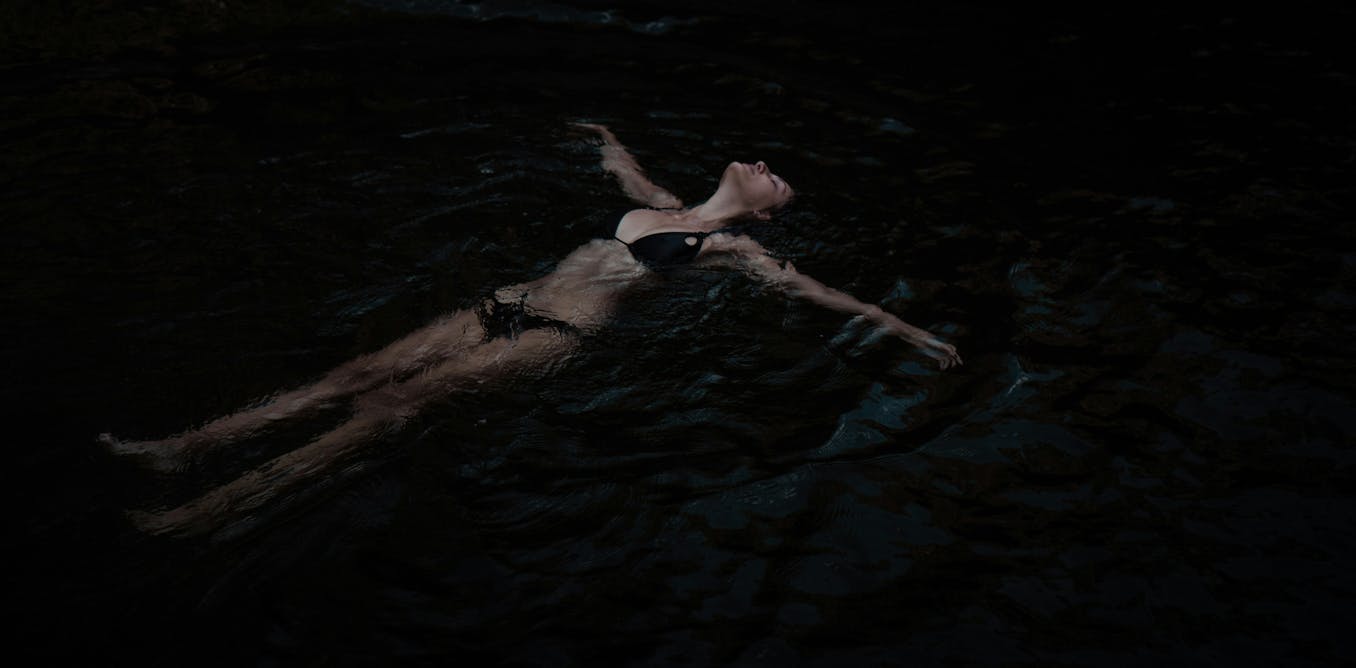
Night Swimming is an incandescent ride through modern poetry and sexual politics, with a thriller plot that will keep your nerves jittering all the way to the climax. It’s also a guide through the territory of insomnia, with its festival of hallucinatory, blackout, sleepwalking night-terror drugs.
Review: Night Swimming – Sharon Kernot (Text Publishing)
Sharon Kernot knows how to make a pressing, potent, aching song from a stanza of free verse lines – and how to make a page of poetry talk its way into your head, until you can’t imagine this story being told in any other way than this hyper-present, syncopated series of stabs at reality, connection, meaning and clarity.
Told in the first person and the present tense (sometimes as “I”, but mostly a step removed from herself, addressed as “you”), there is no escape from the mind of the narrator, January Clare Colson. On the very first page, she lets us know:
… there are nights when I can’t sleep at all.
There are nights when I have an hour, or two.
There are nights that divide into segments.I have nightmares, sleep paralysis,
sometimes I have micro sleeps—
tiny absences

Garry Macrae/Text Publishing
From here, we learn gradually of the terrors, the guilt, the remorse and the suspicions that bedevil her life, all centred on a fatal incident in her early teenage years, when experiments with drugs opened new vistas of feeling and identity. And when an older boy, seductive and already a young man, might have been responsible for the death of her then best friend.
A day after that catastrophe, he had simply slipped away. Clare (as she calls herself) had told the police about him at the time of her friend’s death,
but somehow, he disappeared,
was nowhere to be found.With not one scrap of evidence
to verify his existence.
We follow Clare from doctor to doctor, seeking prescriptions for drugs she takes in quantities that would send most of us into a coma – not to mention the uncountable bottles of wine she washes them down with.
Then she thinks she has met this still-seductive figure from her past, and imagines she might be able to get the answers she needs about the drowning of her childhood friend. We follow her into a vortex of confused emotions and mangled revenge plots, involving impulsive lies and amateur disguises.
Mounting tension
The novel is divided into relatively short poems, each with a helpful heading. Since the poems are embedded in a swirl of life as it is lived and memories that won’t subside, there are many digressions, details, anecdotes and minor incidents.
Sleep-deprived Clare barely holds herself together to make it to work most days; once there, she is a trial to her fellow workers. Nikki, a co-worker at their agency, which assists the needy, almost steals the novel with her dry wit – and the kind of empathy that’s always just about reached its limit.
The workplace scenes are acutely observed and sometimes hilarious.
Joan calls you into her office.
Says, Take a seat.
She’s not smiling her usual warm smile.
She’s not exuding motherly concern.
She is actually frowning.Does she know you have stolen confidential information?
Does she know you are stalking a customer? …_There’s been a complaint.
You brace yourself.
Apparently, you’re not pulling your weight.
_Apparently, you’re not being a team player.
_Oh? you say, relief flooding through you …
There is a boyfriend, too: there for the jokes about soppy men, until he’s there for the dangers that disappointed men bring to women.
There is a lot to recognise about ourselves, a lot to smile at, gasp at and laugh out loud at in the novel. Then there is the mounting tension of the thriller plot, which Clare stumbles through with no ease at all – in fact, at every step, she makes more peril for herself.
It’s in bad faith to give away too much when summarising a thriller or crime fiction. So it will have to be enough to know that you will likely want to read this novel in one, unwisely long and sleepless, sitting. It is both compelling and consistently entertaining.
Poetry and emotional extremes let loose
The fact it is written as verse might feel odd to readers of novels, but it won’t feel any more odd than Clare is. In fact, the compression poetry brings a breakneck speed to the plot that’s entirely appropriate to the way Clare talks us through these events.

Twisty revelations come towards the end, as they must – and they arrive electrically, sizzle after sizzle, as the novel reaches a point where we must leave it, because it leaves us. The desire for revenge, for truth, for justice, for peace at last: have they been served, as they must be (in some sense) in any thriller? Only you, the reader, can answer those questions.
Verse novels constitute their own strong stream in young adult (YA) fiction, and Kernot has authored two YA verse novels. One, The Art of Taxidermy (2018), is a solemn gem on grief, and the other, Birdy (2024), a more complex and poignant tale of social media shaming, death and healing.
Night Swimming carries echoes of those earlier books through its recurrent accounts of teenage risk-taking. But the poetry and emotional extremes have been let loose this time.
Perhaps not since Dorothy Porter’s rare and exotic blend of crime and poetry in Monkey’s Mask (1994) has there been an Australian adult verse novel that feels so powerfully contemporary, so urgent and visceral and so sophisticatedly literary – all at the same time.