




Aid, Armed Conflicts, Artificial Intelligence, Development & Aid, Editors’ Choice, Featured, Global, Headlines, Human Rights, Humanitarian Emergencies, Middle East & North Africa, Peace, TerraViva United Nations
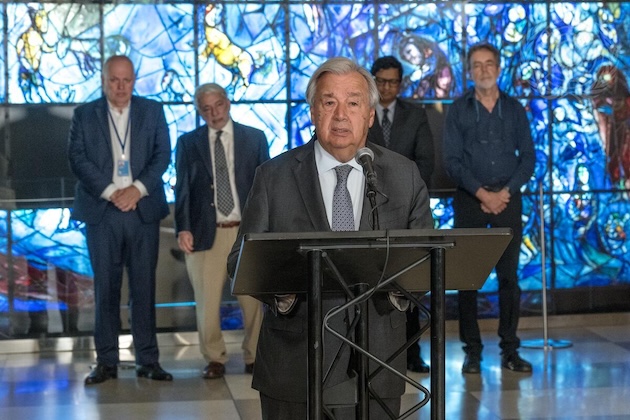

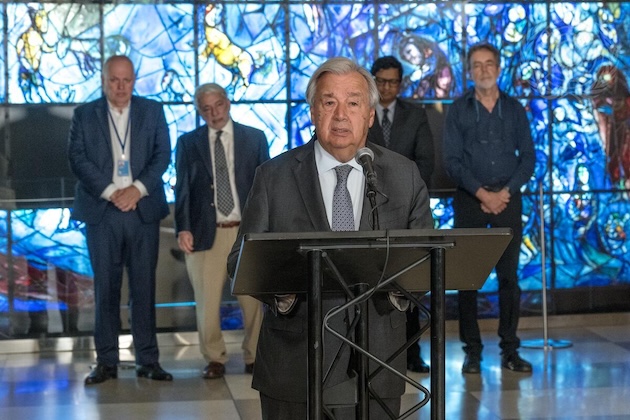
UN Secretary-General António Guterres addresses the wreath-laying ceremony to commemorate the 23rd Anniversary of the bombing of the United Nations Headquarters in Baghdad. Credit: UN Photo/Mark Garten.
UNITED NATIONS, Aug 20 2026 (IPS) – World Humanitarian Day celebrates humanitarian workers and the life-saving services they provide under the most complex and often dangerous conditions.
This year, UN leaders are urging the international community to protect humanitarians working in conflict zones and to seek accountability for those who have been injured or killed in their line of duty.
In late 2008, the UN General Assembly designated August 19th as World Humanitarian Day, five years after the terrorist attack at the Canal Hotel in Baghdad, Iraq, where 22 UN staff members were killed, including the then Special Representative of the Secretary-General for Iraq, Sergio Vieira de Mello.
On Wednesday, UN Secretary-General António Guterres paid tribute to the fallen UN staffers on the 23rd anniversary of the terrorist attack, remarking that their legacy “lives on in every humanitarian worker delivering assistance amid conflict, disaster and despair”.
Guterres also noted that international humanitarian laws meant to protect civilians and humanitarian workers are being violated “with alarming frequency and impunity”.
According to the Office for the Coordination of Humanitarian Affairs (OCHA), 2025 set a new record for violence against humanitarian workers, with 712 incidents recorded, in which 350 workers were killed, 322 were injured, 235 kidnapped, and 280 detained. This year alone there have been 136 major incidents, as reported in the Humanitarian Outcomes’ Aid Worker Security Database. It is only indicative of the growing number of incidents against humanitarian workers in recent years. This represents a jump from 300 reported attacks in 2022 to 471 in 2023 and then 634 incidents in 2024.
“Behind those grim numbers… are names. They are colleagues, they are our friends, they are families, and they are the best of us,” said Tom Fletcher, Under-Secretary-General for Humanitarian Affairs and Emergency Relief Coordinator.
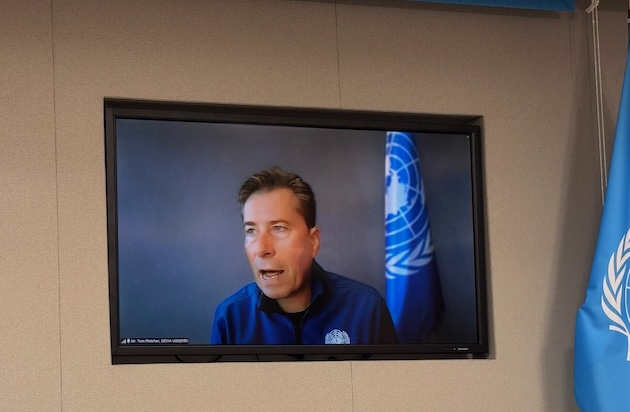

Tom Fletcher, Under-Secretary-General for Humanitarian Affairs and Emergency Relief Coordinator, briefs reporters for World Humanitarian Day. Credit: Naureen Hossain/IPS
Fletcher spoke to reporters virtually from Ukraine, where he is visiting affected areas of the country, including those subjected to drone attacks in recent days. He warned of their increasing use against civilians and infrastructure. Fletcher described seeing many drones during his visit, including an incident in which he and his team had to run for cover because they were in the vicinity.
Drones are increasingly prevalent in areas with ongoing crises, like Ukraine, Gaza, Sudan and Somalia. These weapons, which are controlled by humans but can also be directed by AI, have shaped the way civilians lead their lives and affected humanitarians carry out their work.
They create “a sense of collective anxiety” among civilians and aid workers. Yet, there seems to be little to no impunity for drone attacks or for those who carry out these attacks, who would likely be aware of what they are targeting. Drone technology is also getting cheaper and easier to access, putting them in more hands as parties to conflict experiment with their use.
Fletcher acknowledged that they can be used by aid workers for good, such as delivering vaccines or identifying survivors in emergencies. But otherwise, much of their use in the context of conflict has been “inhumane and reckless”.
“I’ve not been anywhere where drones are so much part of the conversation. Everyone – from the kids I met in shelters, civilians, humanitarians, and my colleagues – can tell the difference between the sound of a first-person-view drone and a fibre-optic drone and the medium-range drones or the loitering munitions, which are such a threat to our work,” Fletcher said.
Fletcher called for the international community, and chiefly Member States, to uphold international humanitarian law and to seek accountability toward the parties involved in conflict, including state actors. Member states can and should take stronger measures to conduct independent investigations.
Fletcher made repeated calls for increased dialogue and reflection on international humanitarian law, including how to protect humanitarian workers from emerging technologies like drones. It should be up to member states and the companies behind these technologies to make sure that it “does not outpace humanity” and it “does not outpace accountability”. He also called for engaging in dialogue with the companies involved in manufacturing and distributing drones so they understand the risks they’re creating.
For those that believe in the United Nations or in the spirit of global solidarity, they also believe that member states still have the will to uphold their responsibilities toward international humanitarian law. “If the world has become so transactional and selfish and inward-looking that member states are no longer able or prepared to do this work, then we really are in a grim dystopian reality,” Fletcher told Inter Press Service.
He added that the public can in turn hold their governments to account. “We need a public demand of their leaders that we manage these risks before it’s too late. And for so many of the people that I work with, my fallen colleagues, for so many of the people who we’re here to serve, it is already too late, I’m afraid.”
IPS UN Bureau Report