







Maia Hirsch’s affinity for fashion design doesn’t STEM from a lifelong love of luxe labels like Chanel, Hermès and Dior.
While admittedly an appreciator of haute finery, Hirsch, 24, a mechanical engineer from upstate Ithaca, is more fascinated with scientific systems and robotics than imported silks and lambskin leather.
But when the pandemic erupted in 2020, leaving the then-undergrad stranded while studying in Florida, she enrolled in a fashion design course at the Istituto Marangoni Miami — merely as a fun, therapeutic outlet amid the chaos.


Now, those stylish sessions have set Hirsch on a technology-paved path to New York Fashion Week 2026, where she’ll be sending her robo-charged regalia down the runway at Times Square nightspot Dramma.
“I’m so honored to be changing the idea of what an engineer or a roboticist looks like by breaking stereotypes,” Hirsch, currently working toward her PhD in robotics at Cornell University, exclusively told The Post.
“Fashion is a high-visibility industry,” the native Venezuelan continued. “So, my work [as a fashion designer] allows science to go into very public and cultural spaces, where it couldn’t go before.
“And I think that’s fantastic.”


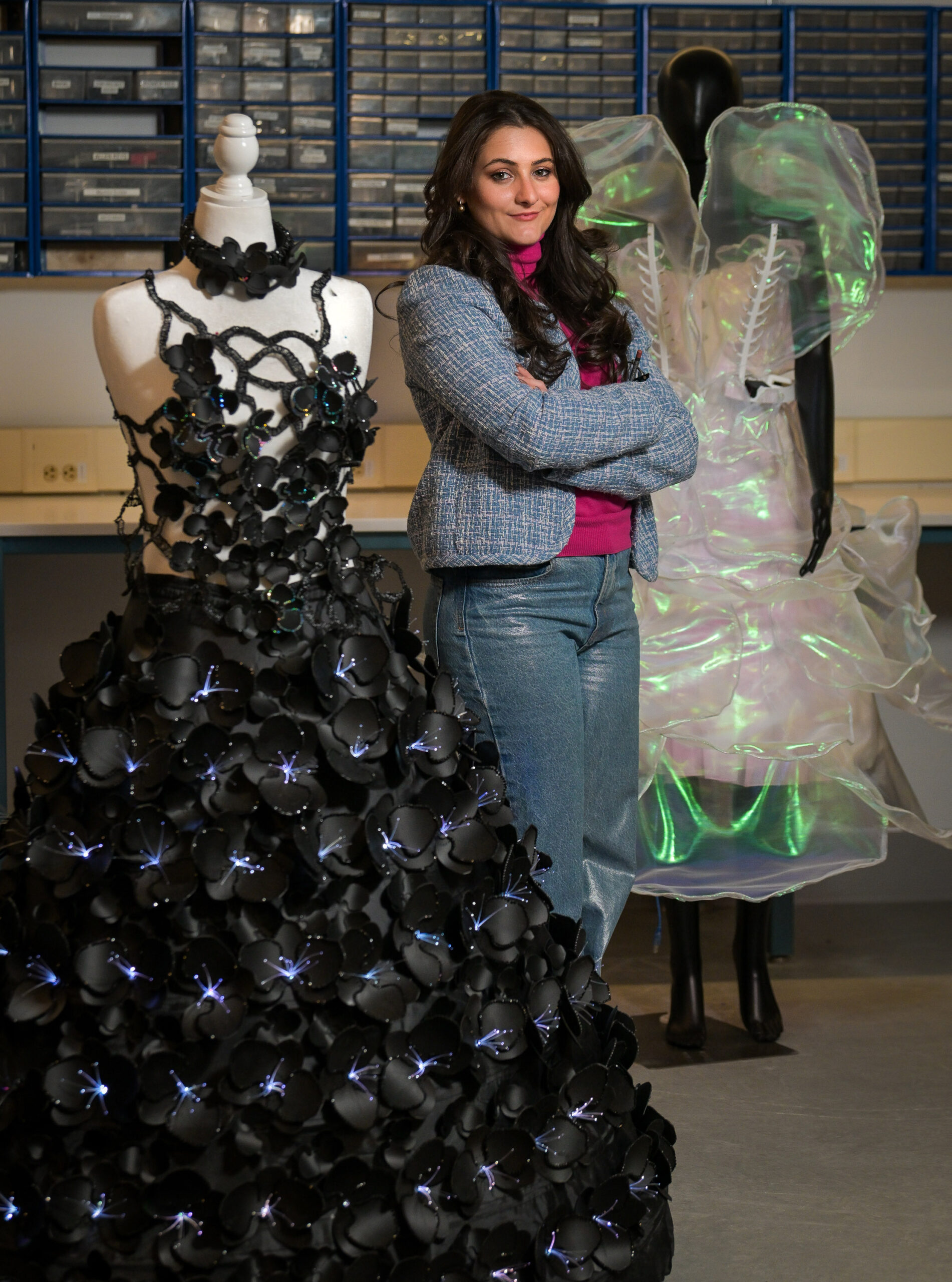
As an innovator in the world of STEM — short for Science, Technology, Engineering and Mathematics — the go-getting Ivy Leaguer is showcasing her “Blooming Dress,” a battery-operated interactive number that blossoms into a dazzling white flower with a simple handshake, at SFWRunway’s “Future of Fashion” show Saturday.
With cotton fabric as its foundation, Hirsch constructed the garb’s moving petals, made of organza, with touch sensors and actuators — devices that enable automation by converting control signals into physical actions like lifting, turning and, yes, blooming.
“There are very small touch sensors that go in the palm of the model’s hand,” the high-tech couturier explained. “So whenever they come in contact with anything, it will activate the whole mechanism, including the motors in the dress, that causes it to bloom.”


Hirsch is also premiering her “Gazing Dress.” It’s a breathtaking masterpiece she’s constructed using optical fibers and stretch sensors. Its intricate inner workings cause the ensemble to illuminate in correspondence to the wearer’s body movements.
“Both dresses will be worn by models during the New York Fashion Week show,” gushed the innovative Gen Zer, who has shown her artistry before — but only on stationary mannequins. “It’s going to be so beautiful.”
Prior to runway day, Hirsch spent countless hours sketching, scraping, reiterating — and sometimes even “frying” (or unintentionally short-circuiting) — her designs to perfection at Cornell Maker Club workspaces.
These elite university labs grant students access to state-of-the-art tools, electronics and equipment — such as 3D printers, laser cutters and embedded systems — used to fine-tune their magnum opuses.


Each of Hirsch’s fashion show pieces cost her over four months to actualize — from ideation to research to trial-and-error and, finally, completion — and “thousands” of dollars in grant funding to execute.
But to the rising avant-gardist, investing time, money, blood, sweat and tears into her robo-wardrobe is a small price to pay if it means busting down the doors of male-dominated disciplines for her fellow sisters-in-science.
“I’m excited to share my work because I live by the phrase, ‘You cannot be what you cannot see,’” she explained. “And I want other women to know that they can be engineers and still love fashion and maintain that side of your femininity.
“You don’t have to trade off one for the other just to belong.”
The number of women in STEM careers has increased since the 1970s, when they made up a paltry 7% of the industry, according to the US Department of Labor.
Still, only 30% of the jobs in those fields are currently held by ladies across North America, per recent data. And less than 20% with technical positions work in computer sciences and engineering.
Hirsch hopes to help enlarge the presence — an aspiration inspired by futuristic fashioners like Iris Van Herpen.


The Dutch designer is oft-lauded for fusing nature, architecture and mechanics into her wearable works of art, such as the world’s first 3D-printed bridal gown. Guided by her taste for tech, Van Herpen has masterminded otherworldly attire for the VIP likes of Cate Blanchett, Beyoncé, Scarlett Johansson, Lady Gaga, Natalie Portman, Rihanna, Björk, Jennifer Lopez and Gigi Hadid.
She also designed the robotic rig donned by entrepreneur Mona Patel for the 2024 Met Gala’s “Sleeping Beauties: Reawakening Fashion” extravaganza. The pièce de résistance of the piece was a kaleidoscope of kinetic butterflies with fluttering wings by artist Casey Curran.
The stunning triumph earned Patel bragging rights as the “winner” of the swank night.


Hirsch told The Post she’d be delighted to stir a similar buzz at NYFW.
But, unlike Van Herpen’s objets d’art, the New Yorker says her glam gear isn’t quite ready to be shipped out to A-list celebs.
“They’re very delicate pieces, not meant for daily wear,” said Hirsch, insisting that she “cannot” put a price tag on how much she’d charge for one of her en vogue inventions. “They’re not weatherproof, so you wouldn’t be able to wear them in the rain or extreme cold because the battery would suffer damage.
“There are also a lot of issues that could arise, like storage,” she added. “How would the average person store it in their closet? If something happened, how would people repair it?”


Even without having every detail ironed out, the voguish visionary is proud to be at the forefront of fashion’s next phase.
“Fashion shouldn’t just be worn — it should also be experienced,” said Hirsch. “Mechanical engineering gives me the ability to create things that have never been made before, and layer fashion on top of them.”


