






Home Fossil Energy Fore-accommodation LNG carrier with four Wind Challenger sails clears LR design appraisal
September 16, 2026,
by
Melisa Cavcic
A new liquefied natural gas (LNG) carrier design that moves the accommodation block and bridge to the bow to make room for four wind-assisted sails has cleared a key technical milestone, with Lloyd’s Register, a maritime classification society, affirming technical readiness of the HD Hyundai Heavy Industries (HHI) and Mitsui O.S.K. Lines (MOL) concept, marking a key step toward commercializing large-scale wind-assisted propulsion for LNG transport.

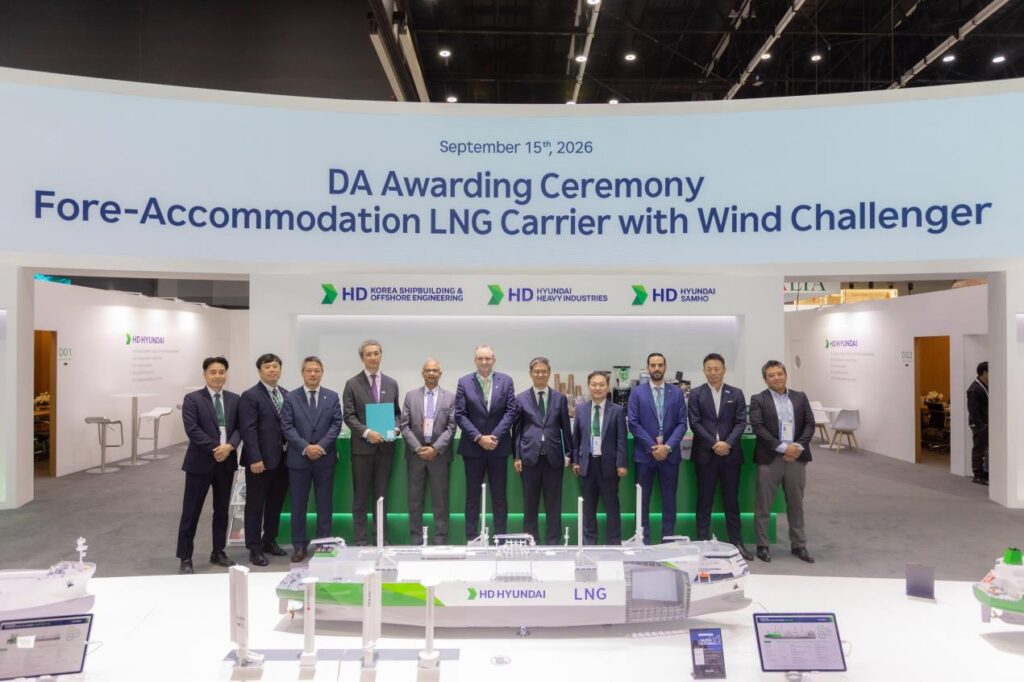
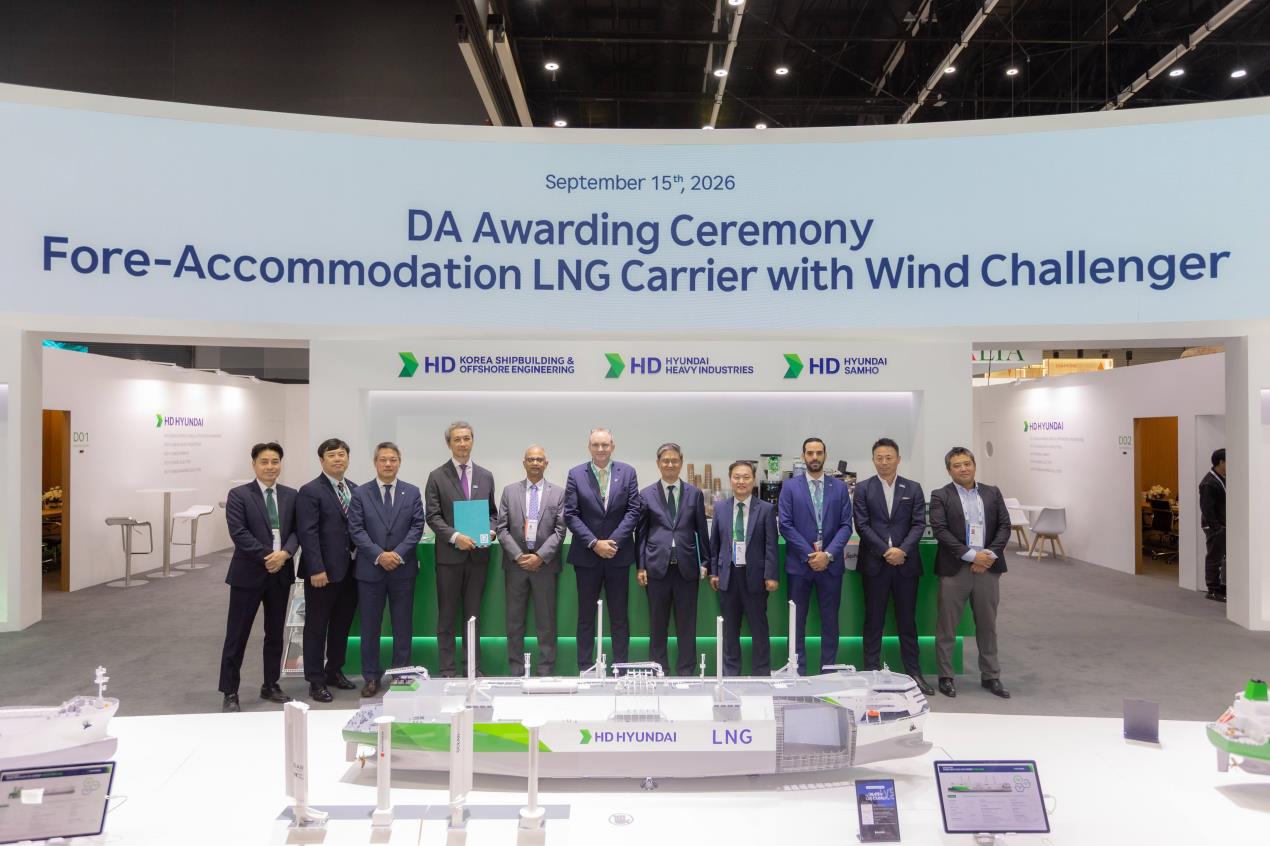
Lloyd’s Register has granted design appraisal for HD Hyundai Heavy Industries’ fore-accommodation LNG carrier design featuring the Wind Challenger wind-assisted propulsion system developed by Mitsui O.S.K. Lines. This move confirms compliance with LR’s Wind-Assisted Propulsion Systems (WAPS) notation requirements.
Andy McKeran, Chief Growth Officer, Lloyd’s Register, commented: “As LNG carrier designs continue to evolve, the industry needs robust technical frameworks to assess new technologies and configurations. This design appraisal demonstrates how collaborative development and independent technical assurance can support the delivery of larger, more capable and operationally efficient vessel concepts.”
The design covers what the project partners describe as the world’s first fore-accommodation LNG carrier equipped with the Wind Challenger hard-sail system and LR’s blessing marks the latest milestone in a joint development project involving the three players and the Republic of the Marshall Islands Maritime Administrator, following approval in principle (AiP) awarded by Lloyd’s Register in 2025.
Hongryeul Ryu, Executive Vice President & CTO, HHI, remarked:“Through close collaboration with MOL and Lloyd’s Register, we have advanced the development of a new LNG carrier concept combining a fore-accommodation arrangement with Wind Challenger in a safe, practical and class-compliant manner.
“Achieving design appraisal for compliance with LR WAPS notation demonstrates the technical maturity of the concept and represents an important step toward future commercial application. HD Hyundai Heavy Industries will continue to develop reliable and sustainable LNG carrier solutions for the next generation of shipping.”
With the relocation of the accommodation block and bridge to the bow of the vessel as a key feature of the concept, this arrangement creates a clear mid-to-aft deck area that can accommodate MOL’s Wind Challenger hard-sail system while maintaining operational and navigational requirements, allowing greater flexibility in the number, size and placement of sails to maximise wind-assisted propulsion performance.
Richard Dias, Deputy Commissioner of Maritime Affairs, Republic of the Marshall Islands Maritime Administrator, highlighted:“The RMI Maritime Administrator is pleased that this project has reached the design appraisal phase and looks forward to continuing its collaboration with its project partners. We are delighted that this project will deliver practical solutions while using sound regulatory frameworks to achieve the International Maritime Organization’s (IMO’s) decarbonization targets.”
This project saw the partners assess technical areas associated with integrating WAPS onto an LNG carrier, including navigational visibility, hull stability, structural stress from hard sails, and integrated emergency shutdown (ESD) systems, while a hazard identification (HAZID) study and risk assessments were conducted in accordance with LR’s Risk Based Certification process.
Yoshihiko Sugimoto, Executive Officer & CTO, Mitsui O.S.K. Lines, said:“This Design Appraisal represents an important milestone in advancing the practical application of wind-assisted propulsion for LNG carriers. Through close collaboration with HD Hyundai Heavy Industries and Lloyd’s Register, we have demonstrated that the world’s first fore-accommodation LNG carrier designed to accommodate four Wind Challenger sails can be realized while maintaining safety, operational effectiveness, and regulatory compliance.
“This concept showcases the potential of large-scale wind-assisted propulsion to further reduce greenhouse gas emissions from LNG transportation and marks an important step toward commercial deployment.”


