

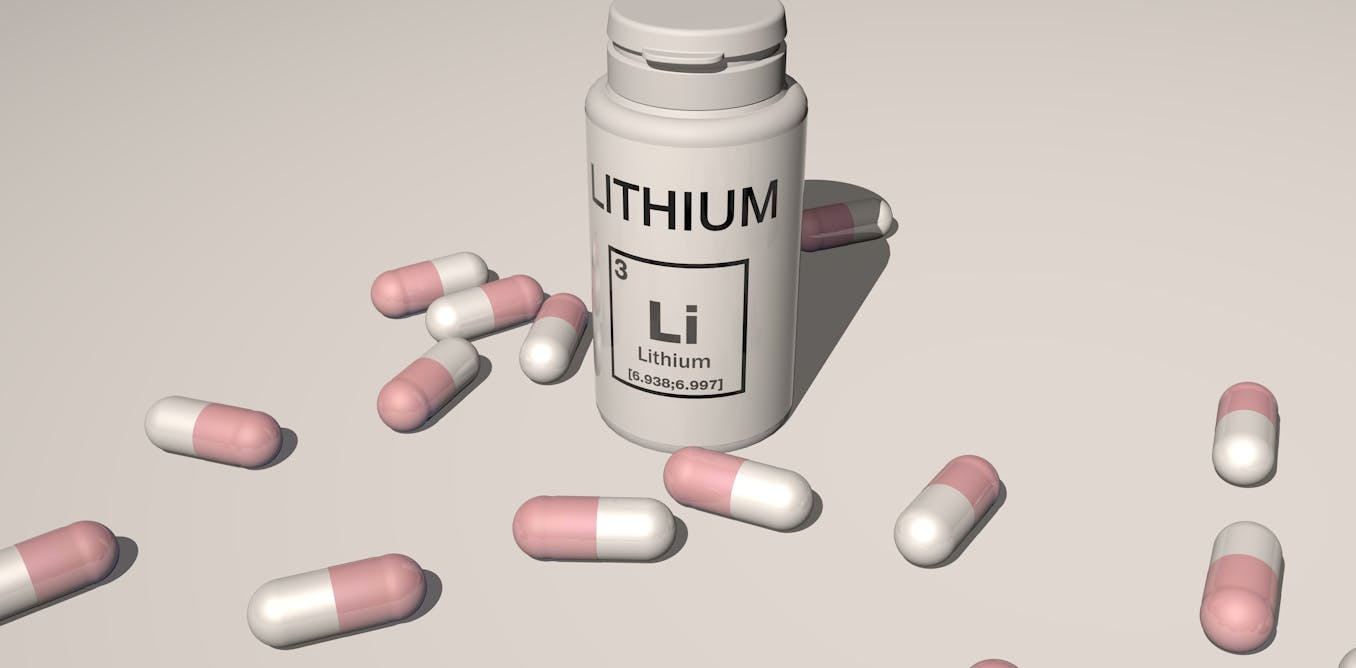
According to recent data from the Global Bipolar Cohort, only 29% of people with bipolar disorder are prescribed lithium. Despite being the “gold standard” for treating this mental health condition, we often prioritise perceptions over scientific reality, and neglect the best available treatment.
Lithium is not some complex molecule synthesised in a state-of-the-art laboratory. It is just an element, the third in the periodic table, and ever since the Australian psychiatrist John Cade discovered its therapeutic properties in 1949, it has maintained a relevance that no other psychotropic drug has been able to match.
This longevity is not a relic of the past, but a reflection of its clinical robustness. Despite decades of research and the constant emergence of new drugs, no alternative has shown comparable efficacy in the long-term prevention of manic and depressive episodes in bipolar disorder.
According to a review published in 2024, lithium is still “the mainstay treatment of mood disorders in general and in bipolar disorder specifically”. It is also the benchmark against which all other treatment options are compared, both for stabilising mood and reducing the risk of relapse.
It is the only mood stabiliser with proven efficacy in treating mania and depression, as well as in preventing relapses. Furthermore, recent studies confirm that it may also have neuroprotective properties, from the modulation of cellular pathways involved in neural plasticity to potential effects in preventing mild cognitive impairment and dementia.
These characteristics explain why international guidelines still rank it as the first-line treatment for bipolar disorder. A consensus published in 2025 stated that it should be prescribed more frequently, contrary to the unfounded reservations that still persist in clinical practice.
Suicide reduction
Above all, there is one aspect that sets lithium apart from other psychopharmaceutical drugs: its ability to reduce the risk of suicide. No other medication has demonstrated such a consistently protective effect.
A 2024 review highlighted that, despite the methodological difficulties in studying this statistically rare event, the body of evidence from clinical trials, observational studies and meta-analyses all points in the same direction: lithium reduces mortality and suicide attempts.
This is likely due to its ability to reduce impulsivity, stabilise extreme mood swings and prevent depressive relapses, all of which create the moments of greatest risk.
Beyond episodic treatment
Current research is also looking into lithium’s ability to alter the course of bipolar disorder. Not only does it stop episodes, but it also protects the brain, and evidence suggests that, unlike some antipsychotics, it improves brain connectivity and preserves verbal fluency.
In fact, there is very interesting data suggesting that it could reduce the risk of dementia by up to 50%. Even residual levels in drinking water appear to have a protective effect at a population level. Lithium is, in short, a molecule with exceptional neuroprotective potential.
But the neuroprotective effects do not stop there. Recent studies also suggest that lithium stimulates the production of brain-derived neurotrophic factor, a protein essential for neuronal survival and growth that is often reduced in patients with bipolar disorder.
In other words, it doesn’t just prevent the brain from deteriorating – it actively helps it to heal.
Read more:
Perimenopause linked with increased risk of bipolar and major depression
Blood monitoring and ‘precision medicine’
It is often argued that the need for blood tests to monitor lithium levels (the optimal therapeutic range is 0.6-0.8 millimoles per litre) is an inconvenience. However, from a rigorous clinical perspective, this monitoring is a safeguard, not a risk. It is what allows the dose to be adjusted to the exact biology of each patient, a form of “precision medicine” that we were already practising long before the term became fashionable.
We should also remember that many commonly used medicines – from anticoagulants to immunosuppressants – require the same kind of laboratory monitoring, yet they are not considered dangerous for that reason.
What lithium management requires is not fear, but rigour. So why is it prescribed less often? The answer is complex. It is partly due to pressure from the pharmaceutical industry to promote new, patentable molecules – lithium, being a natural element, cannot be patented. There is also a degree of clinical reluctance due to its narrow therapeutic window – it needs to be carefully controlled to ensure a safe yet effective dose.
However, international guidelines are clear: lithium should be the first choice. We cannot overlook it in favour of less effective alternatives simply because they appear more modern. This kind of mistake should not influence clinical practice.
Newer is not always better
Good psychopharmacology is not a question of chasing the latest developments, but of using the most appropriate treatment for each individual at every stage of their illness.
Lithium has a proven track record that spans decades, across areas that no other mood stabiliser can address simultaneously. It controls manic and depressive episodes, prevents suicide, and provides active neuroprotection. Three areas, in one single drug.
This does not mean it is right for absolutely everyone. Good psychopharmacology should always push back against fads and dogma alike, but discarding lithium’s use without ever seriously considering it deprives patients of an option that is, according to the evidence, categorically the best therapeutic option.
Our challenge today is not to reinvent the wheel, but to understand how best to use the therapeutic tools we already have. A drug doesn’t become outdated just because time has passed; it becomes outdated when new evidence emerges and supersedes it. In the case of lithium, new evidence only confirms its value.

A weekly e-mail in English featuring expertise from scholars and researchers. It provides an introduction to the diversity of research coming out of the continent and considers some of the key issues facing European countries. Get the newsletter!
