








There is a rich history of Black graduation ceremonies in the United States focused on celebrating the unique experiences and achievements of Black university students.
In Canada, the tradition gained attention with the University of Toronto’s 2017 celebration.
Since then, annual Black graduation ceremonies have been embraced by many other institutions, including McMaster University, Toronto Metropolitan University and Concordia University.
These optional celebrations are complementary to faculty-based convocation ceremonies where students are awarded their degrees. As in the case of Toronto’s event, many are initiated by students seeking to celebrate their achievements in a culturally affirming way.
Their emergence are part of the introduction of Black-focused programs, services and spaces on Canadian campuses, which according to the available evidence, positively impact the well-being and academic success of Black students.
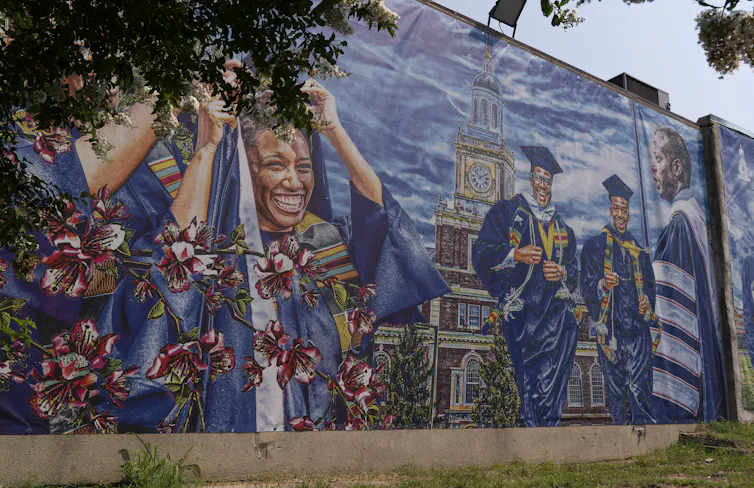

(AP Photo/Jacquelyn Martin)
The principle of ‘Ubuntu’
The celebrations embody the principle of Ubuntu, a South African philosophy about interdependence.
Students, parents and family members are often joined by staff, faculty, alumni and community members in a communal celebration of achievement.
These community celebrations remind graduates they are powerfully networked and supported as they embark on their careers or further studies. They also offer a moment to reflect on the personal, familial and ancestral sacrifices, which have enabled the long-awaited day.
During the celebrations, students are often presented with a Kente Stole. The stole is a scarf-like garment inspired by kente cloth, a vibrant textile created in the 17th century by the Akan people of Ghana drawing on their longstanding traditional weaving practices.
Historically associated with royal gatherings, today kente-inspired stoles are featured in important community celebrations as a symbol of ancestry and cultural pride. Visually stunning, many students proudly wear their stoles during their formal convocation event, reinforcing their undeniable presence and contribution to the university.
Typically, Black graduation celebrations also incorporate cultural attire, music, speeches and awards, which together create the “magic” I’m so fond of.


(RDNE/Pexels)
Accusations of segregation
These celebrations are not without their critics, however, as accusations of segregation are not uncommon. Notably, predominantly white gatherings on campuses evade this criticism because whiteness is often constructed in non-racial terms, preserving for itself the privilege of being seen as simply human.
Accusations of segregation fail to acknowledge that Black graduation celebrations exist in the context of, and are an antidote to, the well-documented barriers Black students experience in the pursuit of higher education.
They are also troubling when situated within the history of segregationist policies in North America and South Africa, which systematically deprived Black communities of vital resources and opportunities as part of state-sanctioned efforts to maintain racial hierarchies.
Fostering belonging
In reality, Black graduation celebrations are inclusive, frequently welcoming non-Black campus allies and graduates’ family members and partners, suggesting accusations of segregation are rooted in ideological opposition rather than evidence.


(Sofia Shultz/Pexels)
Other criticisms focus on the potential for Black graduation celebrations to reduce the participation of Black students in their formal convocations.
This claim runs contrary to available evidence that Black-focused programming at Canadian universities increases students’ sense of belonging, which is a prerequisite for greater institutional engagement.
Based on this logic, Black graduation ceremonies are more likely than not to empower Black students to take up space in their formal convocations alongside peers from their programs.
Celebrating Black achievement
Black graduation ceremonies have also attracted negative comments in popular forums like Reddit threads. Amid the deliberations, profiles from different racial backgrounds sometimes demand equivalent ceremonies in the name of fairness.
This stance is disappointing because it denies the necessity of celebrating Black achievement in a world plagued by a specific, longstanding and deeply entrenched anti-Blackness. It’s also illogical because Black graduation celebrations do not occur at the expense of other communities.
Celebrating Black achievement does not preclude other, also valid, celebrations of success — which can and often do co-exist.
In fact, as is so often the case with innovation born out of Black resistance and creativity, Black graduation celebrations provide both precedent and a model for culturally grounded recognition events and celebrations on campuses.
Repairing reputations, building bridges
It would be a mistake to judge Black graduations as a single celebratory day, as their impact far exceeds one day. Months-long in the planning, they can nurture cross-campus relationships as departments and faculties collaborate in support of the proceedings.
It’s not an exaggeration to say Black graduation ceremonies, which symbolize inclusion, can enhance a university’s reputation among prospective students.
For enrolled students, Black graduation ceremonies provide motivation to continue working towards that long-awaited moment of proudly crossing the stage in the presence of community.
They also have less visible, but no less meaningful, effects. As an outward-facing symbol of institutional commitment to Black students, Black graduations contribute to the repair or enhancement of a university’s reputation with local Black communities. This can lead to meaningful partnerships with community organizations and attract donors who want to augment support for Black students.
Overall, Black graduation ceremonies demonstrate how far we have come since the days of discriminatory admission policies, which excluded Black students from some programs in higher education in Canada. They represent progress and should be a source of pride for universities.


