

This is the web version of Fortune Gulf Brief, a weekly newsletter providing smart coverage on the capital, leaders, and policies transforming one of the world’s most consequential regions. Sign up to get it delivered free to your inbox.
Welcome to this week’s Fortune Gulf Brief. Regular readers might notice a different author byline today, that’s because Melissa is taking a well-earned break although, knowing journalists, probably with one eye on her phone and what’s happening in the Gulf. Ordinary service resumes next week.
Until then, I’m Inzamam Rashid, international journalist and broadcaster based in Dubai, and I’ll be your guide to the region for this week.
There’s no shortage of things to talk about. Donald Trump’s pronouncements are increasingly becoming trading signals for investors in the UAE, while Washington’s new economic offensive against Iran comes as Tehran’s currency hits a record low and one of its most important trading partners slams the door shut.
We’ll also be covering:
- Iran’s currency crisis deepens as UAE lifeline closes
- Saudi Arabia’s Crown Prince goes to Paris and leaves with billions in deals
- Pop stars pull out of Abu Dhabi, but the F1 is staying put
So with Melissa temporarily swapping Gulf Brief for the beach, let’s get into it.
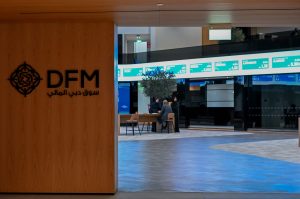
Retail trading activity in Dubai has shown signs of significant growth in response to the market-moving pronouncements of President Donald Trump and fluctuations in the prices of gold and oil.
In the first half of 2026, the Dubai Financial Market’s trading value soared 40% year-on-year to $32.5 billion, while Abu Dhabi’s exchange saw $46.6 billion in trades.
There might be another explanation for Dubai’s retail trading boom beyond Donald Trump, war and a very good year for gold: it’s the sort of people who move here.
“Everyone that moves to the UAE is a risk taker by definition,” Tarik Chebib, Capital.com’s Middle East CEO, told me when we sat down to discuss why trading volumes in the region have surged.
Dubai has spent the past decade attracting entrepreneurs, financiers, executives and increasingly wealthy expats from around the world. Many have already taken one fairly major financial gamble, packing up their lives and moving to the Gulf (of course, the lack of tax is another major influence here).
Chebib argues that this has helped create an unusually receptive audience for retail investing. When he arrived in the UAE 11 years ago, he says, conversations about brokerage accounts were relatively rare. Today, most clients arriving at Capital.com have traded before.
COVID accelerated the change. Chebib says more people began thinking: “I want to manage my own money. I don’t want it to be sitting in a bank anymore. I need to prepare for my future.”
There is another very Gulf-specific factor at play. For many of the expats who make up the UAE’s workforce, the traditional financial safety nets found in parts of Europe are less extensive.
“Here, you’ve got to figure it out yourself,” Chebib said. For some, he argues, trading has become one vehicle for doing exactly that.
That doesn’t mean everyone in Dubai has suddenly become a day trader. But the numbers suggest this is no longer a niche pastime. Chebib tells me the UAE retail trading market is now comparable in size to Singapore, a remarkable shift for a market that hardly registered in international research five years ago.
And traders here certainly aren’t short of things to bet on. This year alone, the obsession has shifted from gold to oil during the war, to AI, and U.S. equities. Nasdaq and S&P 500 products remain particularly popular, while Chebib says Gulf traders are already positioning themselves for what comes next.
Which brings us back to Donald Trump. His statements are now moving this increasingly sophisticated—and increasingly heavily invested—audience almost instantly.
Read my full story here on why Trump is becoming one of the Gulf’s most powerful trading signals for the Middle East.
Inzamam Rashid
Iran’s currency crash deepens as the UAE closes a vital economic lifeline
Iran’s rial plunged to an all-time low of 2.02 million to the dollar this week as Washington launched a new economic offensive against Tehran and one of Iran’s most important trading partners closed the door.
The currency has weakened sharply from 1.53 million to the dollar in early March. The IMF forecasts Iran’s economy will contract 5.4% this year, while inflation is projected at around 70%. Tehran’s central bank governor, Abdolnasser Hemmati, has said the country is not currently exporting oil, depriving it of a critical source of foreign currency.
On Monday, Treasury Secretary Scott Bessent formally launched “Operation Economic Outcast,” expanding secondary sanctions and targeting sectors including digital assets, gold, aviation, technology, and shipping. “The clock just started ticking,” he said.
But Matin Mirramezani, project manager of Stanford University’s Iran 2040 Project, told Fortune the impact will ultimately depend on enforcement. Previous sanctions have sometimes existed “on paper” while enforcement lagged, allowing Iranian exports to increase. This time Mirramezani believes Washington might not even need to act against every company. The threat itself could persuade banks and businesses around the world to stop dealing with Tehran.
That makes the UAE’s decision last week to suspend all trade, commercial exchanges, and financial transactions with Iran particularly consequential.
Before the war, the UAE was Iran’s largest source of imports, accounting for 33.3% of imports in the first quarter of 2025, worth almost $3.9 billion. Mirramezani said roughly a sixth of Iran’s non-oil exports also go to the UAE, while Dubai has long been an important hub for Iranian financial transactions.
Cutting that route means Iran’s options for trade and cross-border transactions “become narrower and narrower,” Mirramezani said, adding pressure to an economy already battling inflation and a collapsing currency.
Two Gulf diplomats told Fortune that Washington has pressed Gulf states to cut financial ties with Iran. The gamble is whether that pressure forces Tehran towards a deal, makes escalation in the Strait of Hormuz look like its best remaining leverage, and determines who else joins the U.S. in economically isolating Iran.
MBS came to Paris for for esports, the real prize was billions in deals
During his visit to Paris, Saudi Crown Prince Mohammed bin Salman joined Emmanuel Macron at the Esports World Cup closing ceremony. Gaming is a key part of Saudi Arabia’s Vision 2030 goals—its Public Investment Fund purchased video game company Electronic Arts for $55 billion earlier this month.
Saudi Arabia and France announced a series of deals in entertainment, transport, logistics, AI, and defence, totaling over $8 billion in investments.
One standout deal is Qiddiya’s €6 billion ($7 billion) plan to build three theme and leisure parks near Paris, including a Dragon Ball Z-themed attraction. The project should create about 22,000 jobs and give Saudi investors a clear presence in France’s entertainment sector.
And investment is moving in both directions. French shipping company CMA CGM and Saudi port operator RSGT agreed on a $434 million deal to expand Jeddah Islamic Port, increasing its capacity by up to 2.6 million containers a year. French rail manufacturer Alstom also won a $580 million contract to provide metro carriages for Riyadh.
The two countries also signed agreements on AI, quantum technology, and defense, and extended their partnership to develop AlUla through 2035.
The main point is that Saudi-French relations are becoming more transactional and increasingly mutual. Riyadh is seeking French technology and infrastructure skills, while Paris is openly welcoming Saudi money.
Pop stars are pulling out of Abu Dhabi but F1 isn’t
It hasn’t been a particularly good few weeks for Abu Dhabi’s concert calendar. Shakira, Christina Aguilera, and The Corrs have all disappeared from upcoming schedules, while the Offlimits Music Festival—also featuring the Jonas Brothers and Ne-Yo—has been scrapped until at least 2027. The Corrs cited “unforeseen circumstances” while other cancellations came without detailed explanations.
It doesn’t necessarily mean international artists think Abu Dhabi is unsafe. Thomas Ovesen, CEO of All Things Live Middle East, told Fortune that the bigger problem is often commercial, because artists need certainty months in advance to sell tickets, move equipment, and protect a wider tour schedule. Insurance is another headache. Cover for cancellations caused by the conflict can be difficult to obtain, potentially leaving promoters exposed to huge losses.
Then came a rather useful vote of confidence. Formula 1 CEO Stefano Domenicali confirmed this weekend that December’s Abu Dhabi Grand Prix will go ahead as planned, ending speculation that the season finale might move elsewhere.
For an events industry that Ovesen described as otherwise “on its knees,” it’s a crucial announcement. He says F1’s commitment gives promoters something positive to take into conversations with nervous international artists.
Plenty is riding on it financially too. Ethara, the Grand Prix promoter, says the event generates more than AED1.5 billion ($408 million) in economic impact and requires more than 12,000 accredited workers.
David Powell, Ethara’s chief portfolio and strategy officer, tells Fortune the race is Abu Dhabi’s version of the Super Bowl, a single weekend that ripples through the economy by driving tourism, hospitality spend and temporary employment. Without it, that money and those jobs would simply not materialize, leaving a conspicuous financial hole in the UAE’s crucial winter tourism season. Formula One’s confirmation is “exactly what’s needed at the right time,” he added.
The race looks secure. The question is how many global pop stars will join the party.
The Big Number
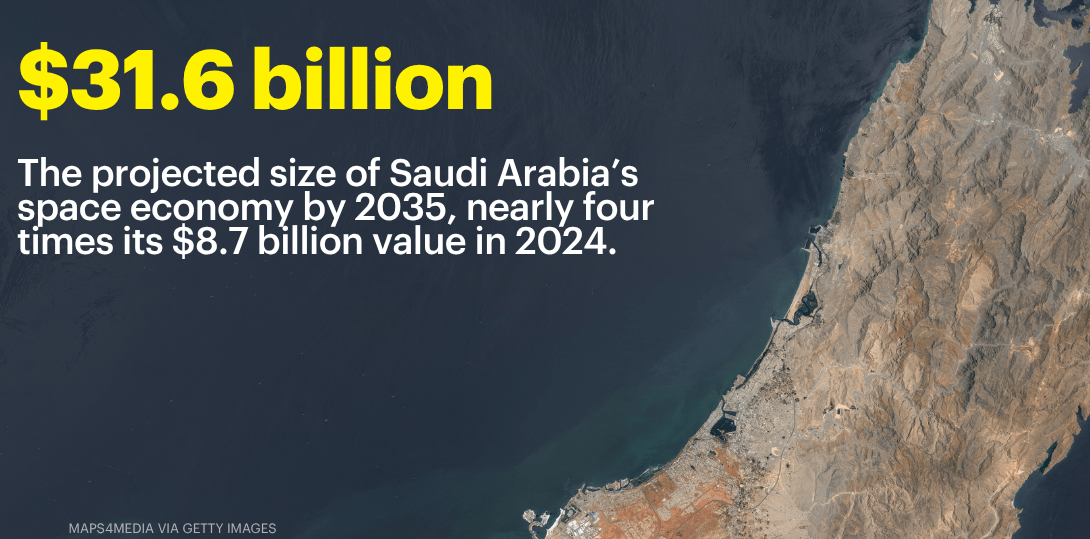
Source: Communications, Space & Technology Commission, 2026
The 3 things we enjoyed reading this week
- A $5,000 drone interceptor being assembled in the UAE could offer one answer to an increasingly expensive problem for the U.S. and its Gulf allies. The New York Times reports on Florida startup Powerus, whose Guardian interceptor is designed to destroy Iranian drones without resorting to multimillion-dollar missiles. The company is producing roughly 3,000 interceptors a month and wants to reach 15,000 globally by mid-2027. It’s a fascinating look at how the war in Iran is reshaping the economics and geography of the defense industry.
- Saudi Arabia is considering becoming an insurer of last resort for war risk, as conflict with Iran and Houthi attacks send commercial insurance costs soaring. The Financial Times reports that Riyadh is discussing a state-backed scheme with London brokers that could provide up to $186 million of cover per incident, potentially backed further by the Saudi Export-Import Bank. It’s another reminder that the war’s economic consequences extend well beyond oil prices and why keeping ships moving increasingly requires governments to step in where private markets are getting nervous.
- And finally, a little Dubai nostalgia. The city’s Toyota Building, a 15-storey Sheikh Zayed Road landmark dating from 1974, is set to be demolished next year. The National’s Daniel Bardsley, who once lived there, writes about a building that predates almost everything now surrounding it and provided an affordable home to thousands of residents over five decades. Dubai is remarkably good at building the future. The piece raises the more difficult question of what from its relatively young past is worth keeping.
