



commentary
Youth protests in Europe and India signal a deepening crisis. For most people, democracy hasn’t delivered
Published
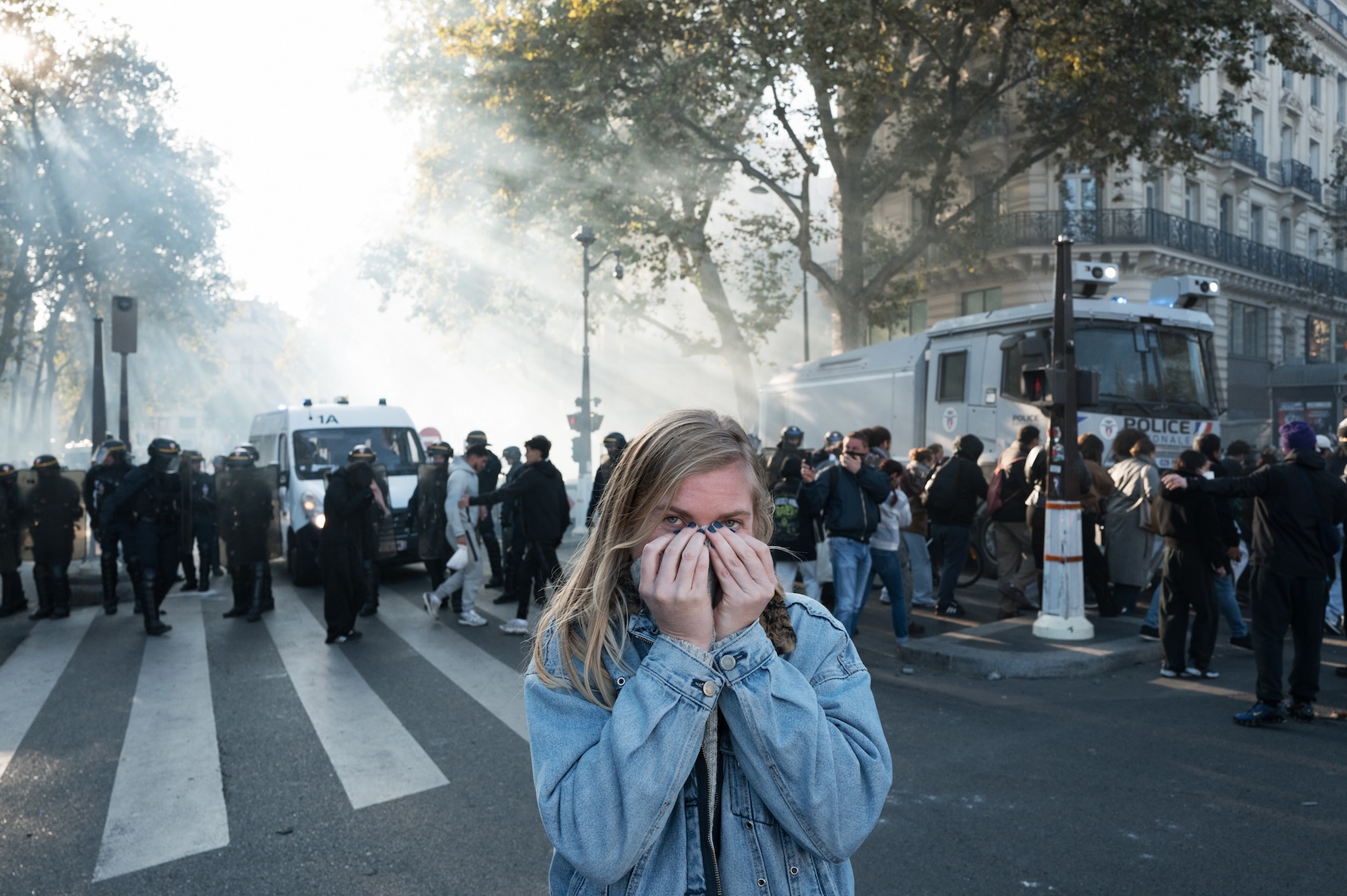

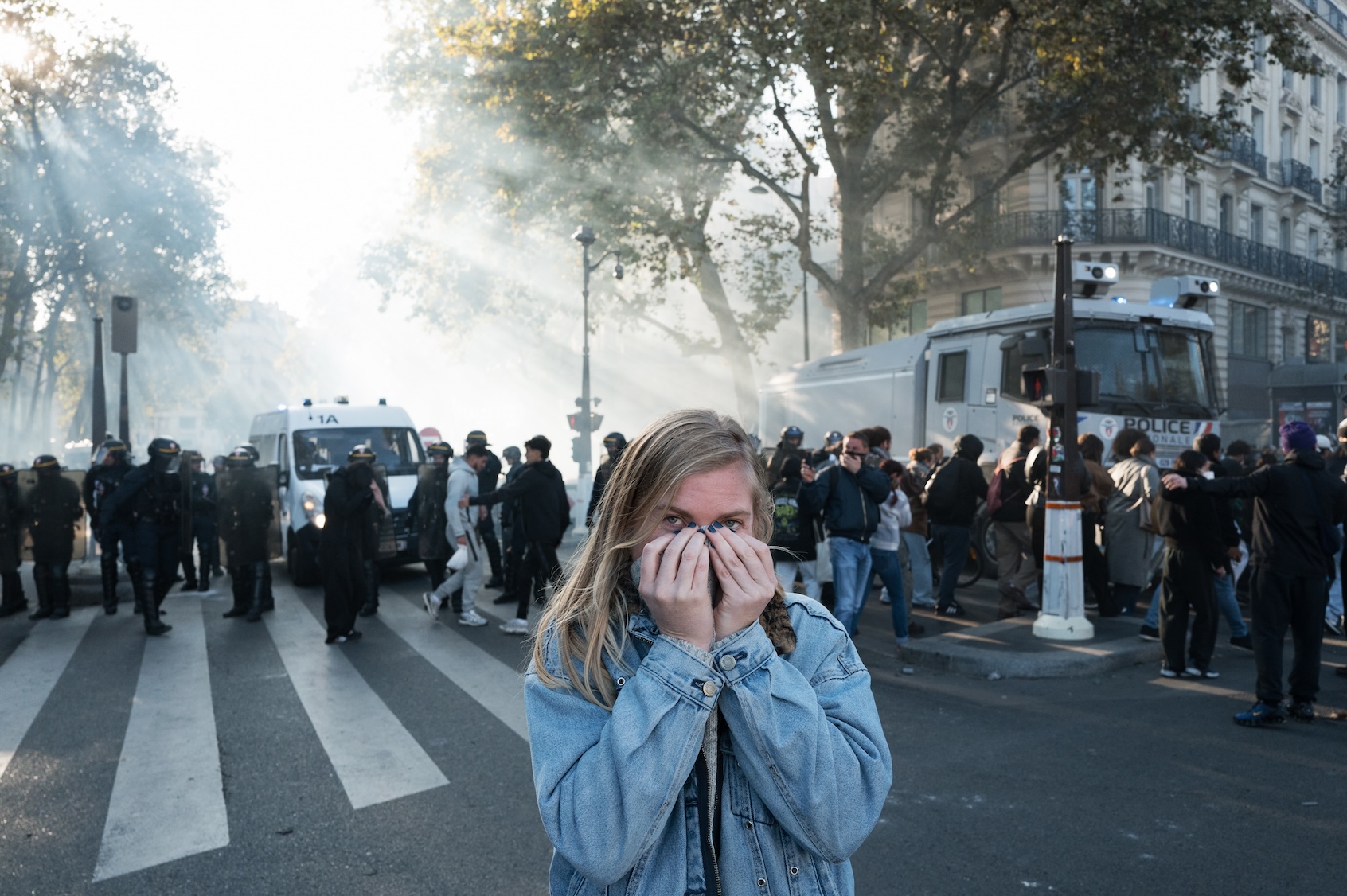
A protester reacts to tear gas fired by police at Place de la République in Paris, Oct. 18, 2026. (Jerome Gilles/NurPhoto via Getty Images)
A specter is haunting Europe, and plenty of other places too. Nobody knows quite what to call it. It isn’t the specter of communism this time around, or at least not under that name — although something approaching class warfare, redefined in 21st-century terms, is on the agenda for the first time in decades.
Student protests that began at secondary schools in the northern suburbs of Paris about a month ago have sparked a wave of demonstrations and street battles— occasionally tipping over into rioting, looting, and organized property destruction — that has now spread to at least six or seven countries, with new outbreaks happening nearly every day. But there is no single unifying issue that has brought students, labor unions, left-wing activists, anarchist rebels and hundreds of thousands of ordinary people into the streets of Paris, Lisbon, Madrid, Brussels, Milan, Belgrade, Athens and Tirana, among many other cities.
While the protests in Belgium and Italy are direct outgrowths of the French student movement, the proximate causes of unrest are local and distinct in every case. Protests in Spain and Portugal reflect years of simmering discontent over the soaring cost of living, especially a housing crisis made worse by the explosion of Airbnb-style tourist rentals. In Greece the protests were initially about workplace safety and public sector wages. In Albania and Serbia, where protest movements were well underway before the French students made headlines, the main issues involve deeply entrenched government corruption.
Thousands of miles away in the world’s largest self-described democracy, India’s youth-driven Cockroach Janta Party (“Voice of the Lazy & Unemployed”) isn’t connected to the French protests at all, except by the kind of historical coincidence that isn’t really a coincidence. The CJP was launched earlier this year, about halfway between political satire and social media experiment, and by midsummer became a mass movement that has shaken the autocratic Hindu nationalist government of Prime Minister Narendra Modi to its foundations.
Given this diversity and the tangential connections between all these events, it’s almost easier to say what the protest wave of 2026 is not about than to define it precisely. No dramatic world-historical event has catalyzed all this, and for the most part these protests are happening in relatively prosperous, relatively peaceful and nominally democratic nations. We’re not on the cusp of global financial or economic crisis, at least not yet, although there are troubling warning signs. There is no immediate threat of military conflict or civil warfare in any of these countries, although Russia’s war in Ukraine, Israel’s murderous war in Gaza and the spectacularly mismanaged U.S. war with Iran have all fueled the rising sense of collective outrage.
To use one of this decade’s most overused words, the outrage seems existential. It’s about everything everywhere all at once or, to more cynical observers, about nothing in particular. It’s about underfunded schools, crumbling infrastructure and soaring rents, and also about Gaza, climate change and the enforced spread of AI, data centers and government surveillance.
To use one of this decade’s most overused words, the outrage seems existential. It’s about everything everywhere all at once: underfunded schools, crumbling infrastructure and soaring rents; also Gaza, climate change, data centers and government surveillance.
Ironically enough given its origins, the outrage is also being driven by a highly literate and globally connected generation, one that is sufficiently well educated to perceive the underlying conditions that have made those things happen. They see paralyzed centrist governments held captive by bankers and tech billionaires; they see an economy built on worsening inequality, systematic insecurity and what sociologists call “elite overproduction” (e.g., university graduates working as baristas); they see the climate crisis addressed only with bland rhetoric or regulatory fiddling as one deadly heat wave follows another.
What the protests of 2026 are not about, to any measurable degree, is skin color or religion. Donald Trump, Elon Musk, Benjamin Netanyahu and far too many of their fellow travelers have seized on the disorder in Europe as evidence of the pernicious effects of “open borders” and Islamic immigration. It’s a losing proposition to quote stuff that the president of the United States says on social media and then feign outrage, as if we were actually surprised. But we are where we are: France is being “conquered, looted and burned to the ground by migrants, jihadists and communists who hate Christianity,” Trump informed us via Truth Social last week.
That fantastical framing tells us a lot more about him and his supporters, needless to say, than about the remarkably diverse crowds in the streets of Europe’s major cities. But the tempting prospect of blaming immigrants for the protests or the acts of violence — maybe not as the primary cause and way below the Trump level, in an effort to fend off critics on the right — has created a kind of acid test or moral hazard for political leaders and media commentators. The pass/fail ratio is both depressing and mildly surprising.
Embattled German Chancellor Friedrich Merz and the newly-installed Hungarian Prime Minister Péter Magyar, for instance, have failed the test, both suggesting that “high rates of migration and a failure to integrate the foreign-born are partly behind the sudden, violent upheaval,” to quote this week’s leading editorial in the Economist. So did New York Times opinion columnist Frank Bruni, an alleged liberal who began his breezy Oct. 22 discussion with right-winger Bret Stephens by stating the unquestioned premise that “a velocity of religious, racial and ethnic diversification over the past quarter century that has exceeded what many longtime residents could easily make sense of and comfortably adapt to” had somehow led to angry high school students and window-smashing anarchists in French cities.
As for French President Emmanuel Macron, bête noire of the protest movement, perhaps he has decided to go down fighting in the last six months of his largely disastrous decade in power. For all his arrogance and hubris, Macron is no racist and has decried the “stupid comments” by foreign leaders he declines to name, who claim that France has been “invaded by hordes of migrants and Islamists, which is completely false.”
But the most forceful rejection of current racist narratives about the European protests, and perhaps the best single summary of why they are happening in the first place, comes, improbably enough, in the above-quoted leading editorial in the Economist:
Even if some young protesters in France wear Algerian football shirts or chant pro-Palestinian slogans, the upheaval in Europe today is not about race or religion. Over 500,000 people marched in France on Saturday [Oct. 17] and they were largely unmasked and white. They were fired up, as in other countries, by the cost of living and poor public services. They want more fuel subsidies, more spending on schools, more handouts.
Leaving aside the buzzword “handouts,” which is meant to signal the innate laziness of the non-wealthy, that’s some straight-up gospel preaching. As the editorial confesses, once upon a time the Economist enthusiastically backed Macron as the golden boy of neoliberal reform, but now he and other “head-in-the-sand centrists” seem to be “out of ideas.” Strikingly, the editorial has no new ideas to offer.
In a Foreign Policy essay last week, former Estonian president Kersti Kaljulaid defines the central problem in Europe, plausibly but rather too vaguely, as “intergenerational hopelessness” and a downward spiral of economic expectation. Once again, the Economist — which can fairly be described as the house organ of global capital — goes at the issue far more directly. Demonstrators on Europe’s streets, its editorial proposes, are “consumed by rage”:
Rage at the failure of the state and against the floundering centrist politicians who govern. Rage at high prices and economic dysfunction. And for some, rage against the idea of centrist politics at all.
Go on with your bad self! It’s not irrelevant or accidental that the call, as they say in horror movies, is coming from inside the house. No one can credibly accuse the Economist of being soft on Marxism or unfaithful to free-market dogma (that same editorial mocks leftist French presidential candidate Jean-Luc Mélenchon, not inaccurately, as an “aging rabble-rouser and onetime Trotskyist”). That gives it the freedom to state plain facts that so-called moderates like Merz and Bruni would rather avoid: Yes, “centrist politics” have visibly failed, not just in France but across the Western democracies. Indeed the entire system or basket of principles known as “liberal democracy” is in big trouble, and on the verge of systemic failure.
Yes, “centrist politics” have visibly failed, not just in France but across the Western democracies. Indeed, the entire system or basket of principles known as “liberal democracy” is on the verge of systemic failure.
“Liberalism” in that context is not an ideological label in the contemporary American sense but a term from old-school political economy, used to describe the forced marriage in Western nations between market capitalism, parliamentary democracy, and a varying list of civil rights and civil liberties. Liberalism in that sense has dominated most of the world since the Cold War, and until recently it encompassed both major political parties in the U.S. I hardly need to convince you that is no longer the case, or that proudly illiberal parties and leaders have emerged and spread throughout the Western-style democracies, like an unpleasant but unkillable fungus. (As this article was published, it appears that Luiz Inácio Lula da Silva, Brazil’s leftist president, has defeated Flávio Bolsonaro — the son of imprisoned former president Jair Bolsonaro — ending a string of six consecutive right-wing victories across Latin America. True to form, Bolsonaro called for the results to be annulled.)
Liberal democracy was a roaring economic success for most of the 20th century, at least in broad strokes and with some well-known caveats. Oddly enough, those bygone glory days are pretty much what Trump keeps promising to bring back, to no visible effect. But the current crisis of liberalism is nothing new. It began to unfold decades ago, well before Francis Fukuyama proclaimed the “end of history.” Today’s enraged French students — and their parents, teachers and neighbors, for that matter — have inherited a world of false promises and diminished expectations.
Want more sharp takes on politics?
Sign up for our free newsletter, Standing Room Only by Amanda Marcotte, also a weekly show on YouTube or wherever you get your podcasts.
Real wages have steadily declined in most Western countries (including our own) since the 1970s, allowing for a brief uptick during the technology boom of the 1990s. Across the liberal democratic zone, social services have been slashed in one “austerity” budget after another while government debt has soared. Rapidly aging population has made large-scale immigration a necessity, while right-wing demagogues have seized on the new arrivals as the main cause of the economic problems that immigrants can ameliorate. The result almost everywhere has been an accelerating vicious cycle of political dysfunction and public disillusionment, fueling the rise of what the Economist calls “charismatic figures from the extremes,” meaning Mélenchon and Marine Le Pen in France, and no doubt Zohran Mamdani and You Know Who over here.
As a leading Marxist scholar told me decades ago, every radical who confidently predicts the collapse of capitalism is always wrong. If and when that ever happens, no one will have expected it. The same is likely true of liberal democracy today, which has survived worse crises than this and still retains broader popular legitimacy than is visible at this moment. Students in Milan and Marseille and Mumbai may well return to school and be reconciled to their lives, at least for now. But they have shown us something: There are dark passages ahead and enormous changes coming, and none of us can accurately identify the specter who blocks the path forward.


