

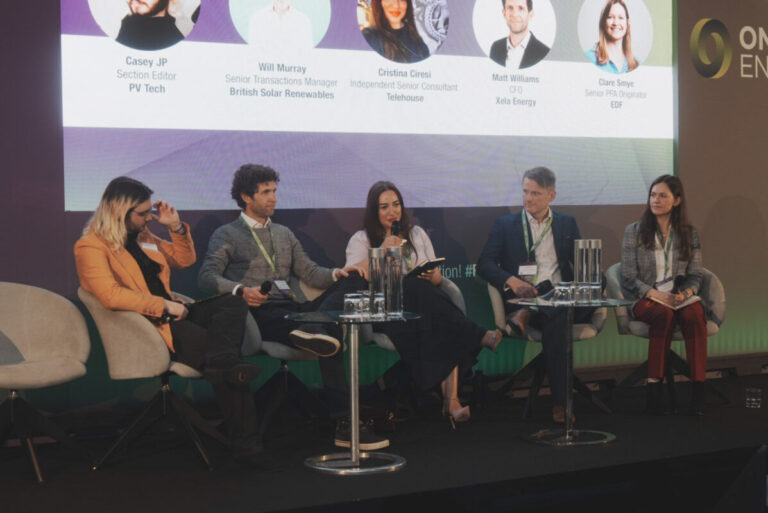
Panellists, moderated by PV Tech features editor JP Casey, addressed the challenges associated with signing a PPA, given the differences in priorities between the parties involved.
“In terms of generator versus corporate, a really key issue around risk that I’ve seen is around project delivery and any delays to a project coming online—this has repercussions for both the developer and the corporate,” Smye continued. “In all these things its around allocation of risk and who is best placed to manage that risk.”
Speaking from the corporate procurement side, Cristina Ciresi, independent senior consultant for data centre operator Telehouse, said the biggest challenge is “finding a structure that generally matches our operation profile and risk appetite”.
“One of the biggest sticking points is related to the fact that operational simplicity is also quite relevant.”
For Smye, mitigating this requires early alignment. “When the corporate starts thinking about whether they want a PPA, and what the key points they’re trying to address with a PPA are, having that alignment when they go out to market and have those bilateral conversations means that both counterparties will go in with a common goal.”
Matt Williams, CFO at UK-based private-wire solutions provider Xela Energy, said it’s “a great thing” that as the corporate PPA market has matured, deals have become commoditised—“to a certain extent”.
“Sometimes we come up against that in a negative way because the corporate don’t know exactly how to deal with us.
“For somebody who’s procuring power relatively infrequently and especially if they don’t have an advisor on board, we can spend a long time getting to understand the product before and might not fully understand what it is they’ve decided to do.”
Increasing complexity, additional risk
Smye agreed that over time corporates have developed better understandings of PPAs, but on the other side utilities and developers are seeing a “shift” in potential risks becoming more prevalent as the complexity of these agreements increases.
Ciresi agreed, saying: “PPAs today are far more sophisticated than a few years ago. It’s no longer enough to just buy renewable power, we need structures that support environmental, social and governance (ESG) reporting, power managing, operational simplicity, which add so many layers of sophistication and increases complexity.
“Every additional requirement changes the risk allocation and as such impacts the price point; the challenge becomes how to balance this sophistication with bankability and execution simplicity.”
Responding to this, Will Murray, senior transactions manager at British Solar Renewables, said that there would “ideally” be a standardised template for a PPA, but “with the market ever-evolving and things like negative pricing coming in, PPAs are always going to evolve and need certain bespoke touches within them.
“I think we need to end up with a tailored risk sharing solution,” he concluded.
There could be an argument that reducing the number of parties involved in PPA negotiations would reduce complexity. However, Murray said that third parties such as lawyers and advisors “most of the time are very good at finding the middle ground”.
For Ciresi, again coming from the procurer’s point of view, advisors can be “extremely valuable” because modern PPAs are highly technical, “so they can bridge the gap”.
“But buyers should deeply understand the implications of a deal; advisors are not going to replace direct commercial alignment,” she added.
Williams said that Xela has done “some great PPAs” without involving advisors, but for power providers there is value in having them involved. “Corporates have a very set process. Advisors help us navigate our way through that, too.
“What we find with particularly big corporations is that there are lots of stakeholders, so having someone who can pull that together on their side and give us some insight that really helps.”
Addition of energy storage ‘whole other layer of complexity’
As was a theme all day at the Renewable Procurement & Revenue summit where the panel was hosted, the possibility of adding battery energy storage to solar projects raises what interplay co-location and PPAs have.
Murray said that while British Solar Renewables does have AC-coupled co-located batteries in its portfolio, not corporates have asked for blended contracts. “Currently we are selling solar to corporates or contracts for difference (CfDs), and the battery is with an optimizer buying on a merchant basis.”
Ciresi said: “While storage improves flexibility and resilience, it also makes the commercial negotiations a lot more complex; operational simplicity is important for a corporation like ourselves.”
Smye agreed that adding storage is “a whole other layer of complexity and knowledge,” coming with additional risk.
“Having said that, I think they lend themselves to a portfolio approach, and offtakers can benefit from that broader portfolio approach,” she said.
Williams said that in his experience, discussions around BESS “quite quickly become too complex” and clients prefer to focus only on the solar offering.
“It’s one of those things that’s not quite there yet, but there are solutions being worked on with batteries, either around flexibility or people looking to bring their grid connections forward.
“There are definitely use cases, we just haven’t had one get through negotiation yet.”
This week’s Renewables Procurement & Revenue Summit, held from 20-21 May in London, is hosted by PV Tech publisher Solar Media. The event will cover PPA design, tackling high energy prices and more; for more information, including the full agenda and ticket options, visit the event website.
