



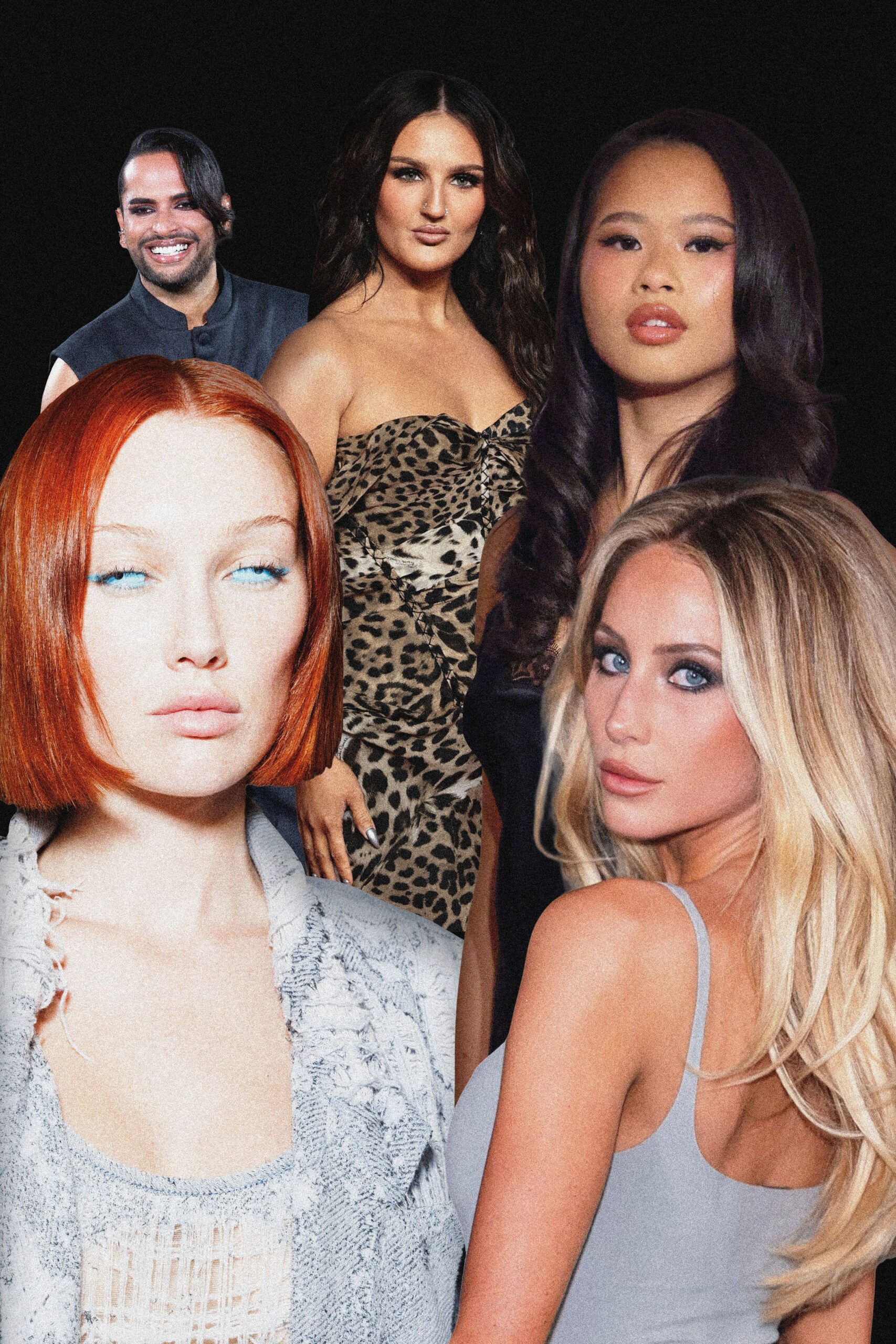
The most prominent creators in beauty today aren’t necessarily known for their creative artistry or scientific expertise, but for their ability to create entertaining, all-access videos showcasing their lifestyles or inner thoughts. One such example is the influencer Meredith Duxbury.
Duxbury began posting videos on TikTok during the Covid pandemic in 2020. But the turning point came in 2022 when her provocative foundation challenge, which involves applying an excessive layer of foundation (10 pumps, no less) and blending it entirely by hand, went viral. It even caught the attention of renowned makeup artist Bobbi Brown, who parodied her heavy-handed technique — inadvertently catapulting Duxbury (who counts more than 17 million TikTok followers and over 1 million on Instagram) into wider mainstream awareness.
Now, Duxbury appears to be gaining momentum once more. In May, she was a model in Gucci’s cruise 2027 show, walking alongside the likes of Paris Hilton and Cindy Crawford. Duxbury also walked the catwalk for the brand back in February, and previously for others including Diesel. And this fall, she’ll release her first book, offering a glimpse into her world of beauty, published by Rizzoli. The goal, she explains, is to “live and show up in different areas” besides on someone’s phone.


Meredith Duxbury for Gucci Resort 2027.
Photo: Courtesy of Gucci
Duxbury’s ascent represents the rise of distinctive, cult personalities across the wider beauty landscape, where the most prominent creators today, like Alix Earle (8.5 million TikTok followers and 5.6 million on Instagram) or Haley Baylee (17 million followers on TikTok and 9.8 million on Instagram), have cultivated an engaged audience with their seemingly frank, uninhibited content. Instead of polished salesy product placements, these influencers tend to share their lifestyles and inner thoughts — like reality TV characters, to be watched, enjoyed, and judged. In beauty, it marks a move away from heavily scripted campaigns and toward relatable, character-driven narratives.
While Duxbury still shares videos applying outrageous amounts of foundation, she has also begun posting “fly on the wall” content that shows her spending time in her New York apartment doing mundane activities like taking out the trash and unloading the dishwasher, while casually including shots of beauty products or applying her skincare. The approach is unlike those of early beauty enthusiasts like Michelle Phan and James Charles, who pioneered the online tutorial genre by posting hacks and how-tos of their extraordinary makeup looks, or professional experts like makeup artists and dermatologists, who use social media to express their creative artistry or share knowledge.
This shift has extended to how brands work with creators. Kirbie Johnson, an LA-based host, producer and co-founder of the Gloss Angeles podcast, recalls an influencer trip to Dubai in 2023 hosted by American beauty brand Tarte. “I remember thinking to myself, a lot of these people are not inherently beauty-specific creators,” she says. “They’re not doing their makeup every day, they’re not reviewing products straight to camera. A lot of these people had no real authority in beauty at all, but their audience identifies with them.”
Tarte was also one of the first beauty brands to host a creator’s birthday trip. When JaNa Craig, best known for her standout appearance on season 6 of “Love Island USA” celebrated her 29th birthday last year, the brand brought Craig and her friends from the show to Turks & Caicos. “Our social content felt like a reality show unfolding in real time. Our community was literally commenting, ‘Tripping with Tarte x JaNa is my new favourite reality show,” Tarte Cosmetics’s founder and CEO Maureen Kelly tells Vogue Business.
As Kelly explains, consumers are “looking for authentic people they trust.” Therefore, the individuals driving “the biggest beauty conversations often aren’t beauty-first creators anymore. They’re lifestyle creators, reality TV stars and cultural figures, who happen to use beauty products,” she says. “Their audiences aren’t following them for a mascara review – they’re following them because they feel invested in their lives. That’s what drew us to creators like Alix Earle, Meredith Duxbury and Katie Fang. Each of them has built a relationship with their audience that’s bigger than any one category.”
An antidote to ‘AI slop’
Earle’s unfiltered content propelled her to viral fame, and it’s a tactic she’s continued using. Just this week, she posted a video doing her makeup while discussing the viral TV series Off Campus. Elsewhere, she can be seen promoting Armani Beauty concealer while sharing her personal red flags alongside her sister. “This is such a creative idea for an ad lol,” reads the top comment.
Earle’s relatability and honesty may resonate with viewers tired of “AI slop” — a term used to describe low-quality, mass-produced content lacking creativity or deeper meaning — and has subsequently propelled her beyond being a mega-influencer and into a global personality in her own right. In 2025, she appeared on the hit American TV series Dancing With the Stars, finishing in second place. And in May, Netflix announced that it would debut a new reality show, Earle Meets World, offering a behind-the-scenes look at her life.
Katie Fang, a New York-based beauty influencer, who counts over six million followers on TikTok and another million on Instagram, seems to be on a similar trajectory. While Fang is best known to viewers for her makeup and skincare recommendations, she has also “started posting more” content outside these topics. “People have really been loving my lifestyle videos, especially since I moved to New York, and now that I’m in college, they’ve really been loving following my routine,” she explains. “So when I film lifestyle content, I integrate beauty products. I feel like that’s more engaging for the audience — and more authentic because I’m just filming everyday life. It doesn’t feel like I’m shoving a product into my audience’s faces.”
As creators take a more holistic approach to their content, the boundaries between beauty and other industries have also rapidly blurred. As a result, influencer marketing promotes more than just the function of products. “Now, you have people who don’t necessarily have any form of professional training, or may not even be creating the bulk of their content within the world of beauty itself, but they dabble in beauty as part of a broader set of lifestyle trends,” says Alex Rawitz, director of research and insights at CreatorIQ, an influencer marketing and creator management platform.
CreatorIQ’s top performing beauty creators by earned media value (EMV) from May 2025 to April 2026 — among them Monica Ravichandran, Aditya Madiraju, and Lina Noory — embody this: while their specialty is beauty, they aren’t limited to the subject. This week, for example, Ravichandran posted a video on how she would get dressed as someone who is “petite” and “curvy”. Meanwhile, Madiraju’s videos aren’t only limited to advice on blush placement and finding one’s foundation shade; he has also talked about getting his eyes checked while trying on a selection of Warby Parker glasses. In another video, he can be seen teasing his appearance on Hosted by Nabela Noor, a new lifestyle series that aired on Tubi in May.
Reality sells
As influencers expand their approaches, there still “has to be something that makes people think about you and know who you are”, advises Johnson. Throughout Duxbury’s highly viral career, her adoption of extreme, full-coverage makeup has frequently sparked intense debate and criticism. Though it’s arguable that, without such controversy, she may not have the following she has today. It hasn’t deterred brands like Prada, YSL Beauty, L’Oréal, Elf Cosmetics, and Morphe from partnering with her either.
The same could be said of American beauty influencer Mikayla Nogueira. With over 17 million followers on TikTok, her “GRWM” videos show her applying makeup while sharing the messy details of her divorce. Nogueira is among a growing wave of creators who use the GRWM format to simultaneously discuss sensitive or unpopular topics. “She’s been very public about it,” says Johnson, adding that the shock factor may be one thing keeping viewers coming back to Nogueira, aside from her love for beauty.


Rawitz observes that with deliberately provocative creators, “there’s some kind of drive for gossip or drama that is satisfied by following them”. It’s often the impetus for a “hate follow”, in which people follow accounts on social media whose content they actively dislike or fundamentally disagree with. In those cases, viewers “don’t necessarily want the lifestyle for themselves, but it satisfies some kind of itch”, Rawitz explains. “I think it’s a large reason why reality TV took off, and creators are starting to blur that line.”
Johnson recounts when an influencer was taken to Coachella as part of a brand deal and “there was big drama” around them at the music festival. “I asked the brand how that was, like, ‘Oh my gosh, was it horrible?’ And they said, ‘No.’ It didn’t drop sales, and if anything, encouraged more people to buy the product.” In her view, “it’s no different than a reality star playbook. There has to be something that makes a mass amount of people talk about you, whether that’s good or bad. I don’t know that brands necessarily care what it is, unless the person does something that’s catastrophically and morally wrong, and obviously anything that is racist or bigoted.”

Asked whether Kelly ever felt it was a risky move for Tarte Cosmetics to work with individuals who were outspoken and therefore, at times, unpredictable, she responds: “I think brands sometimes make the mistake of looking for perfect spokespeople” or try “to smooth out the edges that made someone influential in the first place.” However, “consumers aren’t looking for perfect people, they’re looking for authentic ones.”
Rawitz’s advice for brands is to consider “what you’re trying to achieve”. He explains: “If generating awareness is the primary goal, and they want to break through the noise and expose themselves to a wider audience,” then partnering with creators with strong personalities could lead to such results. However, if the intention is to sell a certain amount of product or generate positive brand sentiment, smaller-scale creators “who tend to be a little closer to their audiences and more detailed in their content” may be the more desirable route.
Duxbury says she’s become accustomed to online scrutiny from viewers who aren’t always fans. “When I started, I knew that I was opening myself up to everyone’s opinions. If someone doesn’t like what I’m doing, it’s fine. I don’t fit everyone’s vibe or journey,” she says “Maybe people don’t love the foundation stuff so much but they follow me for my fashion journey.”
Her drive to live authentically is what may have appealed to brands. At Gucci, beyond modeling the clothes, Duxbury has served as an unofficial consultant. “Demna really wants the consumer who’s buying Gucci to feel like they can relate. So when he creates these lookbooks, he’ll ask things like, ‘On a night out, how high or low would you have this zipper?’ Or, ‘How would you carry this bag?’” She also counts clients like Google, for whom she’s worked with on developing its AI tool, Gemini, and the kinds of beauty advice it could give.
For Amy-Lee Cowey, co-founder and CEO of creative agency They Say Studios, the developments are all indicative of how beauty no longer operates as a distinct, “one-lane” industry, but as a hyper-connected ecosystem. Therefore, “the brands that have navigated this best have understood early that influencer marketing isn’t a distribution channel, it’s a cultural channel,” she says. “In their meetings, they’ve stopped asking, ‘How do we reach beauty consumers?’ But they’ve started asking, ‘Where does culture actually live where beauty consumers are?’ It’s a fundamental shift in how a brand conceives of its influence.”


