



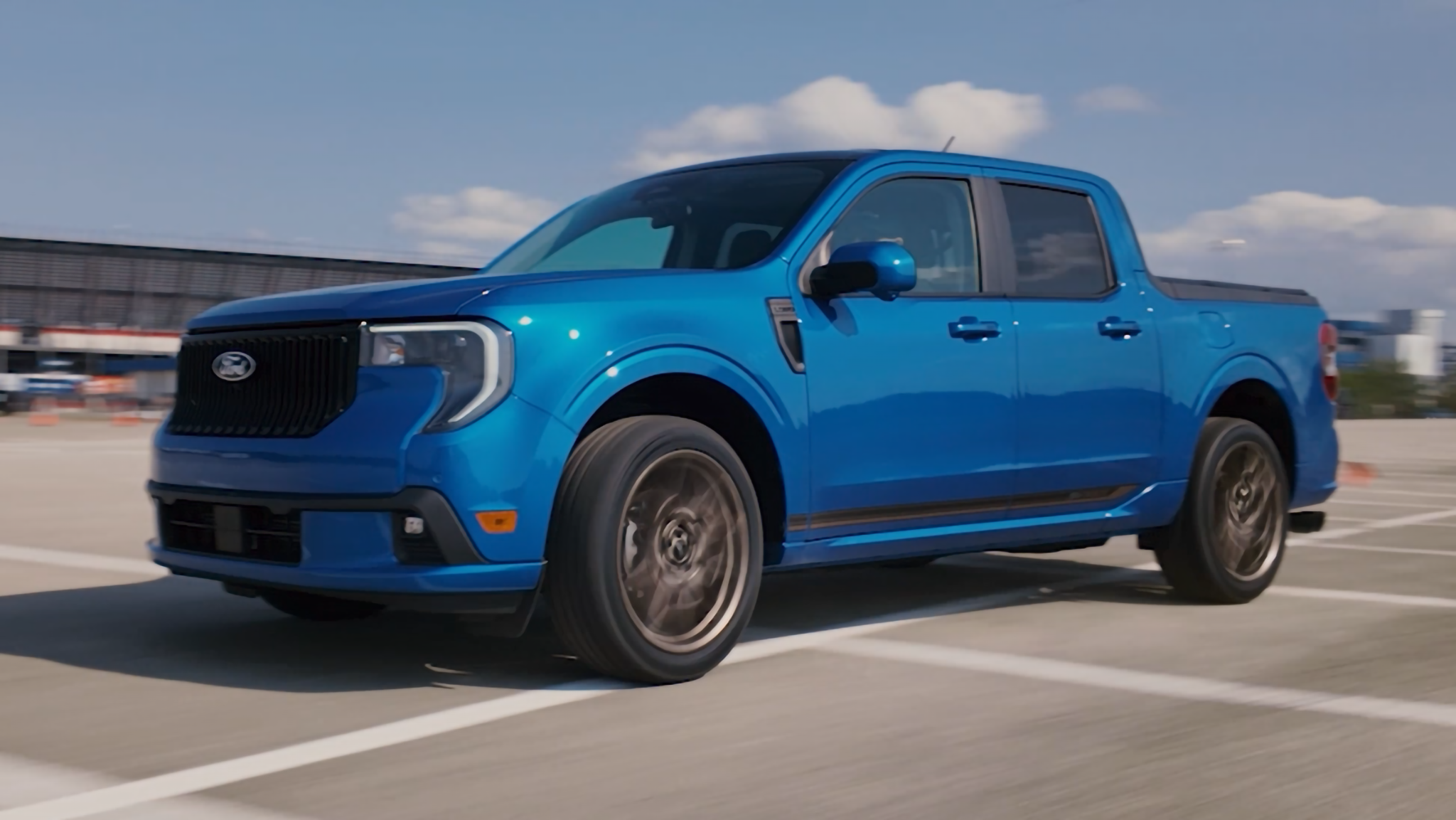
Bend it into a corner, and the Maverick beelines for the apex thanks to the Michelin Pilot Sport 4S summer tires on the trucks we drove. The impressive cornering grip quickly exposes the biggest flaw in the whole SV300T package, though. The Maverick’s soft and flat seats weren’t made for these kinds of g’s. You’ll feel like you’re about to fall out of them even with the seatbelt cinched tight.
Before driving these trucks, I assumed that the Maverick XLT would be the hot ticket—a budget build that punches above its price. After wheeling the SV300T, though, the Lobo is clearly the best starting point. Its quicker steering ratio, paddle shifters, and more relaxed stability control unlock an additional level of fun and intensity. More important, its twin-clutch rear axle jockeys torque left and right, helping the SV300T rotate into corners more playfully.
How Much and When?
Because there are so many ways to build and obtain an SV300T, pricing is complicated. The larger package for XLT and Lariat trucks will cost $5,000, but that doesn’t include installation or tires for the 20-inch wheels. Ford says a dealer should be able to install the components and update the various controllers in about 18 hours, which should put the labor cost around $3,000 to $5,000.
Ford recommends (but doesn’t require) using an XLT or Lariat with $745 4K Tow package, which includes a larger radiator, upgraded cooling fans, and a transmission oil cooler. That means a starting point of $34,030 before the SV300T upgrade. With tires, labor, and the parts package, we’re estimating about $43,000-$45,000 all in for an XLT-based SV300T.
A bare-bones Maverick Lobo costs $37,775 from the factory, but Ford hasn’t disclosed any pricing for the Lobo upgrade kit. We can only say that it will be cheaper than $5,000 since it doesn’t include any suspension components. That package bolts on in roughly 13 hours or $2,000 to $3,000 worth of shop time. We’re hoping a Lobo SV300T will only be one or two more grand than the XLT by the time you account for every expense.
For now, we’re also in the dark on pricing of the turnkey trucks that leave the Hermosillo, Mexico, factory and make a pit stop at Ford’s third-party installer before landing on dealer lots. Theoretically they should be cheaper than paying your Ford dealer to do the labor, but we also won’t be surprised if a dealer in Iowa or Mississippi figures out a way to undercut everyone else.