




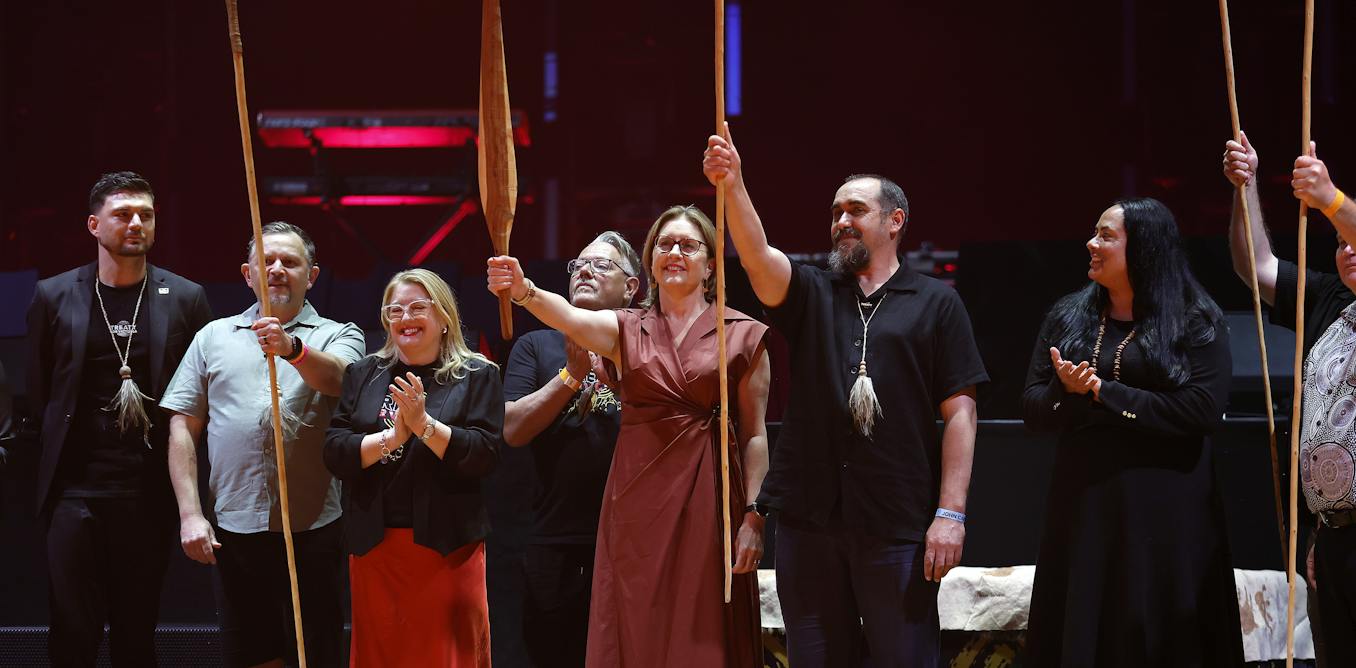
Victoria has made more progress in advancing Indigenous rights than any other jurisdiction in Australia. However, those achievements sit precariously as the state heads to an election on November 28.
If Labor loses and there is a change of government, measures that have been established to support Indigenous self-determination in Victoria will likely be dismantled.
Conservative parties in Victoria, including the Liberals and One Nation, have all promised to abolish treaty.
What’s currently in place in Victoria?
“Treaty”, in the context of Indigenous-settler relations, refers to an agreement between Indigenous groups and the state that resolves grievances stemming from the impacts of colonisation. It usually involves some form of compensation, and establishes new arrangements that recognise and respect the distinct political status of parties.
Victoria’s Statewide Treaty Act 2025 provides the framework for treaty negotiations between Traditional Owners and the state.
Gellung Warl (meaning “tip of the spear” in Gunaikurnai language) is the Indigenous body overseeing treaty negotiations in Victoria. Under this body there is also:
-
Nginma Ngainga Wara, which provides independent oversight and accountability for government
-
Nyerna Yoorrook Telkuna which is continuing truth-telling processes alongside treaty-making.
The First Peoples’ Assembly of Victoria, initially established to investigate treaty, has now become a permanent representative body for Indigenous Victorians and sits within Gellung Warl.
It provides advice to government and can make inquiries directly to state ministers on matters relevant to Indigenous Victorians.
The Treaty Authority is an independent body that assists groups in making agreements through treaty negotiation. It also administers the Treaty Negotiations Register, with eight Traditional Owner groups currently on the list.
The truth-telling work of the Yoorrook Justice Commission has officially ceased, but its recommendations still need implementation.
Four Traditional Owner groups have Recognition and Settlement Agreements with the Victorian government. These agreements, which cannot be voided by repealing the underlying legislation, give formal recognition to Traditional Owner groups through an agreed-upon settlement relating to land claims.
However, there is still the task of implementing agreement provisions. This depends greatly on parties having good working relationships.
Another important piece of the policy infrastructure in Victoria is its Indigenous cultural heritage laws – arguably the strongest of its kind in Australia. The Aboriginal Heritage Act 2006 provides Traditional Owners with means to be involved in identifying and managing potential harm to Aboriginal cultural heritage sites.
So, what’s at stake?
The Liberals, Nationals and One Nation in Victoria are all in favour of scrapping the state-based treaty.
The Liberals have characterised treaty as “divisive”. This language was also used by conservative parties in campaigning against the Voice to Parliament. However, polling shows repealing treaty is not a priority for most Victorian voters.
One Nation has conflated the outcome of the Voice referendum with treaty to suggest Victorians do not support their state treaty.
Scrapping treaty would mean the end of Gellung Warl, the First Peoples’ Assembly of Victoria, and the Treaty Authority. It would put treaty-making in the state on hold.
The current Aboriginal cultural heritage system in Victoria has also been criticised by the Liberal National coalition, amplifying concerns it holds up development. However, less than 1% of proposed developments actually fall within the purview of the legislation.
Dismantling treaty now would also have dire consequences for the truth-telling Yoorrook Justice Commission, as the Victorian government is still working on implementing its recommendations.
What can we expect after the election?
If the Liberal-National coalition is voted in at the election, they will undoubtedly try to abolish treaty.
But, more broadly, the Liberals are campaigning for cutbacks to public spending – despite concern from economists. Cutbacks to Indigenous programs could also be on the cards.
There is also the growing issue of anti-Indigenous sentiment post-Voice referendum, as seen in more visible rejection of Welcome to Country ceremonies, for instance.
One advantage that Indigenous groups in Victoria have over other Australian jurisdictions is how deeply embedded their governance systems are within the state’s political environment.
But, there are also broader political trends happening that must be considered.
The wider backlash
Conservative backlash against Indigenous rights in settler colonial nations is growing across the globe.
New Zealand conservative parties have repealed laws supporting Māori rights, while attempting to weaken the role of the Treaty of Waitangi in Māori-settler relations.
In Canada, First Nations are having to deal with increasing challenges to treaty rights. They have been disregarded and labelled undemocratic in a recent referendum on secession in Alberta, and threatened with annexation by US President Donald Trump.
In Australia, conservative parties have long been generally adversarial towards Indigenous rights. Since the failed Voice referendum, opposition has been turned up several notches. Newly elected conservative-led governments in Queensland and the Northern Territory have scrapped treaty-based initiatives, using the Voice referendum outcome as justification.
More recently, the Queensland government has been accused of deliberately diminishing Indigenous representation, recognition and engagement across the public sector. A recently drafted updated Queensland state planning policy also does not include recognition of Indigenous culture and heritage – a change from the current policy which came into effect in 2017.
If Victoria follows this direction, there could be far-reaching implications for existing structures that support Indigenous self-determination.


