





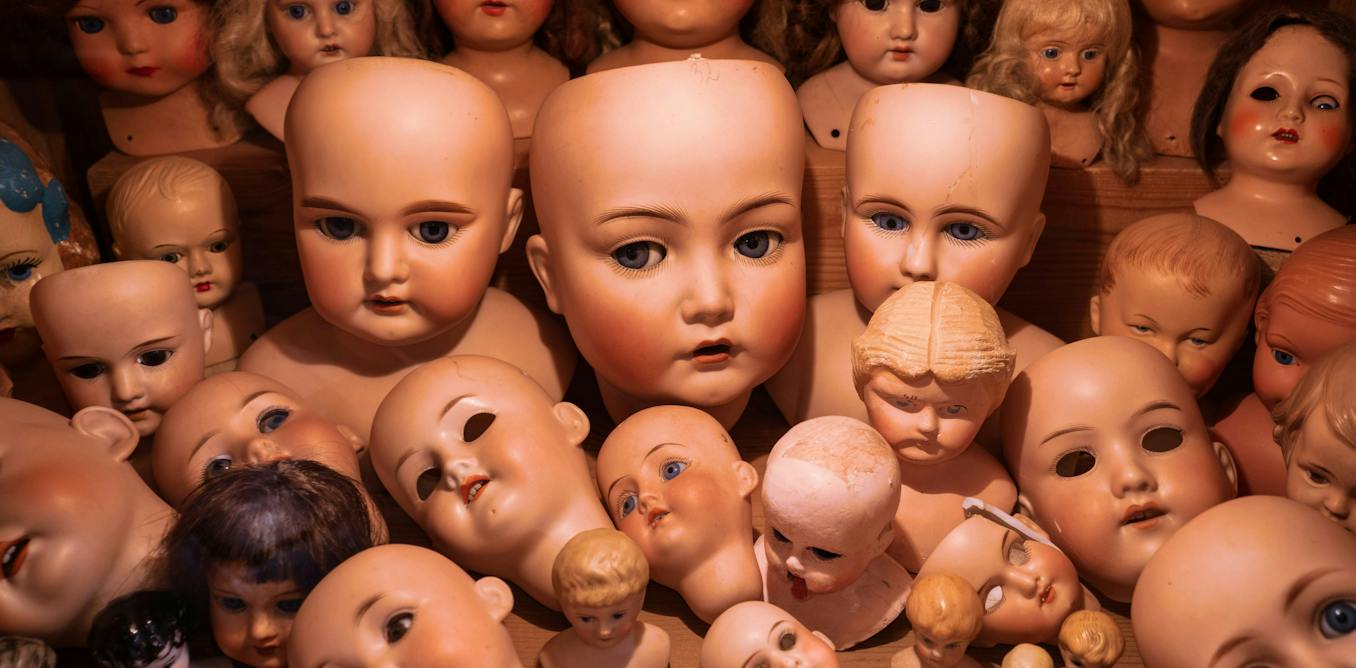
John A. Scott’s latest novel, The Boy Who Loved Dolls, has the bare bones of an archetypal Gothic narrative: a young woman confined in a sprawling mansion; an enigmatic, possibly sinister older man; the disconcerting traces of a former lover, her disappearance still unsolved; the fear of sharing her fate. Early on, there is an allusion to Daphne du Maurier’s Rebecca, and the opening half of Scott’s novel hovers in the same zone of paranoia and hauntedness.
Review: The Boy Who Loved Dolls – John A. Scott (Puncher & Wattmann)
On top of this genre framework, The Boy Who Loved Dolls explores the 20th century’s cultural legacies. Scott, an English-Australian poet and novelist, is a double winner of the Victorian Premier’s Award and double shortlistee for the Miles Franklin Literary Award. The Boy Who Loved Dolls, his 18th book, is animated above all by a passion for the French avant-garde. It looks back to French surrealism and post-war European cinema, and the way they responded to the horrors of fascism and war.

The novel’s protagonist is Jean-Jacques Baille, a fictional French film director from the generation of Jean-Luc Godard, Agnès Varda and François Truffaut, living reclusively in Australia. You need to suspend your disbelief that such a legendary avant-garde artist would decamp to a country estate outside of Melbourne, all the while continuing to make films in France with an apparently Australian crew.
The reason for his antipodean move appears to be love. Late in his career, he falls for a young Australian woman, Anna, whom he casts in all his productions, despite her lack of acting experience or ability to speak French.
In 1984, three years before the main narrative begins, Anna is abducted from her chauffeured car by a gang of masked men. At the time, she was flicking through a script sent to her by the Italian director Bernardo Bertolucci, who was perhaps trying to poach her as a muse of his own. The motive for the abduction and the fate of Anna remain a mystery.
Baille retreats to his Australian estate, but not before making one final cryptic film, Christophe, le Peintre, about a painter grieving for his lost lover. The lover is played by an actor who uncannily resembles the missing Anna.
Dollhouse mentality
The novel properly begins as the film critic Susan Vaughan pulls up to Baille’s estate armed with cameras and an overnight bag. Susan, who seems to subsist on cigarettes and soup, is there to interview Baille for a retrospective documentary about his work.
At 27, she is exactly half the director’s age and she approaches him with a degree of reverence. Both admit to not being good at small talk, so they leap immediately to big talk: childhood trauma, Nazism, the faults of French film director Jean Renoir. Both are spinning fabricated versions of themselves. Both are more broken than they appear.
Baille introduces Susan to his collection of dolls – he is the grown-up boy of the title. In a windowless nook near the dining room, he has created a museum of rare and historic specimens, including a piece by the avant-garde dollmaker Lotte Pritzel and a disturbing surrogate mother doll used in psychological experiments on monkeys in the 1950s.
It makes sense for a director, especially an overbearing auteur like Baille, to be interested in dolls. Alfred Hitchcock, too, was a boy who loved dolls, in the sense that he treated his actresses as things he could dress and manipulate. Within the world of Hitchcock’s films, women are remodelled (like Madeleine in Vertigo) or preserved as doll-like trophies (Norma Bates in Psycho). In Rear Window, the miniaturised clockwork tableaux playing out in each apartment window, controlled by Hitchcock through hidden earpieces, were arguably just another set of dolls for the great director to play with.
We see in Baille a similar dollhouse mentality. More disturbingly still, his dolls evoke fears of the body’s disintegration. His museum includes doll photographs by the German surrealist Hans Bellmer, whose work, Baille explains, “displayed increasingly grotesque manipulations and dismemberments of the human body that reflected the Nazi brutalities”.
When Susan later inspects Baille’s doll hospital, with its racks of spare dismembered parts, she can’t be sure if Baille is repairing and reconnecting or breaking them apart in the manner of Bellmer.

Paramount Pictures, Public domain, via Wikimedia Commons
Figurative dismemberments
The novel presents us with transcripts of Susan’s interviews, conducted over several days. These are intercut with scenes of her wandering the halls of the house and studying copies of Baille’s rarest films in his darkroom.
She is most interested in Christophe, le Peintre, a film that tries to process Anna’s disappearance and grapple with the meaning of art in the face of death. At the gruesome climax of the film, the grieving painter abandons his art and amputates his own hand.
The film is filled with more figurative dismemberments. Its jarring jump cuts and mismatched edits suggest the reality it constructs is, as Baille says, “an act of violence”.
Susan, like a dutiful film school graduate, name-checks the feminist psychoanalytic theorist Laura Mulvey, who made a related claim about the symbolic violence of the camera in her classic essay Visual Pleasure and Narrative Cinema (1975) – though the novel mistakenly calls her “Linda Mulvey”, which is one of a few minor textual errors that could have been smoothed out before publication.
Mulvey argued that Hollywood cinema fetishises and dismembers the female body. Its close-ups of legs, lips and torsos turn actresses into products for the male gaze. In Rear Window, when Jimmy Stewart looks (via a point of view shot) at the legs of the woman he calls “Miss Torso” and muses about how difficult it would be to cut up a human body, the camera can be seen as a mechanism of dismemberment.
Susan starts to notice symbols of severance and bisection everywhere in Baille’s film. There are half moons, half-filled cups, clocks at half-past the hour. When she slices the 100-minute film in half, and then in half again, she believes (in the manner of Michelangelo Antonioni’s film Blow-Up) that she has uncovered a visual clue to a hidden crime.
At almost exactly the halfway point of The Boy Who Loved Dolls, near where the sewn binding is visible through the centre crease, Susan stumbles upon an apparent message within Christophe that seems to be speaking directly to her. It says: “Are you listening?” This opens the door to the second half of the novel, which plays out with the literate luridness of a Brian de Palma film.
The sliced-up imagery of Christophe is an extension of Scott’s interest in severing and suturing, as a theme and a methodology. As literary scholar Peter D. Mathews argues, Scott
‘stitches’ together heterogeneous ideas and influences to form a creative intersection of design and chance, just as the scattered fragments of Orpheus’s mutilated body stir back to life.
Mathews writes that Scott explores “how literature dismembers, and then selectively reanimates, its influences”. The Boy Who Loved Dolls extends this thinking to the film camera’s dismembering and reanimating power. But this late work seems more pessimistic about the redemptive and transfigurative power of art.
Readers may enjoy Scott’s fragmentary and citational style, which refuses easy answers. At times, though, I was hoping for more sustained lines of thought. Some of the novel’s ideas about cinema, gender, violence and fascism seemed to flash and flicker out. In this novel of amputations and spare parts, I was looking for more connected thinking, though there is admirable intellectual ambition and potent image-making in this idiosyncratic take on the Gothic.


