





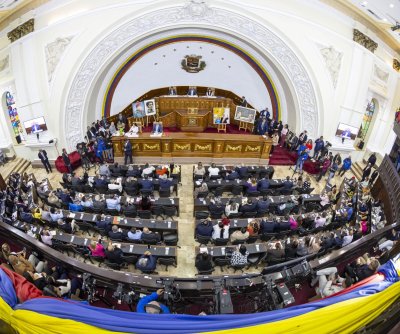
On Feb.19, Venezuela’s National Assembly passed the Amnesty Law for Democratic Coexistence, presented as a step toward social peace and national reconciliation. File Photo by Miguel Gutierrez/EPA
June 23 (UPI) — Amnesty can open a prison door. It cannot, by itself, rebuild justice.
That distinction matters for Venezuela. On Feb.19, the National Assembly passed the Amnesty Law for Democratic Coexistence, presented as a step toward social peace and national reconciliation. For families waiting outside prisons, any release matters. For a person who has spent years detained for political reasons, freedom is not abstract.
For Carmen Teresa Navas, an 82-year-old mother, that promise came too late. She searched 16 months across prisons, courts and government offices in Caracas for her son, Víctor Hugo Quero Navas, detained in January 2025 on terrorism charges. In May, officials finally confirmed what they had long denied: he had died in state custody the previous July, and had been buried without notifying his family. Carmen died 10 days later.
Her case shows why amnesty is not the same as justice.
Human Rights Watch reports that at least 457 political prisoners remain behind bars despite the law, with many opposition members, journalists, and human rights defenders excluded. Amnesty International puts the figure at 485. Many families still do not know whether their loved ones will be included or turned away. Among those denied: Samantha Hernández, a teenager detained in 2025 by Venezuela’s Military Counterintelligence Directorate on charges of terrorism and incitement that rights groups say were politically motivated.
This uncertainty reveals the deeper problem. A genuine transition cannot depend on discretionary mercy from the same institutions that denied justice in the first place.
For years, courts and prosecutors were used not to punish crimes, but to punish dissent. Charges of terrorism and treason were brought against political opponents and ordinary citizens accused of disloyalty. Legal language became a tool of fear, and the officers meant to uphold justice became instruments of that fear.
When the law is used in that way, an amnesty cannot simply erase the damage. It must be part of a larger process that asks who was persecuted, who gave the orders, who benefited, and how the institutions themselves must change.
Human Rights Watch reported in 2024 that detainees released after the post-election arrests were often forced to sign statements barring them from discussing their detention, or to record videos claiming their rights had been respected. There is no indication that these practices have stopped under the new amnesty.
The U.N. Fact-Finding Mission on Venezuela welcomed the law but noted it was adopted without inclusive public consultation and lacks essential mechanisms for truth, accountability, and reparation. U.N. High Commissioner for Human Rights Volker Türk told the Human Rights Council in March that Venezuela needs a comprehensive transitional justice strategy and that the amnesty law was drafted without adequate consultation across society.
Those assessments point to four tasks that the amnesty law alone cannot accomplish.
The first is truth. Venezuela needs an honest public record of what happened: arbitrary detentions, torture, forced exile, and the use of fear as a method of governance. This is not revenge. It is memory made public. A society cannot rebuild trust if victims are told to be silent for the sake of stability. Stability built on silence is fragile.
The second is accountability. Transitional justice requires distinction. There is a difference between a low-level official who followed orders under pressure and a judge or commanding officer who designed or directed persecution. Justice must be credible, but also fair. Collective punishment would deepen division. Total impunity would deepen cynicism. Venezuela needs a path between those two approaches doomed to fail, one that is rooted in due process.
The third is restitution. In May, National Assembly president Jorge Rodríguez told the Venezuelan diaspora to “move on, forgive us and come back.” That request gets the order backward. People who lost years of freedom or family life deserve recognition and repair before they are asked for reconciliation. Reparations can include restored rights, public acknowledgment, and the clearing of politically motivated charges, along with support for families who bore the burden while loved ones were imprisoned.
The fourth is institutional reform. This may be the hardest step. If courts and intelligence services remain unchanged, injustice can easily return, dressed up in new language. A democratic future requires judicial independence and security forces that understand the limits of state power.
This is why transitional justice is not a secondary issue.
Without it, citizens may vote but still fear the state. Without truth, schools may reopen but history will remain distorted. Without institutional reform, new leaders may inherit old tools of repression.
For my generation, this question is not theoretical. We have seen families divided by exile and professionals driven from the country. Carmen Navas searched for her son the way so many of our own families have searched and hoped. Her pain is not distant from ours.
The international community has a role to play, but it must be careful. Outside governments and organizations can support documentation and legal assistance. They can insist that releases be transparent and that human rights obligations be respected. But justice cannot be imported as a foreign formula. It must be owned by Venezuelans.
The International Center for Transitional Justice has observed that the true scope of this amnesty will be measured not only by the number of people it frees, but by its ability to create genuine conditions for pluralism and reintegration. That is the right measure, and it is one the law has not yet met.
Amnesty may be necessary in moments of transition. It can reduce suffering and create political space. But if it asks victims to forget while the institutions of repression remain intact, it becomes a way to close the door on the past, without confronting it.
Venezuela deserves better. The country does not need vengeance. It needs a justice process that can tell the truth, hold the right people accountable, and make sure this cannot happen again.
Daniela Fonseca, a Venezuelan student at Yale University and Jack Kent Cooke Foundation scholar, conducts research on education, transitional justice and democratic reconstruction in her country. The views expressed are solely those of the author.


