

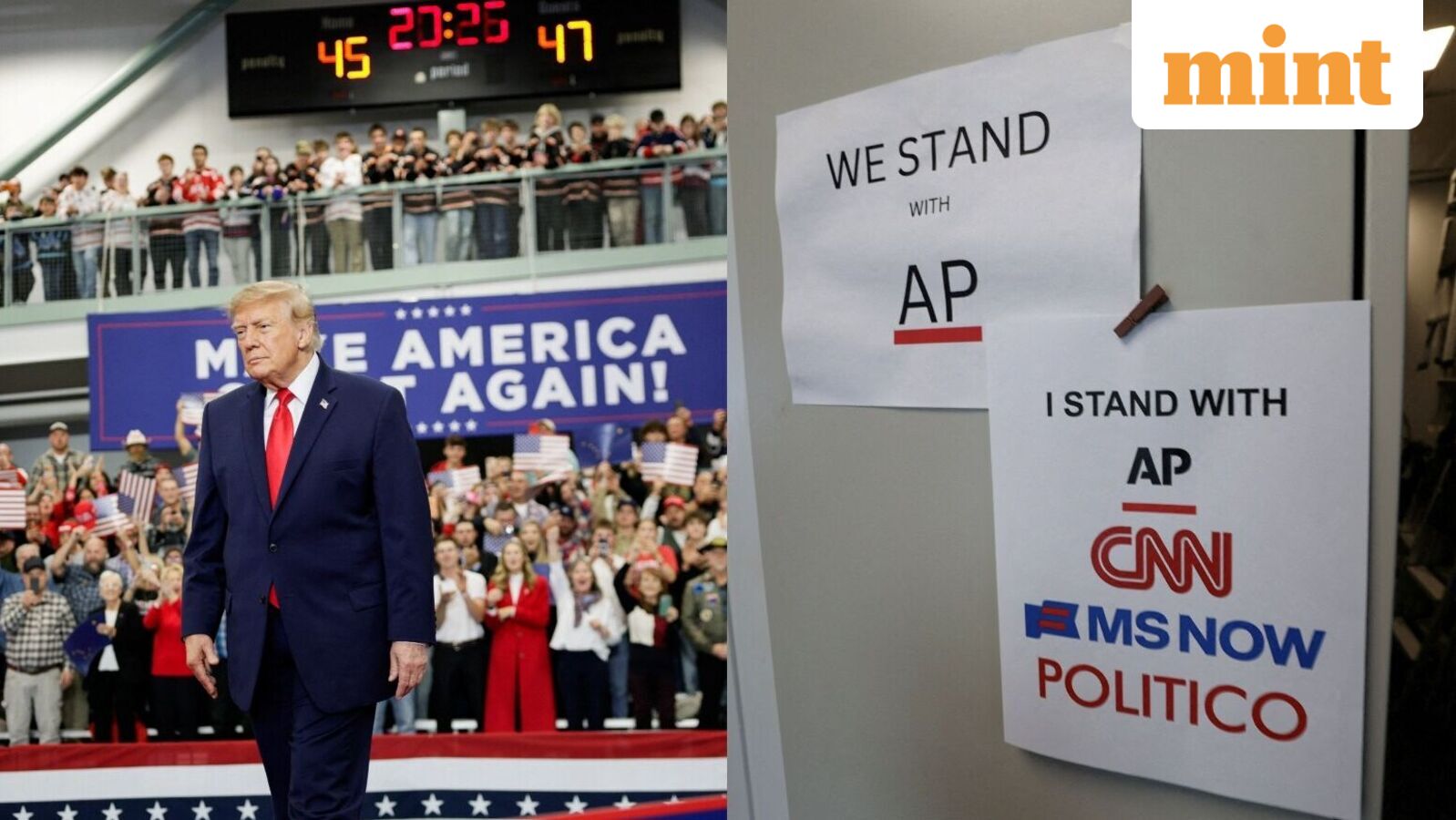
US federal judge Timothy Kelly ordered the White House to restore access for 78 reporters from CNN, MS NOW and Politico, saying Trump’s ban may have broken the law. The outlets welcomed the ruling, which comes weeks before the US midterm elections.

US federal judge Timothy Kelly on Tuesday (local time) granted relief to three news outlets by extending their access to the White House, stating that US President Donald Trump may have broken the law when he tried to bar journalists from CNN, MS NOW and Politico from the premises.
What did the federal judge say?
In his written decision, Kelly elaborated on his 24 September emergency order restoring the journalists’ access to the White House. The news outlets and press freedom organisations have alleged that Trump violated the Constitution by retaliating against journalists whose reporting displeased him, AP reported.
The federal judge went on to say that Trump’s ban affected 78 reporters across three news organisations. He ordered the White House to restore the reporters’ “hard passes”.
The federal judge accepted the plaintiffs’ argument that the administration had raised national security concerns only after taking action but had failed to substantiate them. Kelly wrote that without a preliminary injunction, the outlets “are likely to suffer irreparable harm, and that the balance of the equities and the public interest tip in their favour.”
He further stated that the White House did not warn the plaintiffs they were likely to lose their hard passes before Trump announced the decision on social media. Kelly wrote, “The revocation of Plaintiffs’ hard passes matters a lot as to how, whether, and to what extent they can do their jobs,” and added, “President Trump’s own comments suggest that he intended the revocation of Plaintiffs’ hard passes to alter their reporting on him, bolstering the case that his action here is sufficient to deter a reporter of ordinary firmness from reporting in the same way she had before.”
In his late-night order, Kelly said, “No one should interpret the Court’s decision to suggest that President Trump’s concerns about accuracy and fairness in the media’s reporting are unfounded, or that the government is powerless when its true aim is to protect national security when classified information is unlawfully disclosed.”
Why did Trump revoke the journalists’ White House passes?
Trump announced last month that reporters from the three news organisations would be barred, saying they “shouldn’t be able to constantly write or report FICTION and LIES when they’re covering the President of the United States.” He has since defended the restrictions, describing their coverage as “negative” or “one-sided” and citing those criticisms as grounds for denying the journalists access to the White House.
News organisations hail court’s order
Hailing the court’s ruling, Theodore Boutrous Jr., attorney for the three media organisations, said, “When the President issued his ‘ban on the free press,’ he blatantly and explicitly violated due process and the First Amendment.” Boutrous added, “The harm this ban did to our clients, the First Amendment, and the public as a whole is profound. The Court was right to enjoin the White House from enforcing this ‘unconstitutional ban on the free press’ for the foreseeable future.”
The setback for the Trump administration comes weeks before the US midterm elections, scheduled for 3 November, as Republicans struggle to retain control of Congress.
About the Author
Swati Gandhi
Swati Gandhi is a digital journalist with over four years of experience, specialising in international and geopolitical issues. Her work focuses on foreign policy, global power shifts, and the political and economic forces shaping international relations, with a particular emphasis on how global developments affect India. She approaches journalism with a strong belief in context-driven reporting, aiming to break down complex global events into clear, accessible narratives for a wide readership.
Previously, Swati has worked at Business Standard, where she covered a range of beats including national affairs, politics, and business. This diverse newsroom experience helped her build a strong grounding in reporting, while also strengthening her ability to work across both breaking news and in-depth explanatory stories. Covering multiple beats early in her career has helped her be informed about her current work, allowing her to connect domestic developments with wider international trends.
At Live Mint, she focuses on international and geopolitical issues through a business and economic lens, examining how global political developments, foreign policy decisions, and power shifts impact markets, industries, and India’s strategic and economic interests.
She holds a Bachelor’s degree in English (Honours) from the University of Delhi and a Master’s degree in Journalism and Mass Communication from Guru Gobind Singh Indraprastha University. Her academic training has shaped her emphasis on precision, analytical rigour, and clarity in writing. Her interests include global political economy and the intersection of geopolitics with business.
Outside work, Swati focuses on exploring her passion and love for food. From fancy cafes to street spots, Swati explores food like a true foodie.
