


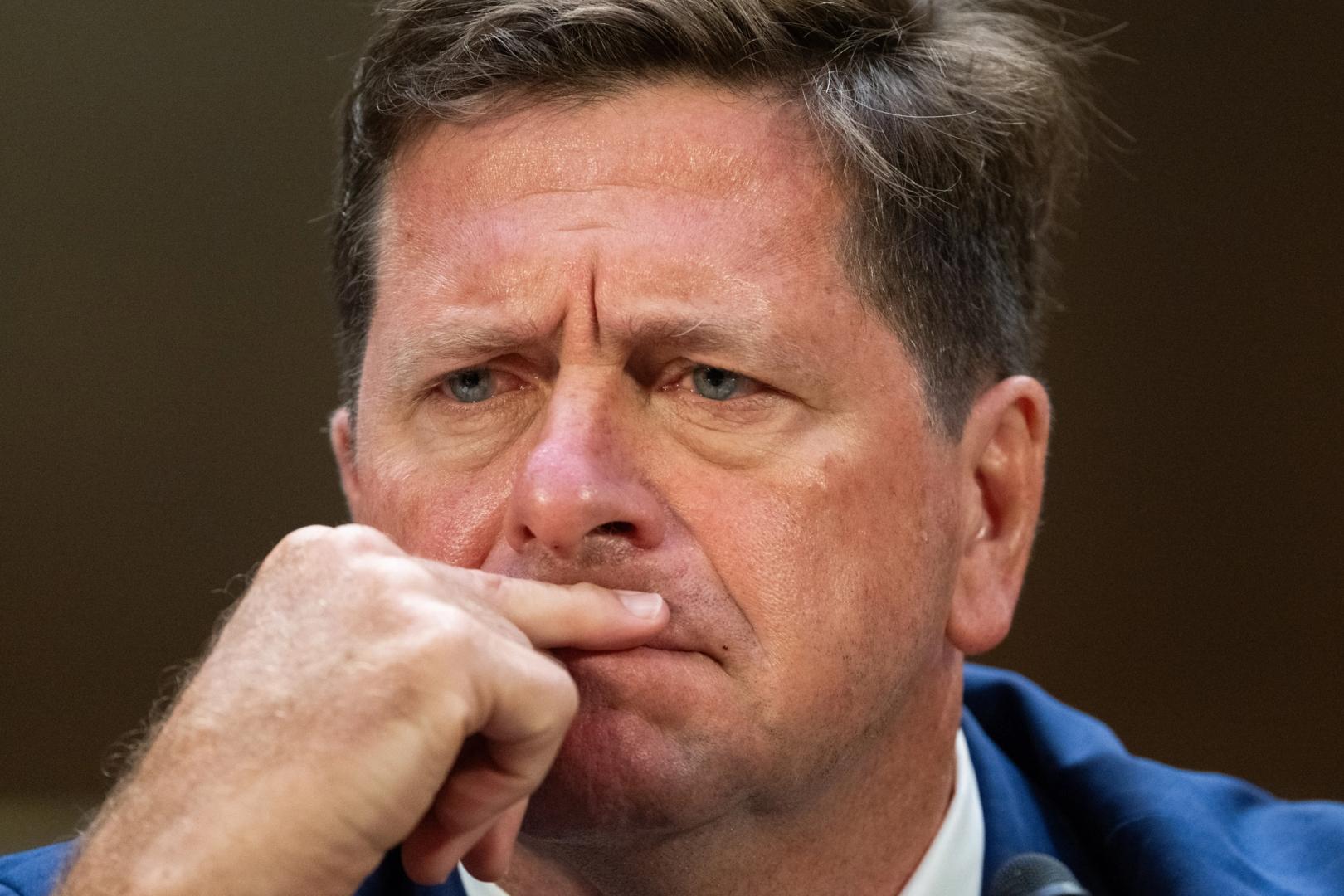
The former SEC chairman who may be tapped to oversee the Trump administration’s AI work has a potentially divisive history as a watchdog of tech innovation.
Updated Published


- Former SEC Chairman Jay Clayton is reportedly about to be named the U.S. AI czar.
- Clayton has a history overseeing emerging technology as former leader of the SEC, where he was responsible for the beginnings of the agency’s regulation-by-enforcement approach to crypto — including the enforcement case against Ripple Labs.
- The new czar job doesn’t seem to have the crypto component as it did when David Sacks held the inaugural role.
Jay Clayton, the former U.S. Securities and Exchange Commission chairman has had a busy career since first tangling with the crypto industry more than a decade ago, and now the frequent appointee of President Donald Trump is reportedly on the verge of taking a job as the administration’s artificial intelligence czar.
That AI czar job seems to have a decidedly different remit than what David Sacks had when he served Trump as the combined crypto and AI czar. If Clayton gets the new job, it’ll focus on the administration’s AI Force to oversee the rapidly growing domestic industry. However, it’s unclear what the task might entail as the president counters those who have sounded alarms over the safety issues posed by increasingly sophisticated machine intelligence.
The job doesn’t seem to have crypto on its agenda, though the two fields have major overlaps, and Trump’s first czar, David Sacks, handled both topics. Sacks left his crypto czar role in March, and the White House’s crypto efforts have since been led by adviser Patrick Witt.
Clayton, who did not respond to a message from CoinDesk, previously served as the U.S. attorney for the Southern District of New York before being appointed this year as Trump’s director of national intelligence. If he becomes a leader in the positioning of the new technology, the AI industry could note his record as a watchdog for digital assets.
The regulation-by-enforcement crypto stance the industry decried under former Chairman Gary Gensler, a Democratic appointee of previous President Joe Biden, had its beginnings in Clayton’s tenure running the SEC. Clayton, who was appointed chairman by Trump in his first administration, began the high-profile legal fight with Ripple Labs as he was about to exit the agency in 2020.
That was one of the major enforcement cases the SEC conducted against a significant industry name, having accused Ripple of failing to register some $1.3 billion of its XRP tokens as securities. (The case was later halted by another Trump appointee, current SEC Chairman Paul Atkins, whose agency dismissed further pursuit of the court action last year.) But Ripple was only the final chapter of a lengthy crypto enforcement record in Clayton’s tenure.
In 2017, he established the SEC’s “Cyber Unit” to focus on the emerging sector, and began policing initial coin offerings (ICOs) and other industry activity. By the time Clayton left in 2020, the agency issued a report outlining his enforcement record, including the 57 cases his agency brought against digital assets, blockchain businesses and ICOs.
His SEC said the cases focused on “efforts to defraud investors through the use of digital asset securities as well as violations of the registration provisions of the federal securities laws in the offer and sale of digital asset securities” — rhetoric familiar to those in the industry who later battled Gensler’s agency.
For context, Clayton’s boss at the time, Trump, had been a crypto skeptic during his first time in the White House and beyond. Referencing the “bitcoins of the world” in 2021, Trump said in an interview in 2021, “I think they should regulate them very, very high.”
Trump leapt on board the digital asset movement as he began making personal moves in the sector — from his initial foray into non-fungible tokens (NFTs) to his launch of a self-referential memecoin and his stake in World Liberty Financial. Trump reinvented himself as a crypto booster on the campaign trail in 2024, and when he returned to the White House, he hired the first czar, Sacks, to watch over both crypto and artificial intelligence policy.
The czar job now appears to be AI-focused, apparently leaving any crypto work at the White House in the hands of a soon-departing adviser. When Trump announced it on his Truth Social platform in September, he likened the AI Force to the Space Force he started in his first administration, and he said he would be announcing an AI czar in the “near future,” saying it would be a “high IQ” individual.
Before Clayton returned to the public sector as a U.S. attorney, he’d served several years on the board of the private equity giant Apollo Global Management, which devoted billions of dollars to back AI and digital infrastructure projects.
More recently, in an interview on CNBC, Clayton said he saw AI as an issue of national security, though he rejected discussions about pausing the technology’s development.
“I don’t think any American should think that that’s a good strategy,” he said.