







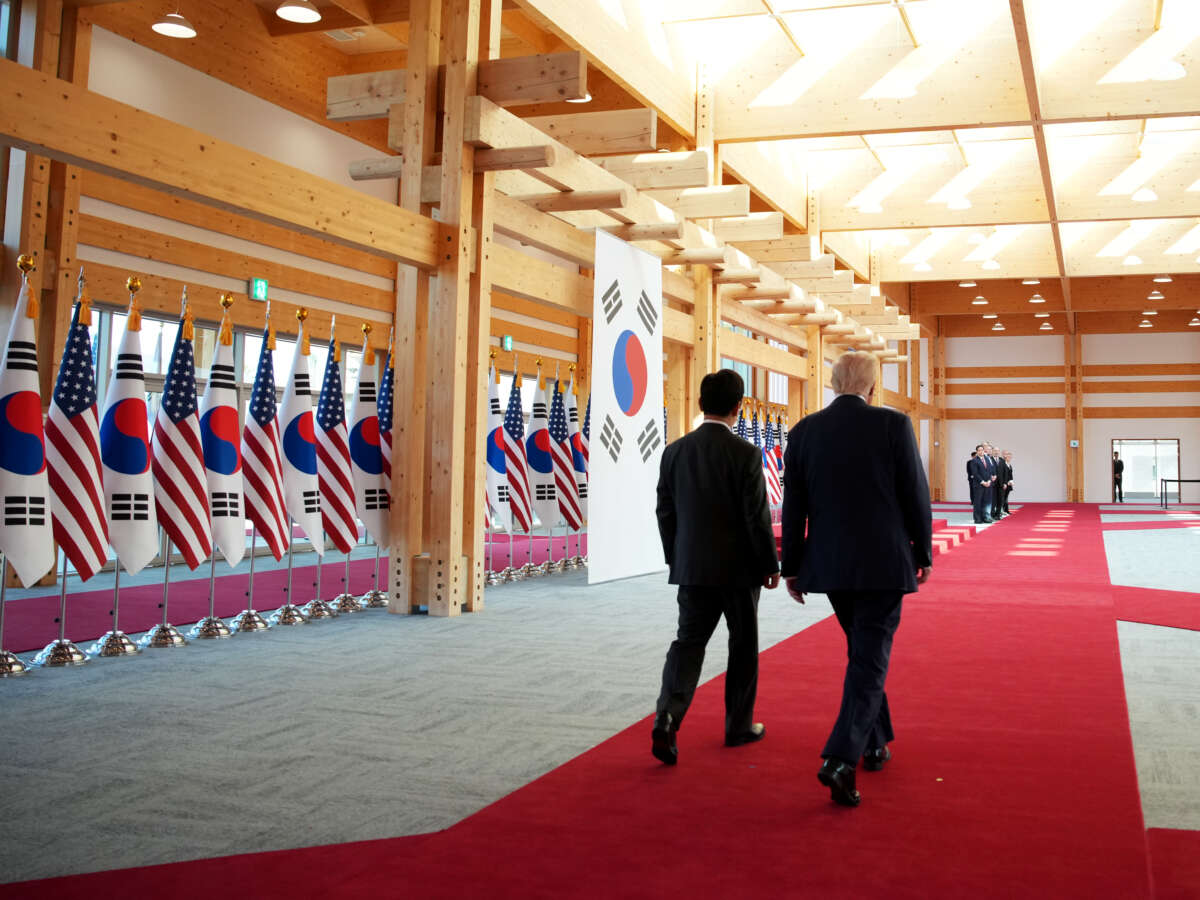
President Donald Trump’s social media post on August 16 calling for a substantial reduction in U.S.-South Korea military exercises triggered panic across partisan lines. Instead of pointing to the high costs of the exercises and unnecessarily hostile approach towards North Korea, Trump highlighted his “very good relationship with Kim Jong Un” and chastised South Korea for refusing to join the disastrous U.S.-Israel war on Iran. Attacks came from Republicans, including North Carolina Sen. Thom Tillis, who defended South Korea as “a solid military ally for over 70 years,” but then made the bizarre claim that reducing joint war drills frees up North Korean troops “to support Putin’s” war on Ukraine.
Democrats, naturally, piled on, attacking Trump for undermining yet another major ally to side with an authoritarian leader. Hillary Clinton, the champion of the failed policy of “strategic patience” during the Obama administration, posted: “The president is making US policy friendlier to North Korea and Russia than Canada and Oman. Are you kidding me?”
While any diplomatic overture from this administration should be viewed with skepticism — this is, after all, the same White House that condemned South Korea for declining to join its war against Iran — progressives shouldn’t miss an opportunity to take a principled position that advances peace, a reduced U.S. military footprint, and the security of the American and Korean people.
First and foremost, reducing tensions with North Korea is the right policy. Period. The United States has been at war with North Korea since the Korean War was temporarily halted in 1953 when the United States signed a ceasefire. This has meant that the United States is still technically at war with North Korea, justifying the presence of roughly 28,500 U.S. troops on dozens of U.S. military bases and installations on the Korean Peninsula. To maintain “readiness,” the U.S. and South Korean militaries regularly conduct provocative war drills involving tens of thousands of troops simulating the invasion of North Korea with the use of B-2 nuclear bombers, nuclear-powered aircraft carriers, and submarines. These joint military exercises are a well-known source of tension with North Korea as they have included training for “decapitation” strikes against the leadership, invasions, and preemptive strikes. Far from deterring North Korea, these exercises may do the opposite. Research suggests that these war drills tend to escalate rather than ease tensions, provoking a more threatening security environment instead of the deterrent effect they’re intended to have.
Second, Seoul has been calling for peaceful coexistence with Pyongyang and has abandoned the idea that North Korea would have to give up its nuclear program before dialogue. On July 23, Unification Minister Chung Dong-young announced South Korea’s “peace-first” approach, which aims instead at freezing North Korea’s nuclear program through a three-step process: halt the production of new weapons, reduce the stockpile, and end with dismantlement. South Korean President Lee Jae Myung has a phrase for the fact that North Korea is never going to give up its nuclear weapons: “harsh reality.”
Given this reality, President Lee has been nudging Trump to do exactly this. At the June 2026 G7 summit in Evian, France, a 90-minute dinner conversation between Presidents Trump and Lee produced commitments from both leaders to a peaceful resolution of North Korean issues — notably, without invoking denuclearization.
Seoul, then, is not an ally being blindsided, regardless of Trump’s lashing out about the Iran war. This is an ally that has been asking for exactly this shift, and finally has a U.S. president willing to upend the Washington political-military-industrial complex establishment that views South Korea as its floating aircraft carrier.
That’s where the so-called sacrament of the “alliance” deserves scrutiny. The narrative that Trump is abandoning South Korea obscures a longer, less flattering story about the actual purpose of the U.S. military presence there. Since 2006, when Washington and Seoul formalized the concept of “strategic flexibility” for U.S. Forces Korea (USFK), the U.S. mission has quietly been shifting toward preparation for a potential war with China. The USFK commander, Xavier Brunson, has publicly described South Korea as a “fixed aircraft carrier,” and more recently, relayed how China itself views the peninsula: “the dagger in the heart of Asia” when Beijing looks out from its east coast. It’s the same imagery a Prussian military adviser used over a century ago, when he warned Meiji Japan that Korea was “a dagger pointed at the heart of Japan.” Only now the metaphor has been repurposed as a geographic fact rather than as a rhetorical warning of Korea’s fate as the flashpoint where great power conflict would begin. Brunson also described the peninsula as a future node in a “kill web” aimed at Beijing, which happens to be South Korea’s largest trading partner. Seoul has protested, but the framing hasn’t changed. In February, 10 U.S. F-16s flew from Osan Air Base toward China’s air defense zone; USFK had told the South Korean military the exercise would happen but withheld its operational plan and purpose. Seoul’s defense ministry confirmed afterward that its military “wasn’t part of the latest training exercise and was not aware of the flight details in advance.” Reducing war drills tied to that broader mission of confronting China is not the same as abandoning South Korea’s defense.
For these reasons, as well as Trump’s push for South Korea to send warships to the Strait of Hormuz as U.S. armaments dwindle, President Lee has been prioritizing clawing back South Korea’s wartime operational control from U.S. Forces Korea. Since the Korean War, wartime command of South Korea’s military has rested with an American general: If hostilities broke out today, South Korean troops would fall under the operational control of the U.S.-led Combined Forces Command, not their own government. Seoul regained peacetime control in 1994; wartime control is the piece they want back. It may have made sense for the U.S. to hold operational control when South Korea was a poor, unstable fledgling state; it makes less sense now, with South Korea the world’s sixth-largest military power and 10th-largest economy. This lopsided arrangement even compelled former USFK Commander Richard Stilwell to describe the perpetuation of South Korea’s operational control delegation as “the most remarkable concession of sovereignty in the entire world.”
This week, in the wake of Trump’s unpredictability, President Lee said that South Korea should quickly press ahead, without disruption, on the planned transfer of operational control during his term.
This brings us back to the economy. These military exercises are absurdly costly. According to a new study by David Vine for the Center for International Policy, the true cost of U.S. bases and troops in South Korea was around $5.58 billion in the 2024 fiscal year, not including South Korea’s direct and in-kind contributions, and may run higher still, given the Pentagon’s well-documented inability to track its own spending.
At a time when most Americans can barely afford to survive, U.S. taxpayers should question why our government spends $5.6 billion every year maintaining a permanent U.S. war footing on the Korean Peninsula — money that could instead fund universal school lunch for every child in the country.
Instead of parroting the political establishment that benefits from forever wars, progressives should challenge the fundamental tenet at the core of this bipartisan backlash: the belief that military superiority produces security, that militaristic “deterrence” is stabilizing, and that allies exist for the U.S. to position them. This is not producing peace, and in the case of the Korean Peninsula, it is producing exactly the escalatory spiral it claims to prevent.
Diplomacy doesn’t have to be principled to be worth pursuing.
As a new generation of progressive lawmakers win primaries and challenge both neoconservatives and Cold War Democrats, peace on the Korean Peninsula should be a no-brainer. Trump wants to talk to Kim Jong Un, and for all its contradictions, this represents something decades of sanctions and military pressure failed to produce: a U.S. president willing to engage Pyongyang without demanding surrender as the price of entry.
None of this requires pretending the optics feel right. Watching two men — each of whom has, at different points, governed in ways widely described as authoritarian — sit down to negotiate the fate of a peninsula at war offends much of the world. Trump may want this for the Nobel Peace Prize, a hotel in Pyongyang, or a Nixon-to-China legacy. None of those motives are admirable. But the people who would actually live with the outcome of an end to the Korean War — the longest-running conflict in modern U.S. history — aren’t basing their positions on ending this war on Trump’s character.
While the Pentagon has spent roughly a billion dollars a day on the U.S. war against Iran, more than 770,000 low-income American children were cut from food assistance. That is not just a budget, it is a statement of values — and progressive candidates who won primaries this summer running on “babies, not bombs” clearly understand that voters are starting to notice.
A deal between Trump and Kim, motivated by whatever mix of vanity and self-interest, isn’t something the left should reflexively oppose just because Trump is the one making it. If it ends decades of war footing on the Korean Peninsula, reduces the risk of a war against North Korea or China, and redirects even a fraction of that nearly $5.6 billion toward people instead of militarization, it is worth taking seriously. Diplomacy doesn’t have to be principled to be worth pursuing.
Trump’s transactional instincts may provide him with a benefit, but they also provide progressives with an opening. A messy, transactional peace beats a permanent war footing that no longer reflects the reality on the Korean Peninsula. Washington should walk through this opening before it loses what leverage it still has.
An important fundraising appeal: We still need to raise $9,000
Truthout is one of only a few platforms for justice-oriented, grassroots journalism. Today, as political censorship from the right intensifies, we have no choice but to ask for your help.
We are fundraising right now to cover our basic operating expenses. If you can support Truthout with a one-time or monthly donation, you will make a significant impact on our work. Anything you can do makes a difference — we appreciate your support.


