


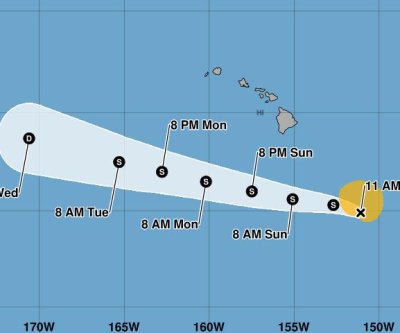
Tropical Storm Moke was predicted to pass south of the Hawiian Islands on Saturday but still be potent enough to cause heavy rains and flooding. Image courtesy National Hurricane Center
Aug. 22 (UPI) — Hawaii on Saturday was preparing for a close encounter with Tropical Storm Moke, which was expected to bring heavy rain, life-threatening flooding and mudslides to the “Big Island.”
As of 7 p.m. Saturday Eastern time, Moke was located about 425 miles southeast of Hilo, Hawaii, and continuing to move to the west-northwest at about 11.5 miles per hour.
On that trajectory its center was expected to pass well south of the Hawaiian Islands, but flash flooding caused by excessive rainfall was still deemed likely for windward and southeast Big Island, according to the National Weather Service in Honolulu.
Rainfall totals of 5 to 10 inches with maximum amounts of 15 inches were expected on Hawaii Island even as the state is still recovering from Hurricane Lala, which left a trail of catastrophic flooding and debris flows across the state last weekend.
“Although the strongest winds associated with Moke are expected to pass south of the Hawaiian Islands, strong gusty winds are likely, particularly in areas within and downslope of higher terrain,” the NWS warned.
Forecasters said Moke would likely reach its peak on Saturday and then begin weakening on Sunday, with that same trend continuing into next week.
Meanwhile, swells generated by the storm could produce elevated surf near exposed east and south facing shores of the Hawaiian Islands through early next week.
Hawaii Gov. Josh Green on Friday said state resources were being rolled out for Moke even as they continue to deal with the damage left by Hurricane Lala.
“I’ve authorized 100 hotel rooms for people to be away from the region as needed. The Department of Human Services will accommodate that,” Green said in a video message, adding that he has been contact with federal officials in an effort to receive an emergency declaration.
“We know there’s already at least $43 million of damaged infrastructure on the Big Island, another $4.6 million to homes, at the very least,” he said. “There’s going to be a lot more to account for and we will be there to provide recovery and resources, but it’s going to take some time.”