




Post
Post
Share
Annotate
Save

As Saudi Arabia’s ambitious Vision 2030 program transforms the nation into a nexus of cultural riches and scientific innovation, one key player, the Saudi Food & Drug Authority (SFDA), is leveraging advanced technologies and ideas to benefit the population in the region and worldwide.
By integrating advanced artificial intelligence into its practices and strengthening international safety standards, this comprehensive regulatory and scientific authority demonstrates its increasing influence as a research hub and leader domestically, regionally, and globally.
“As an evidence-based authority, all our regulations are grounded in scientific data, which informs our decision-making processes,” says His Excellency Dr. Hisham Saad Aljadhey, CEO of the SFDA.
“By harnessing the potential of emerging technologies, including AI, we are creating a collaborative environment that supports research and innovation,” he says. “We are proud of our team of scientists and researchers, whose expertise drives meaningful improvements in health care. Through these efforts, we remain steadfast in our commitment to ensuring the safety and integrity of our food supply, a cornerstone of public health.”
The Multimethod Approach
To safeguard food integrity and authenticity, the SFDA has emerged as a pioneer in detecting and preventing food fraud—the misrepresentation of food products’ origins, ingredients, or purity that threatens consumers’ safety and producers’ and distributors’ reputations and revenue.
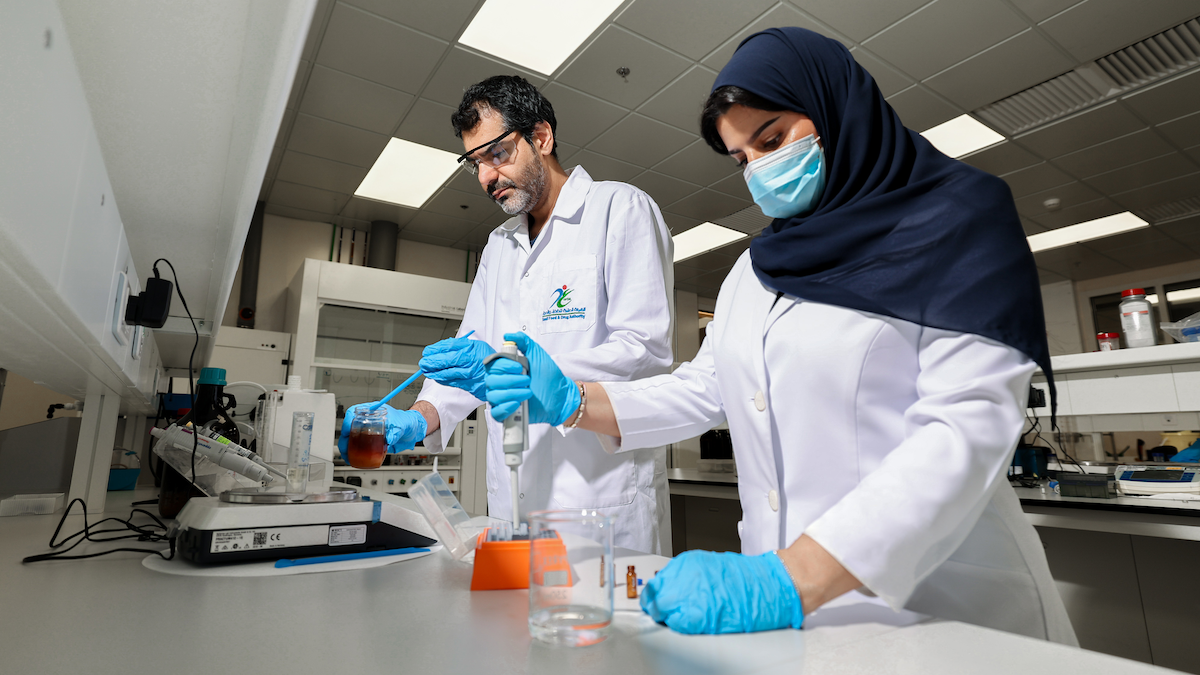
The SFDA’s initiative against fraud is rooted in conventional chemical analysis for testing food quality and composition. In 2021, the authority established specialized laboratories to introduce more scientifically precise fingerprinting. Having introduced these parallel operations into this category-leading multimethod approach, scientists can now more effectively evaluate authenticity and prevent food fraud.
The parallel practices of the multimethod approach now protect some of the most visible—and vulnerable—Saudi food sectors, including honey, milk, olive oil, coffee, and tea.
Milk and Honey
Few foods have such deep importance to Saudi history, culture, and public health as honey. Saudis consume 320 grams a year per person—double the global rate. The kingdom protects the bees that produce two prized varieties: talh, sourced from acacia blossom nectar, and sidr, derived from ziziphus plants. Both are susceptible to fraudulent representation.
The SFDA established unique fingerprints for Saudi honey by collecting samples from verified sources and applying the multimethod approach to its data, pairing traditional analysis—documenting each variety’s origin, valley name, and bee species—with chemical and physical metadata, including metabolite profiles, mineral content, and pH levels. These combined data sets support a robust science-based reference to protect domestic honey against deceptive trade practices.
The multimethod approach has applications far beyond honey. Using such sophisticated techniques and technology as Fourier-transform infrared spectroscopy, isotope ratio, nuclear magnetic resonance, and high-resolution mass spectrometry, the SFDA is now enhancing its methods of detecting adulteration in other Saudi staples, such as milk and olive oil, with greater precision, accuracy, and reliability.
And the success of this strategy extends beyond national borders. After finalizing its internal processes for use in local labs, the SFDA is now sharing the multimethod approach with neighboring countries and outside the region. Adopting these universal food-testing methods and quality standards will improve trade operations and supply chains throughout the Middle East, Africa, and Europe and around the globe.
The Digital Employee
AI plays a central role in the SFDA’s strategy and process enhancements. To detect fraud with maximum efficiency, the SFDA is now developing a vast data set that will support its new AI lab (SAIL).
To streamline and improve operations, the authority introduced the Digital Employee This AI-driven tool automates the collection, integration, and analysis of large data volumes to help decision makers respond rapidly to any threats against food safety.
The SFDA’s ongoing initiatives are a central component of the Vision 2030 program, reflecting Saudi Arabia’s emergence as a global leader in science and technology.
Learn more about the SFDA’s latest scientific advances at sfda.gov.sa/en.
For inquiries, please contact intl.media@sfda.gov.sa.