


When something breaks down, like a washing machine or television, you might find yourself in a showroom or flicking through 12 browser tabs, trying to choose between “eco-friendly” or “green” replacements. They look and cost the same, yet we currently have no way of knowing which claim, if any, is true.
The European Commission has found that more than half of green claims are vague, misleading or unfounded, and four in ten come with no supporting evidence at all. With over 230 sustainability and 100 green energy labels competing for our attention across the EU, no wonder Greenwashing has left consumers and researchers like me trusting none of them.
But the European Product Registry for Energy Labelling (EPREL) is a digital database that provides the hard evidence needed to cut through the noise.
Since 2019, any appliance requiring an EU energy label – washing machines, fridges, dishwashers, even tyres – must have its performance data logged in a public database before it can be sold. Over 2 million products are now registered.
Here’s how to tap into that database the next time you’re in that showroom.
Scan the QR code on the energy label or search for the specific appliance model on the EPREL website. In Great Britain, post-Brexit labels carry their own QR code with the UK flag, but most models appear in EPREL too.
What you’ll find goes beyond the label: electricity use per 100 wash cycles, water use, spin performance, noise, wet grip for tyres, the hidden energy spike of high-contrast TV settings – in other words, the numbers that decide your bills, not the adjectives.
You can also filter by sorting up to three criteria at once – energy first, water second, noise third, for example, and compare side by side. Suddenly “eco-friendly” either shows up in the data or it doesn’t. You can even check how many competitors share a rating (if half the market is A-rated, the boast means little). And if the shop label doesn’t match the register, one anonymous tap reports it straight to the manufacturer and the regulators.
Why is this not being made more obvious? A fair question. The EU-funded EPREL services survey of over 2,500 shoppers found while nine out of ten EU shoppers research products online, more than half have never noticed the QR code on an energy label, and barely one in 16 has ever scanned it.
Ironically, shoppers say they want exactly what EPREL already offers (such as complete data, filters, side-by-side comparison) but they just don’t know it’s there. The database, originally built for regulatory compliance, opened to the public in 2022 and nobody advertised it. That is changing: last month the Commission added a comparison tool and an EU-funded project is building a new app that will pair official figures with prices and availability.
Simple but strong labelling help people decide what to buy. When the EU tidied up its energy labels in 2021, scrapping the baffling A+++ business rating for a clean A to G energy scale, an experiment with more than 1,000 households found that the simpler labels nudged people towards the most efficient choice.
More than washing machines
Once you spot the pattern, you see it everywhere. Europe has been quietly stacking these tools up, one by one.
Since June 2025, smartphones and tablets also carry an energy label grading their repairability from A to E.
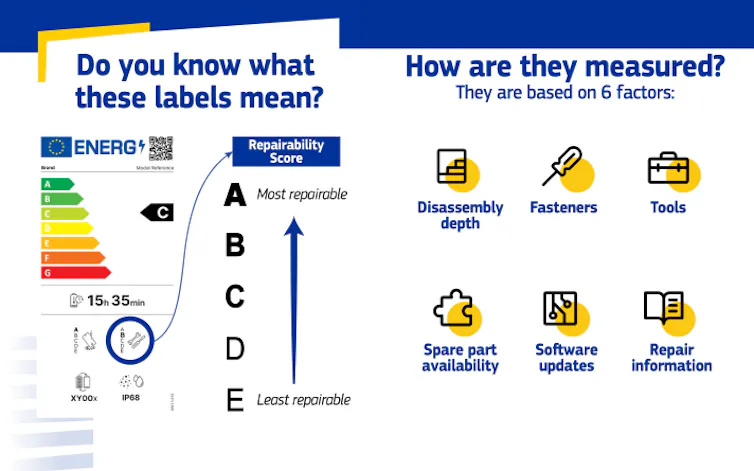
Joint Research Centre, European Commission.
The system scores how crucial components (such as the battery, screen or charging port) perform on design, the tools needed for repair and the availability of long-term support. The label shows a single letter, but the database reveals the full details behind it – so a phone that’s easy to open yet short on software updates can be spotted before you buy. Tumble dryers are expected to carry the same score from 2027.
The A to E repairability grade has teeth too. Manufacturers must keep spare parts available for seven years and software updates for at least five. And the EU’s right to repair directive, in force since July 31, goes further: manufacturers of common products must repair them at a reasonable price even after the warranty ends, repair-blocking tricks (such as software that disables a replaced screen or the refusal to sell spare parts) are banned, and if you choose repair over replacement under guarantee, your guarantee extends by a full year for the whole product.
The net is widening beyond energy. The EU’s new ecodesign rulebook will attach a digital product passport to products sold in Europe – a scannable record of environmental footprint, extending EPREL’s logic to almost everything, starting with batteries from 2027.
Even slogans are on notice. From September 2026, under an EU law adopted in 2024, unproven claims like eco-friendly become illegal across the EU, leaving only independently verified or state-backed labels.
In the UK, the Competition and Markets Authority can already fine companies up to a tenth of their global turnover for misleading green claims, without going to court.
So next time an appliance dies, don’t squint at the word “eco”. Scan the QR code. Check the numbers against the promises. And if the label doesn’t match the register, report it. That tap enables you to hold a manufacturer to account.
The tool is free. It’s already in your pocket.
