

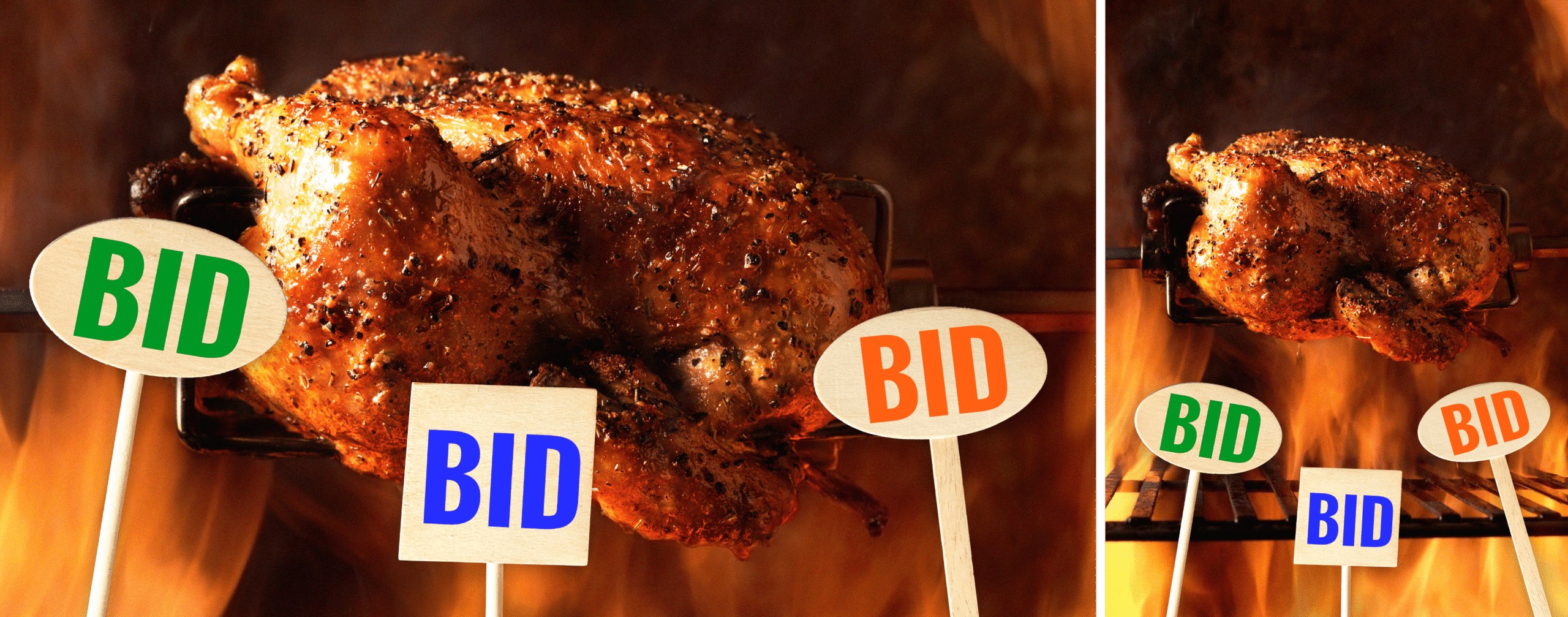
There’s little in New York City that stops me in my tracks. But seeing the price of a rotisserie chicken on a newly posted menu in my Brooklyn neighborhood made me backstep, my mouth dropping open.
I texted the group chat: “How much do you think a rotisserie chicken costs at the cool new spot in my neighborhood?”
No one guessed anywhere close to $77, the listed price of a whole rotisserie chicken at Gigi’s, which is served with “roasted potatoes and a trio of sauces.”
The internet is already aflutter. When influencer Mike Chau posted that Gigi’s half chicken goes for $40, keyboard warriors raged. Even New York City Council Member Chi Osse (who represents a neighboring district), posted a rainbow-gradient, all-caps meme, “$40 Half Chicken at a Wine Bar? Really?” to over 8,000 likes.
Rotisserie chicken is the people’s protein, available both at grocery stores nationwide and some of the hardest-to-score tables in New York City. So what does a $77 rotisserie chicken say about the increasing wealth gap, the disparity between the leisure and working classes, and the overall affordability crisis that certainly irked those who balked at the price?

Like speedy lunch tacos, a halal cart dinner salad, and Vietnamese-inspired wraps.
Gigi’s chickens come from a small farm in upstate New York, which sells them for around $13 or $14 each. The bird is then brined, chilled for about 24 hours, and rotated in a specialty rotisserie oven. Before it cools, chef Thomas Knodell makes jus from the drippings. Organic Norwich Farm potatoes are served alongside the chicken.
Hugo Hivernat, the French restaurateur who owns Gigi’s, shares that all his employees are paid a fair wage, have paid time off and health insurance, and as an owner, he’s just an “everyday person, not driving a Porsche around the Hamptons.” Still, he thinks he may rebrand the $77 dish as a “chicken set.”
Despite the pricing controversy, Gigi’s booked up every April reservation immediately after it opened. This past weekend, walk-ins lingered on the sidewalk, eagerly waiting for standing room-only space at the window counters. Inside, the lucky ones feasted on chicken, $10 rice with drippings, and $19 glasses of orange wine.
“Maybe we gave the wrong perception, but this is a small sit-down restaurant, not a bodega,” says Hivernat. “Is it bad that we ended up having a half chicken at $40? Probably, yes, but this is how the inflation and the affordability crisis is coming through. It’s not our fault we have to do these prices.”
The price of rotisserie and roast chicken has long fascinated New Yorkers. A Reddit thread from last summer asks New Yorkers where to find the most expensive half chicken in the city. Answers include the $78 poulet rôti with foie gras jus, pommes Fifi, and salade verte at Chez Fifi, a ritzy brasserie in an Upper East Side townhouse. There’s also the $85 “half a golden chicken chargrilled with a bowl of baked borlotti beans, wild cress leaves and salsa verde” at King, a cornerside bistro in SoHo.
Meanwhile, Badaboom, a French restaurant in Bed-Stuy, serves a rotisserie chicken with potatoes at $32 for half, $58 for a whole. In April, it will host a “pay what you think is fair” evening, according to co-owner Henry Glucroft.
“There’s been mass-produced, artificially cheap chicken in the market for some time now, and it’s creating this divide,” says Glucroft. “People expect chicken to be the cheapest protein; we want to serve quality chicken.”. That said, “sharing a half chicken for two, $16 each for dinner, is an insane value—it’s our top-selling item,” he adds. “The only pushback we’ve ever had from people about pricing is from people who never actually ordered the chicken.”
Hivernat feels similarly. Knowing Council Member Osse hadn’t yet visited Gigi’s, he reached out to Osse’s office to start a dialogue about the extreme, often prohibitive costs of running a business in New York City, an issue Hivernat believes helped lift Mayor Zohran Mamdani to victory last year.
Of course, there are plenty more popular low-cost rotisserie chickens across the city, but they’re not offered in stylish dining rooms or alongside wine lists boasting over 1,000 bottles. Pio Pio’s whole Peruvian rotisserie chicken goes for $28, The Fly’s trendy rotisserie chicken is $34, and Jubilee Market, located just blocks from Gigi’s, offers a “Five Buck Cluck” that’s locally known as the best supermarket rotisserie chicken. (I concur.)
This is all to say that a costly rotisserie chicken may or may not be worth $77 in the public’s eyes, but the pricing represents a much larger crisis in the restaurant industry, long deemed unsustainable. It’s a crisis for patrons too: If we can’t afford to become regulars at our locally owned, independent neighborhood restaurants, is dining out still a viable pastime? Will restaurants soon be relegated to special occasions for regular, non-wealthy folk?
The pecking order of capitalism favors the few at the very top. Maybe a costly rotisserie chicken will inspire the powers that be to reevaluate what, and who, they really value.
