





Key Points
-
Companies must meet four key criteria to be included in the Schwab U.S. Dividend Equity ETF.
-
This ETF has noticeably reduced its stake in the energy and materials sectors.
-
Its dividend yield is more than three times the S&P 500 average.
- 10 stocks we like better than Schwab U.S. Dividend Equity ETF ›
It has been a rocky start to the year for many major indexes and big-name stocks. It’s not the best feeling, but it reaffirms why investing in dividend stocks can be so effective: You’re rewarded for simply holding a stock, regardless of how the price moves.
Dividend stocks aren’t immune to volatility or slumps, but their payouts act as a natural hedge and provide passive income. If you’re looking for passive income (that’s always a good choice), consider one of the most popular dividend exchange-traded funds (ETFs) on the market: the Schwab U.S. Dividend Equity ETF (NYSEMKT: SCHD). It remains a great, reliable choice.
Will AI create the world’s first trillionaire? Our team just released a report on the one little-known company, called an “Indispensable Monopoly” providing the critical technology Nvidia and Intel both need. Continue »

Image source: The Motley Fool.
Doing some of the legwork for you
With many stocks down through the first three months of the year, you’ll notice some dividend yields look much more attractive. A high yield is good, yes, but only when it’s due to a high payout and is sustainable. It’s not always obvious if that’s the case, but one benefit of this Schwab ETF is that the criteria companies must meet to be eligible for inclusion in the index that it mirrors (the Dow Jones U.S. Dividend 100 Index).
The Schwab U.S. Dividend Equity ETF looks at a company’s five-year dividend growth, return on equity, cash flow to debt, and dividend yield. That isn’t to say some yield traps can’t fall through the cracks, but it’s a built-in vetting process that reduces the chances of it happening.
This fund looks a bit different now than before
When this Schwab ETF did its annual reconstitution (the changing of holdings) recently, it removed 22 stocks and added 25. Notable removals included AbbVie, Cisco Systems, and Valero; notable additions included UnitedHealth Group, Procter & Gamble, and Abbott Laboratories.
After the reconstitution, the sector exposure changed noticeably. Health care and tech increased by 3.6% and 3.4%, respectively. Energy and materials exposure decreased by 7.1% and 3%, respectively.
The decrease in energy stocks is notable because the sector has been the best performer over the first three months of the year, largely due to the Middle East conflict, which has driven up oil prices. Any changes in the situation could flip the script, so it makes sense to limit exposure to those stocks, especially after the impressive run at the beginning of the year.
A consistent dividend you can depend on
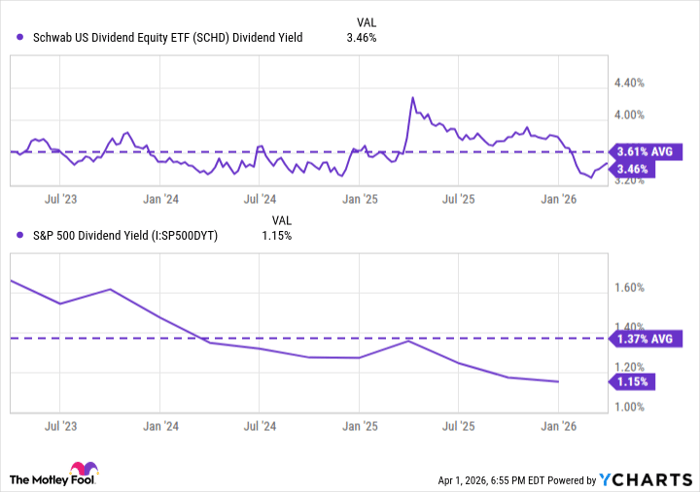
As of market close on April 1, the ETF’s dividend yield was close to 3.5%, slightly below its 3.6% average over the past three years. Its current yield is more than three times the S&P 500 average, and its average yield over the past three years is more than 2.5 times the S&P average.

Data by YCharts.
It might not be the ultra-high yield you can receive from some individual stocks, but when it comes to consistent, growing passive income from a dividend ETF, it’s hard to beat it. And you don’t have to second-guess its stability; it’s as dependable as it comes.
Should you buy stock in Schwab U.S. Dividend Equity ETF right now?
Before you buy stock in Schwab U.S. Dividend Equity ETF, consider this:
The Motley Fool Stock Advisor analyst team just identified what they believe are the 10 best stocks for investors to buy now… and Schwab U.S. Dividend Equity ETF wasn’t one of them. The 10 stocks that made the cut could produce monster returns in the coming years.
Consider when Netflix made this list on December 17, 2004… if you invested $1,000 at the time of our recommendation, you’d have $532,066!* Or when Nvidia made this list on April 15, 2005… if you invested $1,000 at the time of our recommendation, you’d have $1,087,496!*
Now, it’s worth noting Stock Advisor’s total average return is 926% — a market-crushing outperformance compared to 185% for the S&P 500. Don’t miss the latest top 10 list, available with Stock Advisor, and join an investing community built by individual investors for individual investors.
*Stock Advisor returns as of April 5, 2026.
Stefon Walters has no position in any of the stocks mentioned. The Motley Fool has positions in and recommends AbbVie, Abbott Laboratories, and Cisco Systems. The Motley Fool recommends UnitedHealth Group. The Motley Fool has a disclosure policy.
The views and opinions expressed herein are the views and opinions of the author and do not necessarily reflect those of Nasdaq, Inc.