


By Charles Kennedy – Jun 27, 2026, 6:00 PM CDT

You might think that Shark Tank’s “Mr. Wonderful,” Kevin O’Leary, is betting it all on AI, but he is not.
He is betting on the $5+ trillion in infrastructure required to run it, and that’s where big capital is flowing now.
And he’s betting on Bitzero (NASDAQ: AIBZ) to be one of the first to break AI’s biggest chokepoint: power.
Bitzero was looking further ahead while most of the rest of the market was narrowly focused on AI software and semiconductors.
As a result, on May 5th, Bitzero signed a binding letter for a 15-year lease deal for AI power as it makes its first official leap from low-carbon bitcoin mining to being a power provider for a $5-trillion data-center industry that is desperate for cheap electricity.
This Canadian cryptominer-turned-energy-provider for AI has already secured more than a gigawatt of low-cost power across Norway, Finland, and the United States, as the money moves into the assets that AI can’t run without.
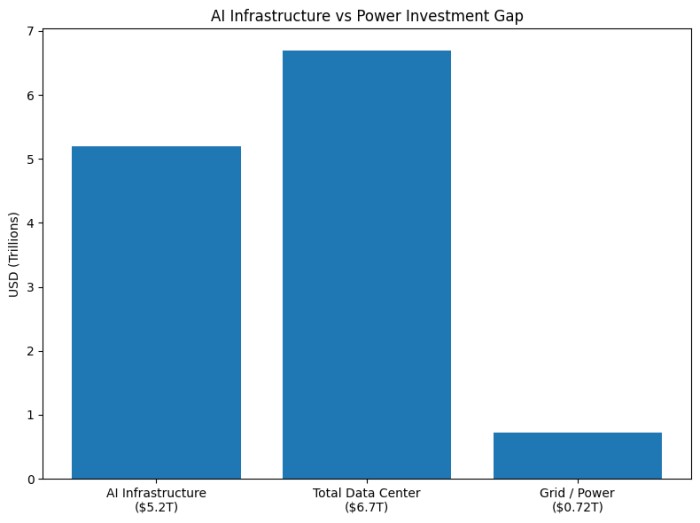
Amazon alone projects $200 billion in 2026 capital spending, with most of it tied to data centers. Microsoft is expected to be around $190 billion. Alphabet is also projected near $190 billion, and Meta has laid out a $600 billion U.S. infrastructure plan through 2028. Current estimates now put combined 2026 capex for Amazon, Microsoft, Alphabet, and Meta as high as $725 billion, driven largely by AI data centers, chips, power, and long-lived infrastructure. McKinsey estimates another $5.2 trillion will be deployed into AI infrastructure this decade. That capital is funding land, power, facilities, substations, and equipment before AI capacity can operate.

Source: Oilprice.com; Reuters; McKinsey & Company; Amazon, Meta, Microsoft, Alphabet Q3 earnings.
Half the AI data centers being announced today may not get built because projects fail to secure power on time.
More than 70% of interconnection requests are withdrawn, and only a fraction reach operation. Global data center electricity demand is projected to approach 945 terawatt-hours by 2030, roughly equal to Japan’s total consumption, according to the latest research from Berkeley Labs, which is affiliated with the U.S. Department of Energy’s Science Office.
Megawatts will decide who builds and who doesn’t.
The AI Build List Is Under Duress
A large share of the AI data centers being announced today may never reach completion because power is not available when projects need it. That creates an advantage for companies like BitZero (NASDAQ: AIBZ) that already control gigawatt-scale electricity.
Artificial intelligence demand is expanding quickly, but the electricity required to run it is becoming harder to secure, slower to connect, and more expensive to deliver.
More than 70% of interconnection requests are withdrawn, and only a small portion reach operation. At the same time, global data center electricity demand is projected to approach 945 terawatt-hours by 2030, roughly equal to Japan’s total consumption.
While investors were previously focused on semiconductor chips as the make-or-break element of the AI boom, it’s now clear that it’s a question of power above all.
And that’s exactly why a forward-thinking cryptominer like Bitzero is well positioned to take advantage of the AI-power gap.
“As electricity prices climb across the U.S., driven in large part by soaring demand from both Bitcoin mining and the rapid expansion of AI data centers, Bitcoin miners are at a distinct advantage because we locked in power access well ahead of the curve,” Mohammed Bakhashwain, founder and CEO of Bitzero Holdings, Inc., told Oilprice.com in a recent interview.
Both cryptomining and AI require the same infrastructure: reliable power, advanced cooling, and industrial-grade data centers.
“While others are still fighting for grid access, permits, and infrastructure, Bitzero secured those assets over the past four years and knows how to operate energy-intensive facilities at scale. That creates valuable optionality. The same megawatt can mine Bitcoin or support AI and data center workloads. In a market where power is the real constraint, we believe flexibility is a competitive advantage,” Bakhashwain said.
Full Speed Ahead on the Biggest Boom in Computing History
Earlier this month, Bitzero (NASDAQ: AIBZ) completed engineering due diligence for up to 520 megawatts at its Kokemäki, Finland campus, eyeing up to 1GW at full ramp. An initial 80MW phase is targeted for the first half of 2027, with 400MW to 800MW expected to follow in later stages as the full buildout advances.
And that’s just one venue.
Bitzero’s Norway operations are already running as a fully built industrial platform. The company is operating Bitcoin mining at power costs below four cents per kilowatt-hour, which keeps the site active and monetized while additional infrastructure is layered on top.
At Namsskogan, the next 70MW tranche is scheduled for energization in the fourth quarter of 2026, tied directly to a defined 325MW expansion corridor that follows existing grid capacity.
And here, in Norway, is where Bitzero’s great leap into data center power just became official.
On May 5, Bitzero signed a binding letter of intent with OneQode Networks covering the full 110 MW capacity of its Namsskogan, Norway data center site under a 15-year lease tied to GPU-based AI workloads. The agreement carries an implied value of roughly $2.6 billion over the lease term and marks Bitzero’s formal entry into the large-scale AI data-center infrastructure market.
This is a double victory for Bitzero.
When it mines in Norway, Bitzero uses its own electricity to generate revenue from the Bitcoin it produces. Under the AI agreement, Bitzero generates revenue by leasing the site’s power capacity and infrastructure to OneQode. Simultaneously, OneQode pays the electricity bill tied to running the AI systems inside the facility.
That means Bitzero captures the recurring infrastructure revenue from the site without directly absorbing the massive ongoing power costs associated with operating large-scale AI workloads.
According to Bitzero management, at full utilization of 110 MW, the Namsskogan site could generate roughly $176 million to $178 million in annual revenue. A recent shareholder analysis modeling the agreement estimated potential annual NOI of roughly $151 million based on an 85% margin profile tied to the lease structure.
It’s the plentiful, low-cost, low-carbon energy Bitzero has harnessed in Scandinavia that OneQode is after.
Norway is served by hydro power, and Finland is served by a cocktail of low-cost hydro, nuclear, solar and wind energy.
Finally, the North Dakota footprint gives Bitzero a second operating lane tied to U.S. demand. The company controls power-backed sites there that position it inside a different pricing and regulatory environment from its Nordic assets.
Across Norway, Finland, and North Dakota, the operating model is consistent: secure power first, bring megawatts online in stages, and deploy that capacity into whichever use case offers the highest return at that point in the cycle, whether it’s mining, colocation, or AI compute.
The AI Investment Model Is Outrunning The Grid
It takes up to 7 years to build out a large-scale power source to feed a data center.
Still, investors have been operating on a massive assumption: That the power will magically be there once all the data centers are built. This is where the data center hype meets an electrification reality.
But securing power isn’t that easy. At a bare minimum, it requires grid studies, transmission access, permitting, utility negotiations and long-term pricing frameworks.
And demand is bursting.
The IEA expects global data-center electricity use to grow 4X the growth rate of total electricity demand from every other sector combined. The agency is eyeing data center power demand of roughly double to around 945 TWh by 2030.
Similarly, Goldman Sachs has forecast data-center power demand soaring 175% by 2030 compared to 2023 levels.
That’s like adding an entire country to the grid.
The business of sourcing power is not keeping pace with the business of building out data centers.
We will need $6.7 trillion in capital by 2030, including $5.2 trillion for AI infrastructure alone, in order to make the data center hype a reality. Yet, so far, grid investment expected to support that demand is only around $720 billion.
With more than a gigawatt of power already secured across Norway, Finland and North Dakota, Bitzero already controls sites, permits, grid access, and expansion capacity while AI developers line up to get a start on the 7-year process.
Why Bitzero’s Model Is Getting Attention
Bitzero (NASDAQ: AIBZ) is building large-scale campuses backed by secured, low-cost power and positioning them for AI and high-performance computing demand. It’s not choosing between crypto and AI. It is running both. Bitcoin mining keeps capacity active and generates cash flow, while the same sites are being developed to support AI and HPC workloads as that demand scales.
“We see a really big opportunity in HPC,” CEO Mohammed Bakhashwain said, pointing to an engineering team that has already worked on deployments with Microsoft and Nscale in Norway. The company controls land, power, and infrastructure in place to deliver large campuses, and is already moving to market that capacity to AI tenants.
The model is built to capture two revenue streams off the same megawatts. Mining today and higher-value AI and colocation tomorrow.
“We’re hoping to get the best of both worlds—the long-term, investment-grade cash flows from HPC and AI, while having exposure to Bitcoin,” Bakhashwain said.
That keeps sites operating while capacity is repositioned for larger, longer-term contracts.
That structure is what has drawn investor attention.
Kevin O’Leary doesn’t frame Bitzero as a mining company. He calls it an energy contract business. The asset is the site: power secured at low cost, tied to land, permits, and continuous load. Mining monetizes that power now. Leasing compute and capacity to large off-takers is where the longer-term value sits.
“The value of what Bitzero has has risen dramatically, and I think over time the market will recognize that,” O’Leary said.
The company is building capacity that can be deployed into whichever market pays more at a given time. That is how the same infrastructure can generate cash flow today and scale into larger contracts as AI demand continues to build.
The AI power boom is also reshaping investor interest across some of the largest publicly traded U.S. energy companies. EQT Corporation (NYSE: EQT), the country’s largest natural gas producer, is widely viewed as a key supplier of fuel for the gas-fired generation expected to support rising electricity demand. Vistra Corp. (NYSE: VST) has become a leading AI infrastructure play through its diverse fleet of natural gas, nuclear and renewable power assets, while Constellation Energy (NASDAQ: CEG) has attracted significant attention thanks to its position as the nation’s largest producer of carbon-free nuclear electricity. Together, these companies underscore a growing realization across markets: the AI race is no longer just about chips and software—it is increasingly about securing dependable, long-term power. Companies that already control energy assets and grid-connected infrastructure are likely to occupy an increasingly strategic position as electricity becomes the defining constraint on AI expansion.
Given all of this, Bitzero is not simply participating in the AI buildout. It may be sitting on part of the infrastructure that others will have to come to, just as OneQode did on May 5th.
The bigger point is where capital could start to flow as that logic sinks in.
By. Charles Kennedy
The AI boom is triggering an unexpected and unprecedented bull run in natural gas and power stocks. If you aren’t paying attention to the energy demands of data centers, you will miss the biggest energy story of the decade. The smart money is already quietly moving into the few companies prepared to power the trillion-dollar AI machine.
Oilprice Intelligence brings you the inside view on where the next gains will come from, breaking down the market’s biggest growth driver with analysis from veteran oilmen and experts. Click here to get this crucial intel for free
IMPORTANT NOTICE AND DISCLAIMER
Neither the author nor the publisher, Oilprice.com, was paid to publish this communication concerning Bitzero Holdings, Inc. (NASDAQ: AIBZ). The owner of Oilprice.com owns shares and/or stock options of the featured company and therefore has an incentive to see the featured company’s stock perform well. The owner of Oilprice.com may buy or sell shares of the featured company at any time including at or near the time you receive this communication. This share ownership should be viewed as a major conflict with our ability to be unbiased. This is why we stress that you conduct extensive due diligence as well as seek the advice of your financial advisor or a registered broker-dealer before investing in any securities.
This communication is not, and should not be construed to be, an offer to sell or a solicitation of an offer to buy any security. Neither this communication nor the Publisher purport to provide a complete analysis of any company or its financial position. The Publisher is not, and does not purport to be, a broker-dealer or registered investment adviser. This communication is not, and should not be construed to be, personalized investment advice directed to or appropriate for any particular investor. Any investment should be made only after consulting a professional investment advisor and only after reviewing the financial statements and other pertinent corporate information about the company. Further, readers are advised to read and carefully consider the Risk Factors identified and discussed in the advertised company’s SEC, SEDAR and/or other government filings. Investing in securities is speculative and carries a high degree of risk. Past performance does not guarantee future results. This communication is based on information generally available to the public and does not contain any material, non-public information. The information on which it is based is believed to be reliable. Nevertheless, the Publisher cannot guarantee the accuracy or completeness of the information.
INDEMNIFICATION/RELEASE OF LIABILITY. By reading this communication, you acknowledge that you have read and understand this disclaimer, and further that to the greatest extent permitted under law, you release the Publisher, its affiliates, assigns and successors from any and all liability, damages, and injury from this communication. You further warrant that you are solely responsible for any financial outcome that may come from your investment decisions.
TERMS OF USE. By reading this communication you agree that you have reviewed and fully agree to the Terms of Use found here http://oilprice.com/terms-and-conditions If you do not agree to the Terms of Use http://oilprice.com/terms-and-conditions, please contact Oilprice.com to discontinue receiving future communications.
INTELLECTUAL PROPERTY. Oilprice.com is the Publisher’s trademark. All other trademarks used in this communication are the property of their respective trademark holders. The Publisher is not affiliated, connected, or associated with, and is not sponsored, approved, or originated by, the trademark holders unless otherwise stated. No claim is made by the Publisher to any rights in any third-party trademarks.
Download The Free Oilprice App Today